Need help?
Do you have a question about the CCL 832X and is the answer not in the manual?
Covers physical installation requirements, wiring, and environmental considerations for the PBX.
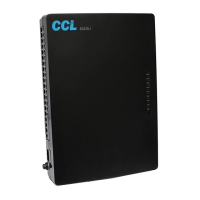
Details the front panel indicators and the various connectors on the PBX side panel.
Lists essential precautions to follow during the PBX installation process.
Covers features like Alarm, Allowed Table, Auto Call Back, and Disconnection.
Introduction to the Auto Attendant functionality and its basic operations.
Configures how the PBX handles caller input or lack thereof in auto attendant mode.
Describes how to set up a night message for the auto attendant feature.
Instructions for recording and managing voice messages for internal auto attendant.
Details on using an SD card for auto attendant voice messages.
Configuration for advanced multilayer auto attendant systems using SD cards.
Details on enabling, disabling, and setting times for day and night modes.
Enables diverting all incoming calls to another extension.
Diverts calls when an extension is busy or does not answer.
Adjusts the ringing time for calls diverted when busy or unanswered.
Explains how to park calls and configure the parking hold time.
Methods to check PBX version using SLT phones with and without CLI.
Details CLI transferability, digit addition, receiving, and transmitting modes.
Setting up internal conferences between extensions.
Establishing conferences involving junction lines and extensions.
Table for disallowing specific numbers for extensions with L=4.
Table for disallowing specific numbers for extensions with L=5.
Enables forwarding door phone calls to mobile or landline numbers.
Details the optional door lock functionality and its operation.
Configures extensions for call barring or hotel reception mode.
Adjusts the duration of the flash signal for call handling.
Allows changing extension numbers to 2, 3, or 4 digits.
Configures GSM card speech volume and checks signal strength.
Enables direct junction line access upon lifting the handset.
Enables direct extension access upon lifting the handset.
Defines junction line access during power outages.
Covers junction access codes and circular/sequential dialing modes.
Manages extension access to junction lines and dialing restrictions.
Procedures for holding, transferring, and managing multiple junction calls.
Settings for junction dialing delay time and grouping.
Configures direct, simultaneous, or round robin ring modes for junction lines.
Enables or disables individual junction lines.
Features for forwarding junction calls or connecting two junction lines.
Programming of DSS keys for one-touch access or dialing.
Viewing KTS call details and configuring Least Call Routing.
Stores and dials telephone numbers using 2-digit codes.
Configures the operator extension and paging system.
Manages the PBX programming password and redial function.
Instructions for remote programming and resetting PBX defaults.
Adjusts ringing times for internal and auto attendant calls.
Enables SD card and Paging card functionality, with considerations for junction limits.
Sets the playing mode for SD cards (Auto Attendant or Hold Music).
Provides solutions for common PBX problems like no ring or no dial tone.
Guides for service engineers on testing PBX ports and functionality.
Lists the technical specifications of the PBX system.
 General
| Max Extensions | 32 |
|---|---|
| Humidity | 10% to 90% non-condensing |
| VoIP Protocols | SIP |
| Network Interfaces | 1 x 10/100 Mbps Ethernet |
| Operating Temperature | 0°C to 40°C |

 To Next Page