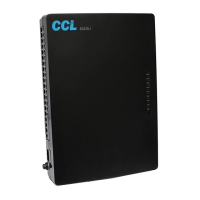
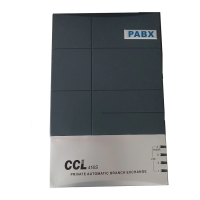
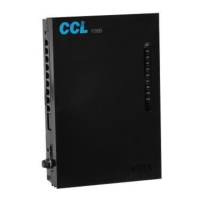
Need help?
Do you have a question about the CCL 8120X and is the answer not in the manual?
Welcomes users to the Copper Connections family and introduces support services.
Defines key terms and abbreviations for PBX system features and operations.
Details the process and commands for programming PBX features and settings.
Procedure for setting, clearing, and managing extension alarms.
Configures tables to allow specific numbers for extensions based on L value.
Enables users to request a callback from busy junction lines or extensions.
Programs automatic disconnection for outgoing junction calls after a set time.
Guides on how the PBX handles incoming calls with automated greetings.
Configures system behavior for unanswered or wrong number inputs in auto attendant.
Details on selecting and managing different voice messages for auto attendant.
Instructions for playing a specific greeting message during night mode.
Programming specific times for automatic switching between day and night modes.
Procedures for manually changing the PBX system between day and night modes.
Enables all extensions to ring and connect for emergency situations.
Configuration for custom extension numbering schemes (e.g., 2, 3, or 4 digits).
Designating and configuring a specific extension as the system operator.
Process for changing the default programming password for the PBX system.
Enables performing PBX programming remotely via a junction line.
Restoring PBX programming settings to their default values.
Provides solutions for common problems encountered with the PBX system.
Allows extensions to listen into or join ongoing calls.
Diverting incoming calls to other extensions or external numbers.
Methods for answering calls intended for other extensions.
Temporarily holding calls for later retrieval by any extension.
Displaying caller ID information on compatible telephones.
How caller ID is displayed for external and internal calls.
Adding leading zeros to CLI numbers for compatibility with phone displays.
Setting modes for receiving and transmitting caller ID signals (DTMF/FSK).
Establishing conference calls between internal extensions.
Setting up conference calls involving external junction lines and extensions.
Defining lists of numbers to be blocked for outgoing calls.
Silencing incoming calls to a specific extension.
Connecting, configuring, and operating door entry phones and locks.
Making direct calls between internal extensions and call barring options.
Setting up internal, SD card, or external music for call holds.
Automatically connecting to junction lines or extensions upon lifting handset.
Configuring circular or sequential assignment of junction lines for outgoing calls.
Managing extension access to junction lines and controlling dialing permissions.
Managing hold, transfer, and multiple calls on junction lines.
Assigning how incoming junction calls are routed to extensions.
Enabling or disabling individual junction lines within the PBX system.
Diverting incoming junction calls to external numbers or other junction lines.
Enabling KTS, programming DSS keys, and viewing call details.
Feature to route calls via the most cost-effective junction line.
Storing and dialing frequently used numbers using short codes.
Connecting and using a PA system for broadcasting messages.
Configuring the duration calls ring on extensions and junction lines.
Enabling and configuring SD cards for auto attendant and hold music.
Details on power supply, ambient conditions, and cabling.
Provides terms, conditions, and procedures for warranty claims.


 To Next Page
 General