EasyManua.ls Logo

Cessna 1971 Super Skymaster - Page 20

Cessna 1971 Super Skymaster
63 pages
Print Icon
To Next Page IconTo Next Page
To Previous Page IconTo Previous Page
Loading...
If
it
is
necessary
to
climb
rapidly
to
clear
mountains
or
reach
favor-
able winds
at
high
altitudes,
the
best
rate-of-climb
speed
should
be
used
with maximum power (full
throttle
and 2800 RPM).
This
speed
is
114 MPH
at
sea
level,
decreasing
3 MPH
for
each
5000
feet
above
sea
level.
The
mixture
should
be
leaned
as
shown by the Maximum
Performance
Take-
orr
and
Cllmb
Settings
placard
located
adjacent
to the fuel flow indicator.
If
an
obstruction
ahead
requires
a
steep
climb
angle,
an
obstacle
dearance
speed
should be
used
with flaps up and maximum power.
This
speed
is
85 MPH
at
sea
level
and
increases
to
92
MPH
at
10,000 feet.
CRUISE.
Normal
cruising
is
done between 65% and 75% of
rated
power. The
power
settings
required
to
obtain
these
powers
at
various
altitudes
and
outside
air
temperatures
can
be
determined
by using your
Cessna
Power
Computer
or
the OPERATIONAL DATA, Section
VI.
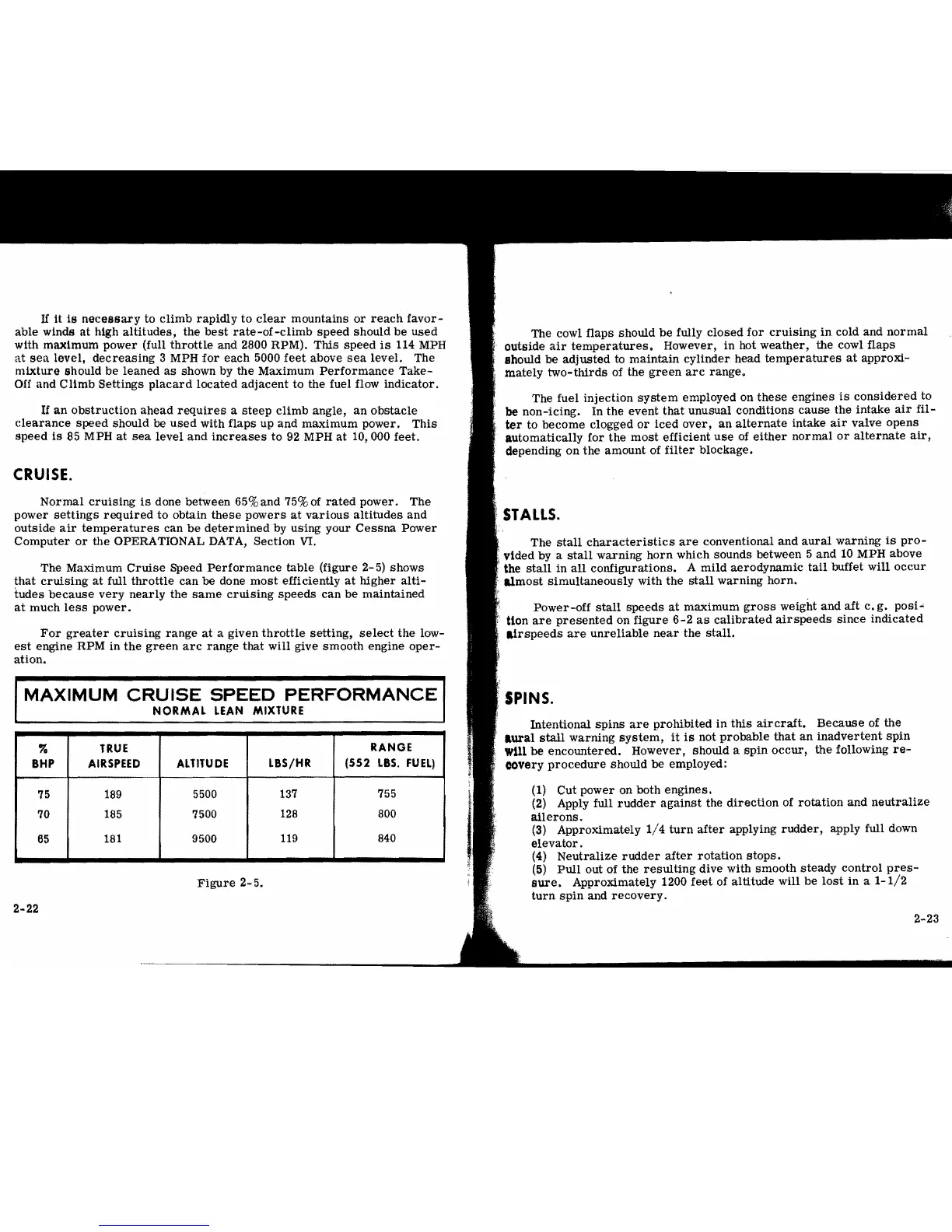
The Maximum
Cruise
Speed
Performance
table
(figure
2-
5)
shows
that
cruiSing
at
full
throttle
can be done
most
efficiently
at
higher
alti-
tudes
because
very
nearly
the
same
cruiSing
speeds
can
be
maintained
at
much
less
power.
For
greater
cruising
range
at
a given
throttle
setting.
select
the low-
est
engine RPM in
the
green
arc
range
that
will
give
smooth
engine
oper-
ation.
I
MAXIMUM
CRUISE
SPEED
PERFORMANCE
NORMAL
LEAN
MIXTURE
"
BHP
TRUE
AIRSPEED
ALTITUDE
LBS/HR
RANGE
(552
lBS.
FU
Ell
75
70
65
189
185
181
5500
7500
9500
137
128
119
755
800
840
Figure
2-5.
The cowl flaps should
be
fully
closed
for
cruising
in
cold and
normal
outside
air
temperatures.
However,
in
hot
weather,
the cowl
flaps
should be
adjusted
to
maintain
cylinder head
temperatures
at
approxi-
mately
two-thirds
of the
green
arc
range.
The fuel injection
system
employed on
these
engines
is
considered
to
be
non-icing. In the event that unusual conditions
cause
the intake
air
fil-
ter
to
become
clogged
or
iced
over,
an
alternate
intake
air
valve
opens
automatically
for the
most
efficient
use
of
either
normal
or
alternate
air,
depending
on
the amount of
filter
blockage.
tI
The
stall
characteristics
are
conventional and
aural
warning
is
pro-
I'
vided by a
stall
warning
horn
which sounds between 5
and
10
MPH above
the
stall
in
all
configurationS. A
mild
aerodynamic
tail
buffet
will
occur
!111
almost
simultaneously
with the
stall
warning horn.
Power-off
stall
speeds
at
maximum
gross
weight and
aft
c.
g.
posi-
tion
are
presented
on
figure
6-2
as
calibrated
airspeeds
since
indicated
airspeeds
are
unreliable
near
the
stall.
Intentional
spins
are
prohibited
in
this
aircraft.
Because
of
the
aural
stall
warning
system,
it
is
not
probable
that
an
inadvertent
spin
will be
encountered.
However, should a
spin
occur,
the following
re-
covery
procedure
should be employed:
(1)
Cut power on both
engines.
(2)
Apply full
rudder
against
the
direction
of
rotation
and
neutralize
ailerons.
(3)
Approximately
1/4
turn
after
applying
rudder,
apply full down
elevator.
(4)
Neutralize
rudder
after
rotation
stops.
(5)
Pullout
of the
resulting
dive with smooth
steady
control
pres-
sure.
Approximately 1200
feet
of altitude will
be
lost
in
a
1-1/2
turn
spin
and
recovery.
2-23
2-22