EasyManua.ls Logo

Cessna 1971 Super Skymaster - Page 29

Cessna 1971 Super Skymaster
63 pages
Print Icon
To Next Page IconTo Next Page
To Previous Page IconTo Previous Page
Loading...
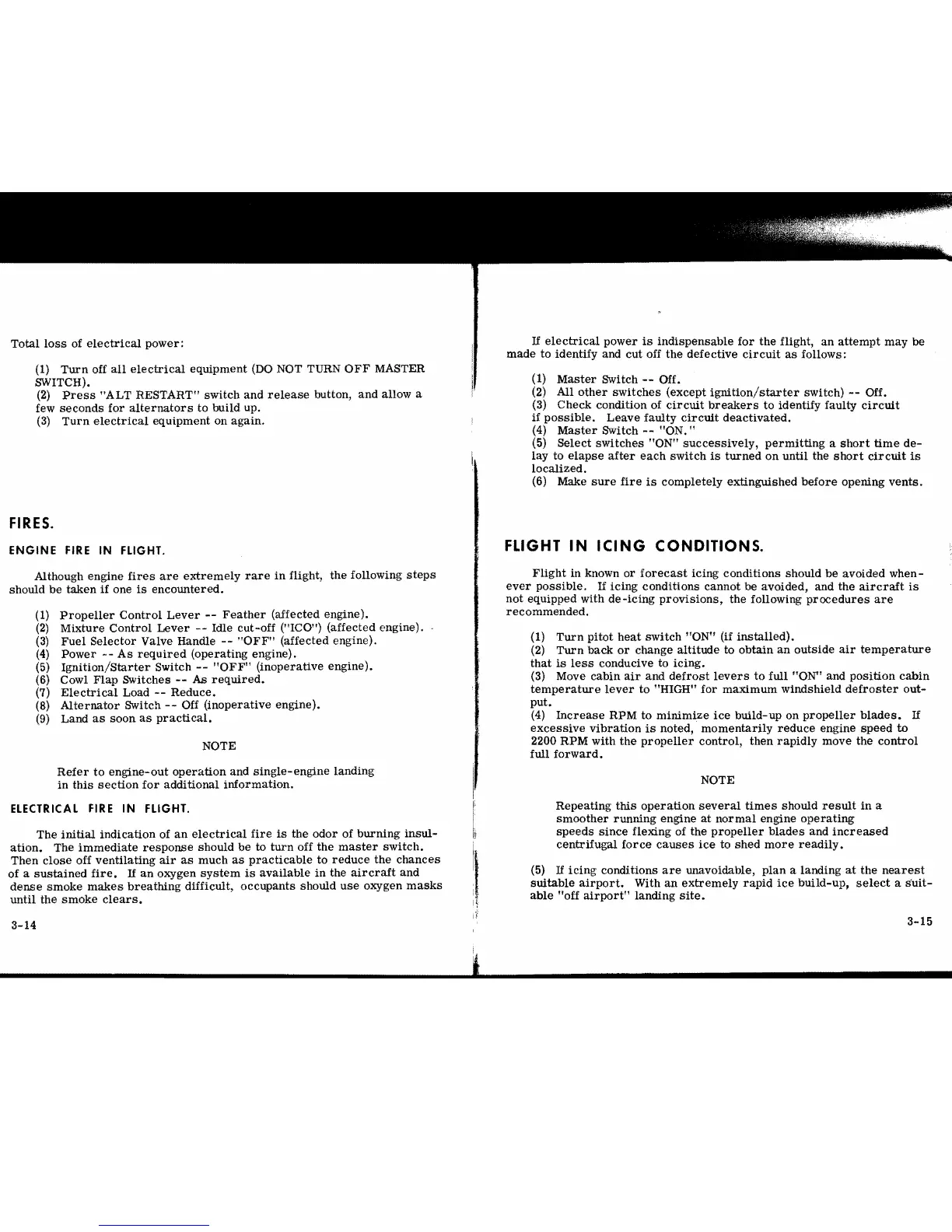
Total
loss
of
electrical
power:
Turn
off
all
electrical
equipment
(DO
NOT TURN
OFF
MASTER
SWITCH).
(2)
Press
"ALT
RESTART"
switch
and
release
button.
and
allow a
few
seconds
for
alternators
to
build up.
(3)
Turn
electrical
equipment
on
again.
FIRES.
ENGINE
FIRE
IN FLIGHT.
Although engine
fires
are
extremely
rare
in
the
following
steps
should
be
taken
if
one
is
encountered.
(1)
Propeller
Control
Lever
--
Feather
(affected engine).
(2)
Mixture
Control
Lever
--
Idle
cut-off
("ICO") (affected engine).
(3)
Fuel
Selector
Valve Handle
--
"OFF"
(affected engine).
(4)
Power
- -
As
required
(operating engine).
(5)
Ignition/Starter
Switch
--
"OFF"
(inoperative engine).
(6)
Cowl
Flap
Switches
--
AJ:3
required.
(7)
Electrical
Load
--
Reduce.
(8)
Alternator
Switch
--
Off
(inoperative
engine).
(9)
Land
as
soon
as
practical.
NOTE
Refer
to
engine-out
operation
and
single-engine
landing
in
this
section
for
additional
information.
ELECTRICAL
FIRE
IN FLIGHT.
The
initial
indication
of
an
electrical
fire
is
the
odor
of
burning
insul-
ation.
The
immediate
response
should
be to
turn
off
the
master
switch.
Then
close
off
ventilating
air
as
much
as
practicable
to
reduce
the
chances
of
a
sustained
fire.
If
an
oxygen
system
is
available
in
the
aircraft
and
If
electrical
power
is
indispensable
for
the
flight,
an
attempt
may
be
made
to
identify and
cut
off
the
defective
circuit
as
follows:
(1)
Master
Switch
--
Off.
(2)
All
other
switches
(except
ignition/starter
switch)
--
Off.
(3)
Check
condition of
circuit
breakers
to
identify faulty
circuit
if
possible.
Leave
faulty
circuit
deactivated.
(4)
Master
Switch
--
"ON."
(5)
Select
switches
"ON"
successively,
permitting
a
short
time
de-
lay
to
elapse
after
each
switch
is
turned
on
until
the
short
circuit
is
localized.
(6) Make
sure
fire
is
completely
extinguished
before
opening
vents.
FLIGHT
IN
ICING
CONDITIONS.
,I
Flight
in known
or
forecast
icing
conditions
should be avoided
when-
ever
possible.
If
icing
conditions
cannot be avoided, and
the
aircraft
is
1'\11
not
equipped with
de-icing
proviSions,
the following
procedures
are
recommended.
(1)
Turn
pitot
heat
switch
"ON"
(if
installed).
(2)
Turn
back
or
change
altitude
to
obtain
an
outside
air
temperature
that
is
less
conducive to
icing.
(3) Move
cabin
air
and
defrost
levers
to
full "ON" and
position
cabin
temperature
lever
to
"HIGH" for
maximum
windshield
defroster
out-
put.
(4)
Increase
RPM
to
minimize
ice
build-up
on
propeller
blades.
If
excessive
vibration
is
noted,
momentarily
reduce
engine
speed
to
2200 RPM with
the
propeller
control,
then
rapidly
move
the
control
full
forward.
NOTE
Repeating
this
operation
several
times
should
result
in
a
smoother
running
engine
at
normal
engine
operating
speeds
since
flexing
of the
propeller
blades
and
increased
centrifugal
force
causes
ice
to
shed
more
readily.
(5)
If
icing
conditions
are
unavoidable,
plan
a landing
at
the
nearest
dense
smoke
makes
breathing
difficult,
occupants
should
use
oxygen
masks
II.
suitable
airport.
With
an
extremely
rapid
ice
build-up.
select
a
suit-
able
"off
airport"
landing
site.
until
the
smoke
clears.
I
~
1\
,i
,
j'll_r'
1N~'i\'\
3-14
3-15

Related product manuals