EasyManua.ls Logo

Cessna 1971 Super Skymaster - Page 28

Cessna 1971 Super Skymaster
63 pages
Print Icon
To Next Page IconTo Next Page
To Previous Page IconTo Previous Page
Loading...
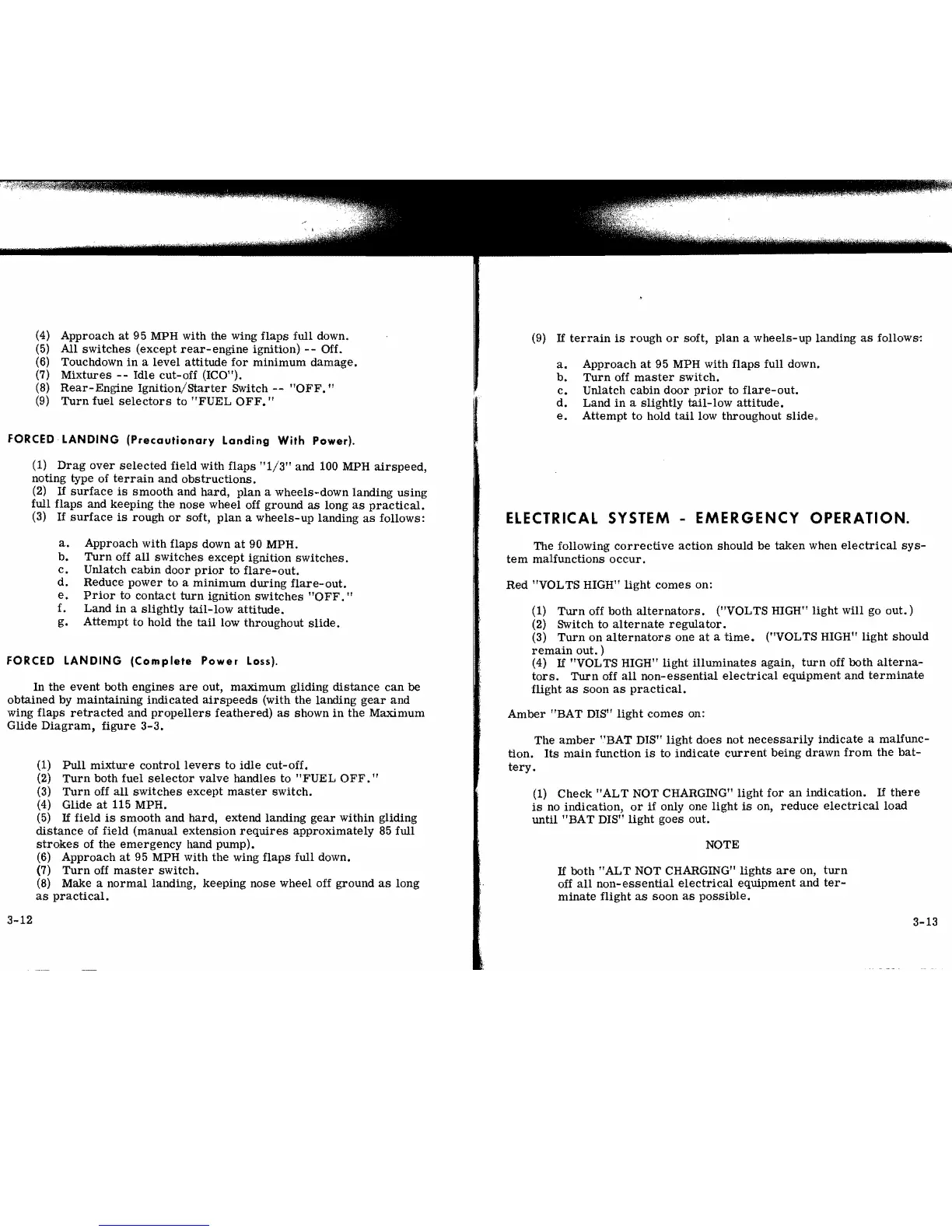
(4)
Approach
at
95 MPH with the wing
flaps
full down.
(5)
All
switches
(except
rear-engine
ignition)
--
Off.
(6)
Touchdown
in
a
level
attitude
for
minimum
damage.
(7)
Mixtures
--
Idle
cut-off
(ICO").
(8)
Rear-Engine
Ignition/Starter
Switch
--
"OFF."
(9)
Turn
fuel
selectors
to
"FUEL
OFF."
FORCED
LANDING
(Precautionary
Landing
With
Power),
Drag
over
selected
field
with
flaps
"1/3"
and 100 MPH
airspeed,
noting type of
terrain
and
obstructions.
(2)
If
surface
is
smooth
and
hard,
plan
a
wheels-down
landing
using
full
flaps
and keeping the
nose
wheel off ground
as
long
as
practical.
(3)
If
surface
is
rough
or
soft,
plan
a
wheels-up
landing
as
follows:
a.
Approach
with
flaps
down
at
90 MPH.
b.
Turn
off aU
switches
except
ignition
switches.
c.
Unlatch
cabin
door
prior
to
flare-out.
d.
Reduce
power
to
a
minimum
during
flare-out.
e.
Prior
to
contact
turn
ignition
switches
"OFF.
"
f. Land
in
a
slightly
tail-low
attitude.
g.
Attempt
to
hold the
tail
low throughout
slide,
FORCED
LANDING
(Complete
Power
Loss),
In the
event
both
engines
are
out,
maximum
gliding
distance
can
be
obtained
by
maintaining
indicated
airspeeds
(with the landing
gear
and
wing
flaps
retracted
and
propellers
feathered)
as
shown
in
the Maximum
Glide
Diagram,
figure
3-3.
(1)
Pull
mixture
control
levers
to
idle
cut-off.
(2)
Turn
both
fuel
selector
valve
handles
to
"FUEL
OFF."
(3)
Turn
off
all
switches
except
master
switch.
(4)
Glide
at
115 MPH.
(5)
If
field
is
smooth
and
hard,
extend landing
gear
within gliding
distance
of
field
(manual
extension
requires
approximately
85
full
strokes
of the
emergency
hand pump).
(6)
Approach
at
95 MPH with the wing
flaps
full down.
(7)
Turn
off
master
switch.
(8)
Make a
normal
landing, keeping
nose
wheel off ground
as
long
as
practical.
(9)
If
terrain
is
rough
or
soft,
plan
a
wheels-up
landing
as
follows~
a.
Approach
at
95 MPH with
flaps
full down.
b.
Turn
off
master
switch.
c.
Unlatch
cabin
door
prior
to
flare-out.
d.
Land
in
a
slightly
tail-low
attitude.
e.
Attempt
to hold
tail
low throughout
slide,
ELECTRICAL
SYSTEM
- EMERGENCY OPERATION.
The following
corrective
action
should
be
taken
when
electrical
sys-
tem
malfunctions
occur.
Red "VOLTS HIGH"
light
comes
on:
(1)
Turn
off both
alternators.
("VOLTS HIGH"
light
will
go
out.)
(2)
Switch to
alternate
regulator.
(3)
Turn
on
alternators
one
at
a
time.
("VOLTS HIGH"
light
should
remain
out. )
(4)
If
"VOLTS HIGH"
light
illuminates
again,
turn
off
both
alterna-
tors.
Turn
off
all
non-essential
electrical
equipment
and
terminate
flight
as
soon
as
practical.
Amber
"BAT
DIS"
light
comes
on:
The
amber
"BAT
DIS"
light
does
not
necessarily
indicate
a
malfunc-
tion.
Its
main
function
is
to
indicate
current
being
drawn
from
the
bat-
tery.
(1)
Check HALT NOT CHARGING"
light
for
an
indication.
If
there
is
no
indication,
or
if
only one
light
is
on,
reduce
electrical
load
until
"BAT
DIS"
light
goes out.
NOTE
If
both
"ALT
NOT CHARGING"
lights
are
on,
turn
off aU
non-essential
electrical
equipment
and
ter-
minate
flight
as
soon
as
possible.
3-12
3-13

Related product manuals