EasyManua.ls Logo

Cessna 1971 Super Skymaster - Page 27

Cessna 1971 Super Skymaster
63 pages
Print Icon
To Next Page IconTo Next Page
To Previous Page IconTo Previous Page
Loading...
(3)
Operate
the hand pump up and down until
the
down
indicator
(green)
light
comes
on, and continue pumping until the landing
gear
handle
returns
to "down
neutral".
Allow 2 to 3 minutes for
this
operation.
NOTE
If
the
emergency
hand pump cannot be
operated
and
seems
to
be
"frozen,
"
it
is
because
there
is
normal
hydraulic
pres-
sure
from
the
engine-driven
pump, and
the
hand pump
can-
not
be
operated
against
it.
In
this
event,
refer
to
the
in-
structions
in
the
following
paragraphs.
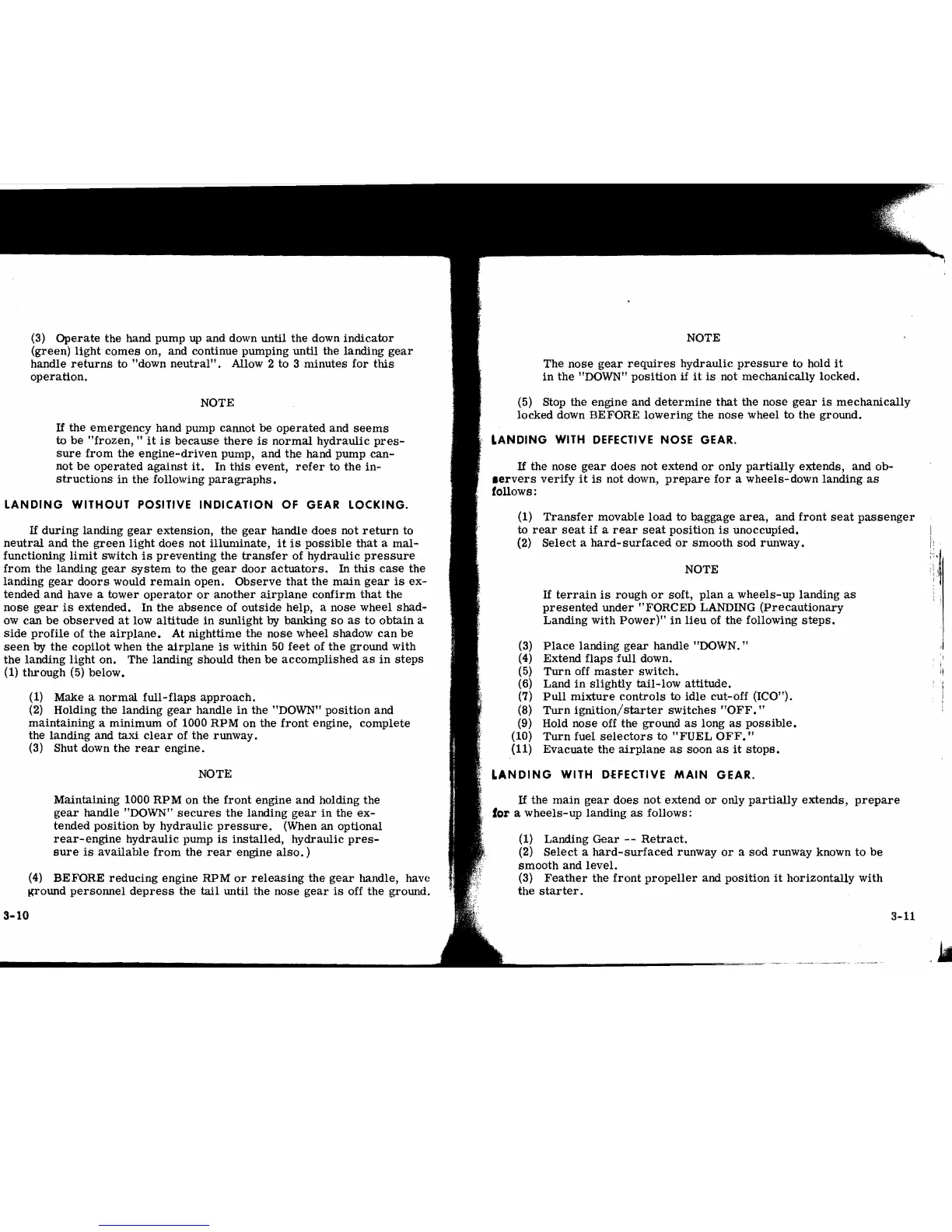
LANDING
WITHOUT
POSITIVE
INDICATION
OF GEAR LOCKING.
If
during
landing
gear
extension, the
gear
handle
does
not
return
to
neutral
and
the
green
light
does
not
illuminate,
it
is
possible
that
a
mal-
functiOning
limit
switch
is
preventing
the
transfer
of
hydraulic
pressure
from
the
landing
gear
system
to the
gear
door
actuators.
In
this
case
the
landing
gear
doors
would
remain
open.
Observe
that
the
main
gear
is
ex-
tended and have a
tower
operator
or
another
airplane
confirm
that
the
nose
gear
is
extended. In
the
absence
of
outside
help, a nose wheel
shad-
ow
can
be
observed
at
low
altitude
in
sunlight
by
banking
so
as
to
obtain
a
side
profile
of
the
airplane.
At nighttime
the
nose
wheel shadow
can
be
seen
by
the
copilot when
the
airplane
is
within
50
feet
of
the
ground with
the
landing
light
on. The landing should
then
be
accomplished
as
in
steps
(1)
through
(5)
below.
(1)
Make a
normal
full-flaps
approach.
(2)
Holding the landing
gear
handle
in
the "DOWN"
position
and
maintaining
a
minimum
of 1000
RPM
on
the
front
engine,
complete
the landing and
taxi
clear
of
the
runway.
(3) Shut down the
rear
engine.
NOTE
Maintaining 1000
RPM
on the
front
engine and holding the
gear
handle "DOWN"
secures
the
landing
gear
in
the
ex-
tended
position
by
hydraulic
pressure.
(When an optional
rear-engine
hydraulic
pump
is
installed,
hydrauliC
pres-
sure
is
available
from
the
rear
engine
also.)
(4)
BEFORE
reducing
engine RPM
or
releaSing
the
gear
handle, have
ground
personnel
depress
the
tail
until
the
nose
gear
is
off the ground.
NOTE
The nose
gear
requires
hydraulic
pressure
to hold
it
in
the
"DOWN" pOSition
if
it
is
not
mechanically
locked.
(5) Stop the engine and
determine
that
the nose
gear
is
mechanically
locked down BEFORE
lowering
the
nose
wheel
to
the ground.
LANDING
WITH
DEFECTIVE
NOSE GEAR.
If
the
nose
gear
does
not
extend
or
only
partially
extends, and ob-
.ervers
verify
it
is
not down,
prepare
for
a wheels-down landing
as
follows:
(1)
Transfer
movable
load
to baggage
area,
and
front
seat
passenger
to
rear
seat
if
a
rear
seat
pOSition
is
unoccupied.
(2)
Select
a
hard-surfaced
or
smooth
sod
runway.
NOTE
If
terrain
is
rough
or
soft,
plan
a
wheels-up
landing
as
presented
under
"FORCED LANDING
(Precautionary
Landing with
Power)"
in
lieu
of the following
steps.
(3)
Place
landing
gear
handle "DOWN. "
(4)
Extend
flaps
full down.
(5)
Turn
off
master
switch.
(6)
Land
in
slightly
tail-low
attitude.
(7)
Pull
mixture
controls
to
idle
cut-off (ICO").
(8)
Turn
ignition/starter
switches
"OFF."
(9)
Hold nose off the ground
as
long
as
possible.
(10)
Turn
fuel
selectors
to
"FUEL
OFF."
(11)
Evacuate
the
airplane
as
soon
as
it
stops.
LANDING
WITH
DHECTIVE
MAIN
GEAR.
If
the
main
gear
does
not
extend
or
only
partially
extends,
prepare
for
a
wheels-up
landing
as
follows:
(1)
Landing
Gear
--
Retract.
(2)
Select
a
hard-surfaced
runway
or
a
sod
runway known
to
be
smooth
and
level.
(3)
Feather
the
front
propeller
and
position
it
horizontally
with
the
starter.
3-11
3-10

Related product manuals