EasyManua.ls Logo

Cessna 1971 Super Skymaster - Page 26

Cessna 1971 Super Skymaster
63 pages
Print Icon
To Next Page IconTo Next Page
To Previous Page IconTo Previous Page
Loading...
ROUGH
ENGINE
OPERATION
OR LOSS OF POWER.
SPARK
PLUG
FOULING.
An
engine
roughness
in
flight
may
be
caused
by
one
or
more
spark
Plu~s
beccming
fouled by
carbon
or
lead
deposits.
This
may
be
verified
by
turning
the
ignition
switch
momentarily
from
"BOTH"
to
either
"LEFT"
(II"
"RIGHT" pOSition.
An
obvious
power
loss
in
single
ignition
operation
is
evidence
of
spark
plug
or
magneto
trouble.
Assuming
that
spark
plugs
are
the
more
likely
cause,
lean
the
mixture
to
the
normal
lean
setting
for
cruiSing flight.
If
the
problem
does not
clear
up
in
several
minutes,
de-
termine
if a
richer
mixture
setting
will
produce
smoother
operation.
If
not,
proceed
to
the
nearest
airport
for
repairs
using
the
"BOTH"
pOSition
of
the
ignition
switch
unless
extreme
roughness
dictates
the
use
of a
sin-
gle
ignition
pOSition.
MAGNETO MALFUNCTION.
A
sudden
engine
roughness
or
misfiring
is
usually
evidence of
magneto
problems.
Switching
from
"BOTH"
to
either
"LEFT"
or
"RIGHT" ignition
switch
position
will
identify
which
magneto
is
mal-
functioning.
Select
different
power
settings
and
enrichen
the
mixture
to
determine
if
continued
operation
on
"BOTH"
magnetos
is
prac-
ticable.
If
not,
switch
to
the
good
magneto
and
proceed
to
the
near-
est
airport
for
repairs.
LOW
OIL
PRESSURE.
If
low
oil
pressure
is
accompanied
by
normal
oil
temperature,
there
is
a
possIbility
the
oil
pressure
gage
or
relief
valve
is
mal-
functioning. A
leak
in
the
line
to
the
gage
is
not
cause
for
immed-
iate
concern
because
an
orifice
in
this
line
will
prevent
a
sudden
loss
of
oil
from
the
engine
sump.
However,
power
should
be
re-
duced
as
a
precautionary
measure
and
a landing planned
at
the
next
airport
having
service
facilities.
If
a
total
loss
of
oil
pressure
is
accompanied
by
a
sudden
rise
1n
oil
temperature,
there
is
reason
to
suspect
an
engine
failure
is
1mminent.
Close
throttle
and
verify
faulty engine
before
feathering
the
propeller.
After
reviewing
single-engine
approach
procedures
In
th1s
section,
perform
an
engine-out
landing
at
the
nearest
suit-
!lule
aIrport.
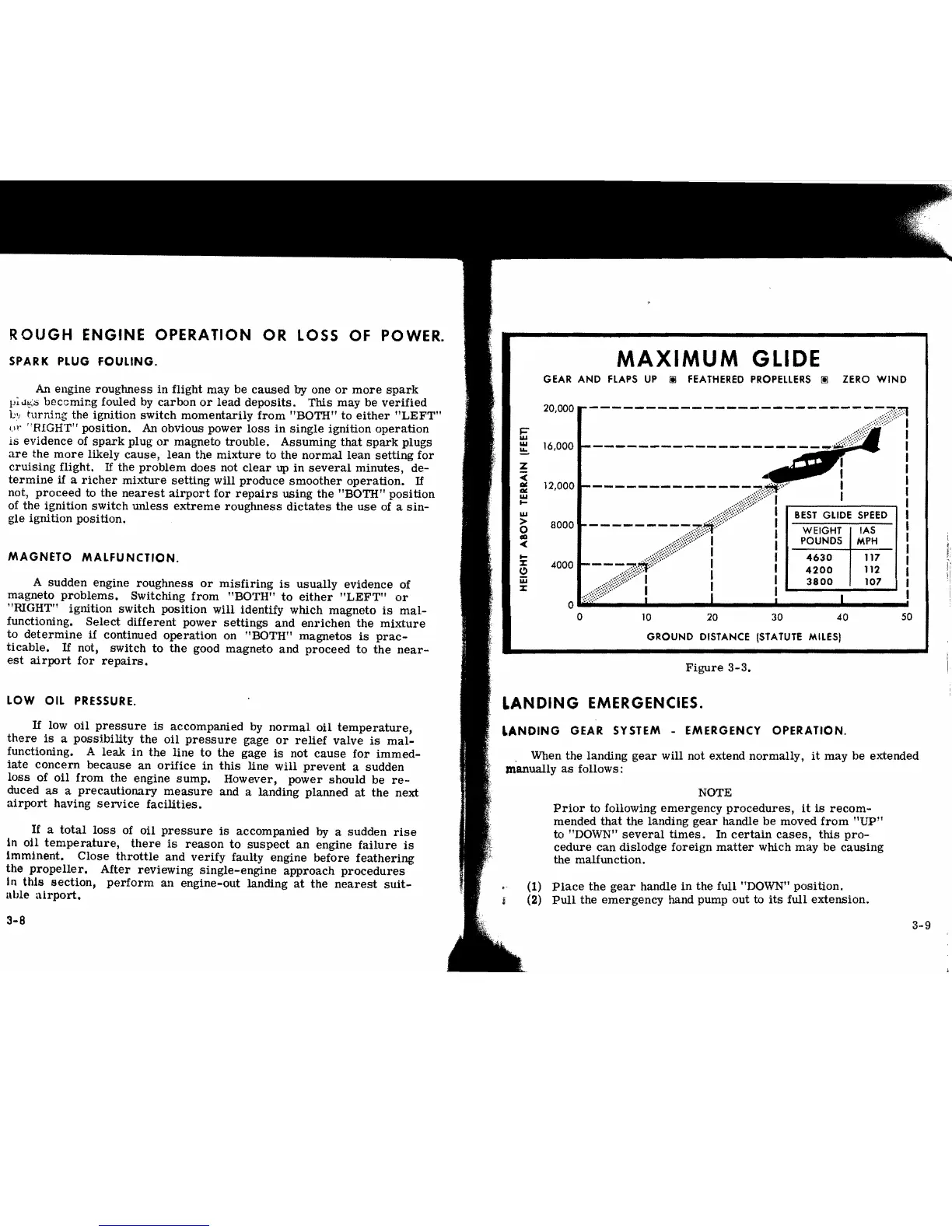
MAXIMUM
GLIDE
GEAR
AND
flAPS
UP
fjj
FEATHERED
PROPELLERS
fjj
ZERO
WIND
20 000
r--------------------------~·.,
iii
',:d,P'
~
16,000
~---------------------;;ji;.jj:.::
..
1'P,
-
z
:;(
-d
IIIIi
at
12,0001---------------~:~::····
1.1.1
I-
..
:::/;tj}$?;'::::"!
w
>
80001----------:.7}ff::···
o
III
•.
:::,:.:¥ii::···
I
«
...
:::;i:.i
P
::··
I
:r
4000 t----:::::l*ttf::··· I
iii
"
I-
:r
o
t:;:::j.$pp::··
! I
o
10
20
GROUND DISTANCE
(STATUTE
MILESI
Figure
3-3.
LANDING
EMERGENCIES.
LANDING
GEAR
SYSTEM
-
EMERGENCY
OPERATION.
When the landing
gear
will
not extend
normally,
it
may
be extended
manually
as
follows:
NOTE
Prior
to following
emergency
procedures,
it
is
recom-
mended
that
the
landing
gear
handle
be
moved
from
"UP"
to "DOWN"
several
times.
In
certain
cases,
this
pro-
cedure
can
dislodge
foreign
matter
which
may
be
causing
the malfunction.
(1)
Place
the
gear
handle
in
the full "DOWN"
position.
(2)
Pull
the
emergency
hand pump
out
to
its
full
extension.
3-9
~
I
I
I
I
30
I
I
BEST
GLI~E
SPEED
WEIGHT lAS
POUNDS
MPH
4630
117
4200
112
3800
107
40
50
3-8

Related product manuals