EasyManua.ls Logo

Cessna 1971 Super Skymaster - Page 25

Cessna 1971 Super Skymaster
63 pages
Print Icon
To Next Page IconTo Next Page
To Previous Page IconTo Previous Page
Loading...
(5)
Auxiliary
Fuel
Pump
Switch
--
"HI."
(6) Ignition Switch
--
"START" (until engine
starts
windmilling).
(7)
Mixture
--
Adjust
for
a fuel flow between 10 to 35
lbs/hr
while
starting.
Then
adjust
for
maximum
engine
acceleration
to 1000 RPM.
(8) Auxiliary
Fuel
Pump Switch
--
Off.
(9)
Throttle
--
Adjust
for
smooth
engine
acceleration
and
to
prevent
propeller
overspeed.
(10)
Power
--
Increase
slowly until
cylinder
head
temperature
reaches
200°F.
SINGLE-ENGINE APPROACH.
(1)
Landing
Gear
--
Extend on downwind
leg.
NOTE
If
the
front
propeller
is
feathered,
the
landing
gear
must
be
extended with the
emergency
hydraulic
hand pump (un-
less
an
optional
rear-engine
hydraulic
pump
is
installed).
Allow 2 to 3
minutes
for
emergency
gear
extension
operation.
(2)
Wing
Flaps
--
Minimum
setting
necessary
(until landing
is
assured).
(3)
Airspeed
--
90 to 100 MPH
in
approach.
SINGLE-ENGINE
GO-AROUND.
(1)
Power
--
Full
throttle
and 2800 RPM.
(2)
Airspeed
--
100 MPH (95 MPH with
obstacles
ahead).
(3)
Wing
Flaps
--
Retract
to
"1/3"
down.
(4)
Cowl
Flaps
--
Open on
operating
engine.
(5) Wing
Flaps
--
Retract
after
obstacles
are
cleared
and a
safe
altitude
and
airspeed
are
reached.
(6)
Landing
Gear
--
Retract
after
obstacles
are
cleared.
NOTE
With the
front
engine
inoperative,
leave
the landing
gear
extended (unless
an
optional
rear-engine
hydrauliC pump
is
installed).
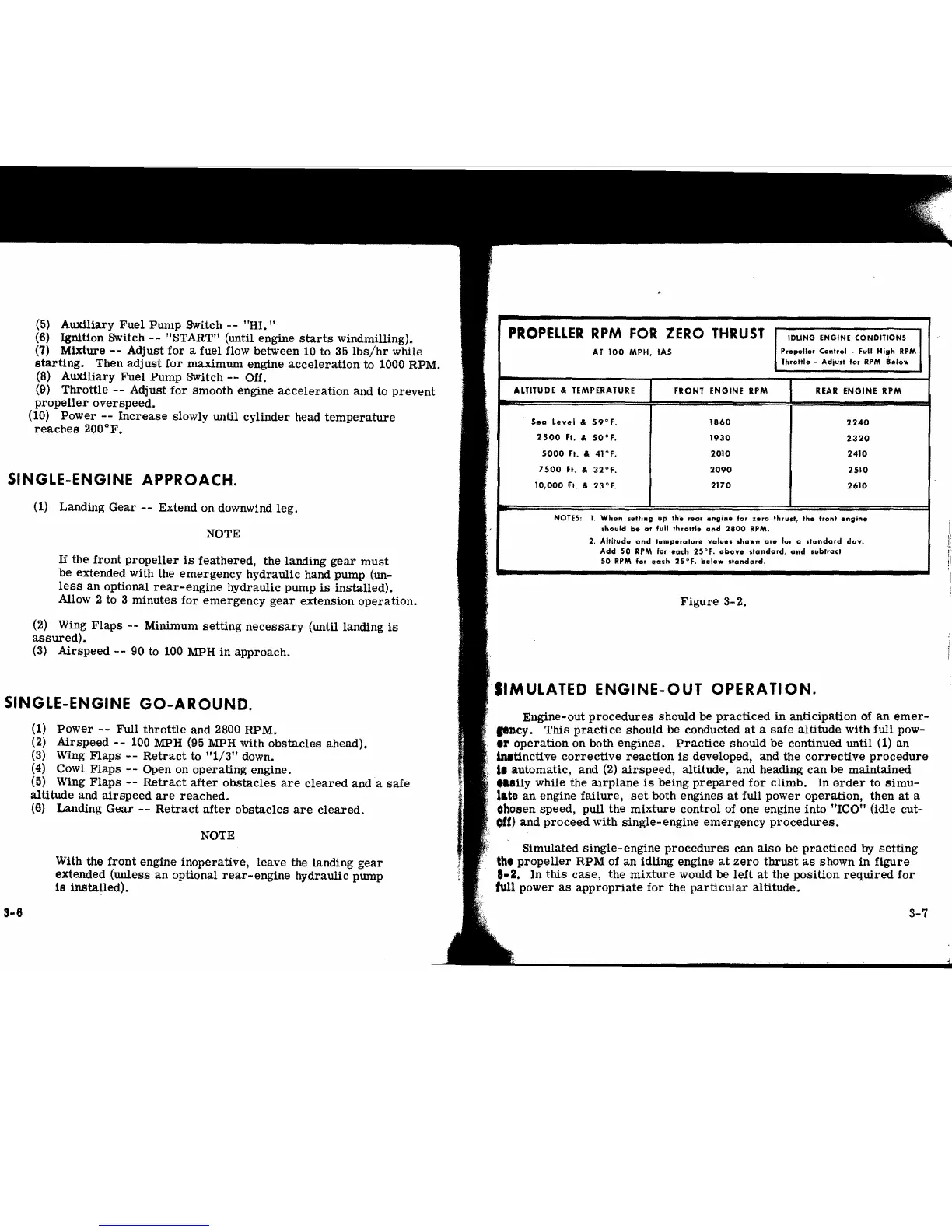
PROPELLER
RPM
FOR
ZERO
THRUST
IDLING
ENGINE
CONDITIONS
AT
100
MPH, lAS
Propell.r
Control - Full
High
RPM
Throttle - Adju.t lor
RPM
ielow
ALTITUDE & TEMPERATURE
FRONT ENGINE RPM
REAR
ENGINE RPM
Sea
Lev.1
&
59¢F.
1860
2240
2500
Ft. &
50¢F.
1930
2320
5000
Ft. & 41¢F.
2010
2410
7500
Fl. &
32
Of.
2090
2510
10,000
fl.
&
23¢F.
2170
2610
NOTES:
1.
When
setting
up
the
'eOf
e,.gin"
for
zero
thru.t,
the
front
engine
.hould
be
at
lull throttle
and
2800
RPM.
2.
Altitude
and
temperotur.
value.
shawn
or.
tor
standard
day.
Q
Add
50
RPM
for each
2sof.
above
standard,
and
subtract
50
RPM
for
each
25°F. below
standard.
I
Figure
3-2.
SIMULATED
ENGINE-OUT
OPERATION.
Engine-out
procedures
should be
practiced
in
antiCipation of
an
emer-
..ney.
This
practice
should be conducted
at
a
safe
altitude
with full pow-
.r
operation
on both
engines.
Practice
should
be
continued until
(1)
an
lnltinctive
corrective
reaction
is
developed, and the
corrective
procedure
II
automatic,
and
(2)
airspeed,
altitude,
and heading
can
be
maintained
tUily
while the
airplane
is
being
prepared
for
climb.
In
order
to
simu-
late
an
engine
failure,
set
both engines
at
full
power
operation,
then
at
a
Ohosen
speed,
pull
the
mixture
control
of one engine into
"ICO"
(idle
cut-
otf)
and
proceed
with
single-engine
emergency
procedures.
Simulated
single-engine
procedures
can
also
be
practiced
by
setting
the
propeller
RPM
of
an
idling
engine
at
zero
thrust
as
shown
in
figure
1.2, In
this
case,
the
mixture
would be
left
at
the pOSition
required
for
full
power
as
appropriate
for
the
particular
altitude.
3-7
3-6

Related product manuals