EasyManua.ls Logo

Cessna 1971 Super Skymaster - Page 54

Cessna 1971 Super Skymaster
63 pages
Print Icon
To Next Page IconTo Next Page
To Previous Page IconTo Previous Page
Loading...
OXYGEN
SYSTEM
Two oxygen
cylinders,
located
side
by
side
in
the
cabin ceiling,
supply oxygen
for
the
system.
The
left-hand
cylinder
is
equipped
with
a
pressure
regulator
which
reduces
cylinder
pressure
to
an
operating
pressure
of 70
psi.
A line
from
the
right-hand
cylinder
is
connected
to
this
same
regulator,
and
oxygen
is
supplied
from
both
cylinders
simultaneously.
A
shut-off
valve
is
included
as
part
of the
regulator
assembly
to
control
the flow
from
both
cylinders.
An oxygen
cylinder
filler
valve
is
located
in
the
right
wing
root
and
is
accessible
by
re-
moving
the
small
cover
plate
on top of the
right
wing leading edge.
Cylinder
pressure
is
indicated
by a
pressure
gage
located
in the
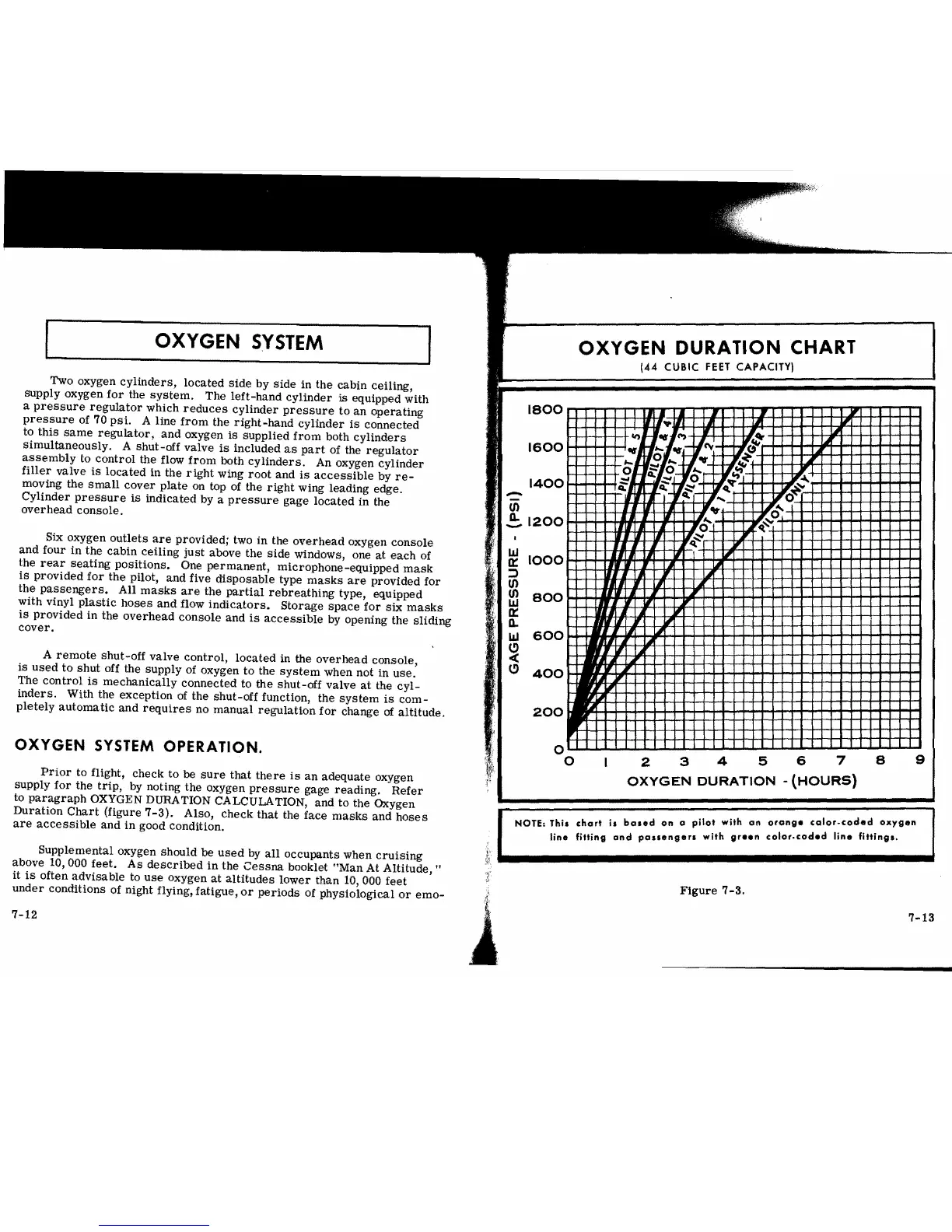
OXYGEN
DURATION CHART
144
CUBIC
FEET
CAPACITY)
1800
0 E E 0
lllJ-fA
I11I
II
&fIlii III
L11111111
16001'
, I 1 I 1
__
,..
.. _
140011
I I 1
liflrlr-l~tI;-ti:IG~
U
U1!~;
I I I 1 I I I
120011111
11.1t11111"~I-r
11:::llllm
U#1111111111111111111
~
overhead
console.
Six oxygen
outlets
are
provided;
two
in
the
overhead
oxygen
console
and
four
in
the
cabin
ceiling
just
above
the
side
windows, one
at
each
of
the
rear
seating
positions.
One
permanent,
microphone-equipped
mask
is
provided
for
the
pilot,
and
five
disposable
type
masks
are
provided
for
the
passengers.
All
masks
are
the
partial
rebreathing
type, equipped
with
vinyl
plastic
hoses
and
flow
indicators.
Storage
space
for
six
masks
is
provided
in the
overhead
console
and
is
accessible
by opening the
sliding
cover.
A
remote
shut-off
valve
control,
located
in the
overhead
console,
is
used
to
shut
off the supply of oxygen
to
the
system
when not
in
use.
The
control
is
mechanically
connected
to
the
shut-off
valve
at
the
cyl-
inders.
With the exception
of
the
shut-off
function,
the
system
is
com-
pletely
automatic
and
requires
no manual
regulation
for
change
of
altitude.
OXYGEN
SYSTEM
OPERATION.
Prior
to
flight,
check
to
be
sure
that
there
is
an
adequate oxygen
supply
for
the
trip,
by noting
the
oxygen
pressure
gage
reading.
Refer
to
paragraph
OXYGEN DURATION CALCULATION, and
to
the Oxygen
Duration
Chart
(figure
7-3).
Also,
check
that
the face
masks
and
hoses
are
accessible
and
in
good condition.
Supplemental oxygen
should
be
used
by
all
occupants
when
cruising
above
10,000
feet.
As
described
in
the
Cessna
booklet
"Man
At
Altitude,
"
it
is
often
advisable
to
use
oxygen
at
altitudes
lower
than
10,000
feet
under
conditions of night flying, fatigue,
or
periods
of
physiological
or
emo-
1·')
CJ)
~
l
D..
~
600
IIIJJJYt
1)1111111
III1
I11I
11II11I11111
«
C>
23456
7 8 9
OXYGEN
DURATION
-
(HOURS)
NOTE. This
chart
is
baud
on
a
pilot
with
an
orang.
calor-coded
oxygen
line
fitting
and
panen"e
..
with
gr
••
n
color.cod.d
line
fitting
••
Figure
7-3
.
7-13
.
.
..
j
7-12