POST LIGHT (TYPICALI
SELECTOR
SWITCH
AND
ON·OFF INDICATOR
LIGHT
NAV
AUTOPILOT.OMNI
SWITCH
STACK
~----.I---SPEAKER---
___
~
COM
NAV
~
___
e-=-p:O'
AUTOPILOT
BACK
COURSE
SELECTOR
SWITCH
RADIO
SELECTOR
SWITCHES
I
BOOM
MICROPHONE
I
AND ON.OFF INDICATOR
LIGHT
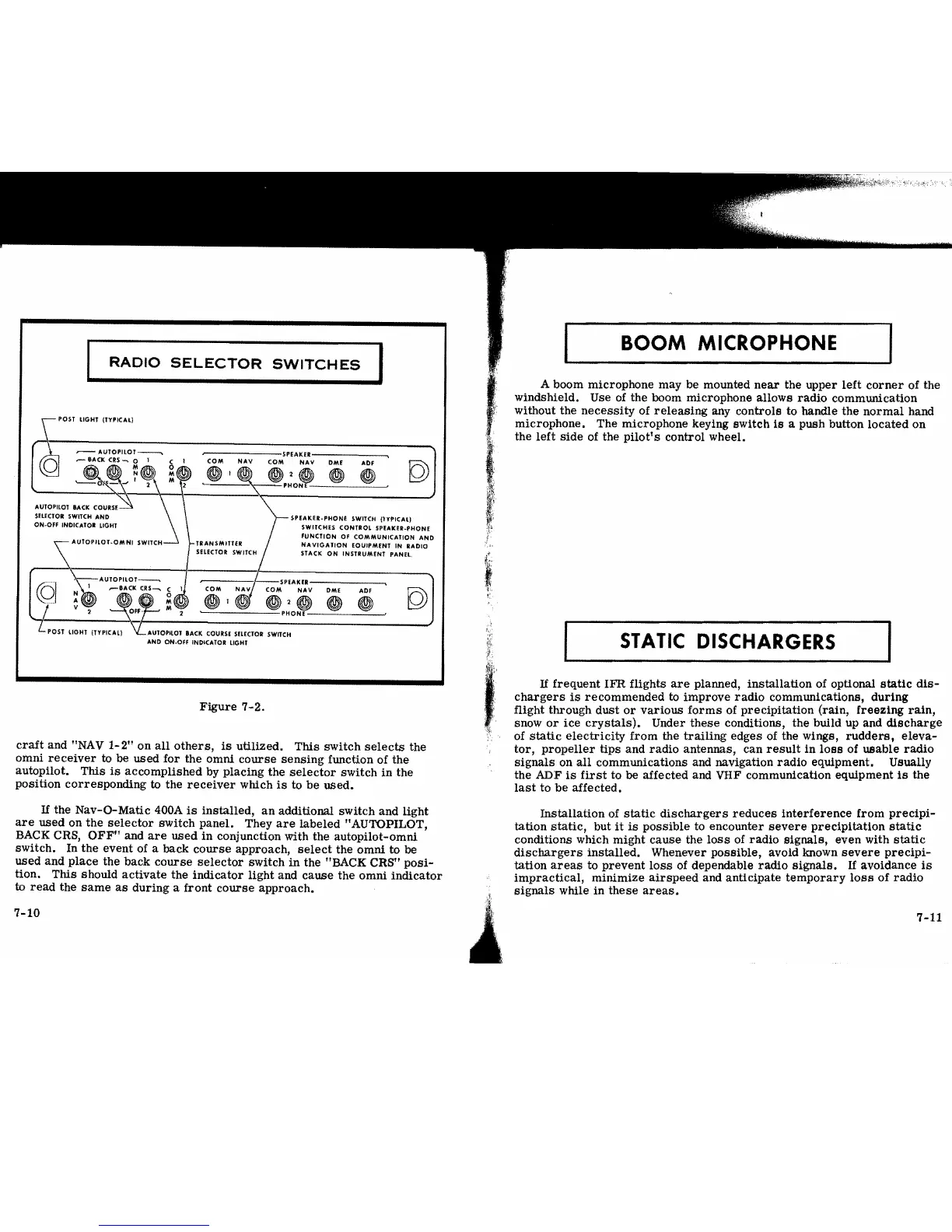
Figure
7-2.
craft
and "NAV
1-2"
on
all
others,
is
utilized.
This
switch
selects
the
omni
receiver
to be
used
for the omni
course
sensing
function of the
autopilot.
This
is
accomplished
by placing the
selector
switch
in
the
pOSition
corresponding
to the
receiver
which
is
to
be
used.
If
the
Nav-O-Matic
400A
is
installed,
an
additional switch and light
are
used
on
the
selector
switch
panel.
They
are
labeled "AUTOPILOT,
BACK CRS,
OFF"
and
are
used
in
conjunction with the autopilot-omni
switch. In
the
event of a
back
course
approach,
select
the
omni
to be
used and
place
the
back
course
selector
switch
in
the "BACK CRS" pOSi-
tion.
This
should
activate
the
indicator
light and
cause
the omni
indicator
to
read
the
same
as
during
a
front
course
approach.
DM£
ADF
\Q)
~
~
SHAKER·PHONE
SWITCH (!YPICALI
SWITCHES CONTROL SPEAKER.PHONE
FUNCTION
OF
COMMUNICATION
AND
NAVIGATION
EOUIPMENT
IN
RADIO
ON
INSTRUMENT PANEL,
DME
ADF
\Q)
e e
A boom microphone may be mounted
near
the upper
left
corner
of
the
Windshield. Use of the boom microphone allows
radio
communication
without the
necessity
of
releasIng
any
controls
to handle the
normal
hand
microphone. The microphone keying
switch
is
a push button
located
on
the
left
side
of the
pilot's
control wheel.
I
/
·r·
.
. '
STATIC
DISCHARGERS]
If
frequent
IFR flights
are
planned,
installation
of optional
static
dis-
chargers
is
recommended
to
improve
radio
communications,
during
flight through
dust
or
various
forms
of
precipitation
(rain,
freezing
rain,
snow
or
ice
crystals).
Under
these
conditions,
the
build up and
discharge
of
static
electricity
from
the
trailing
edges of the Wings,
rudders,
eleva-
tor,
propeller
tips
and
radio
antennas, can
result
in
loss
of
usable
radio
signals
on
all
communications and navigation
radio
equipment. Usually
the ADF
is
first
to be affected and VHF communication equipment
is
the
last
to
be
affected.
Installation
of
static
dischargers
reduces
interference
from
preCipi-
tation
static,
but
it
is
possIble
to encounter
severe
precipitation
static
conditions which
might
cause
the
loss
of
radio
Signals, even with
static
dischargers
installed.
Whenever pOSSible, avoid known
severe
precipi-
tation
areas
to
prevent
loss
of dependable
radio
signals.
If
avoidance
is
impractical,
minimize
airspeed
and anticipate
temporary
loss
of
radio
i
signals
while
in
these
areas.
l
7-11
J,j' n
r5
q
7-10



 To Next Page