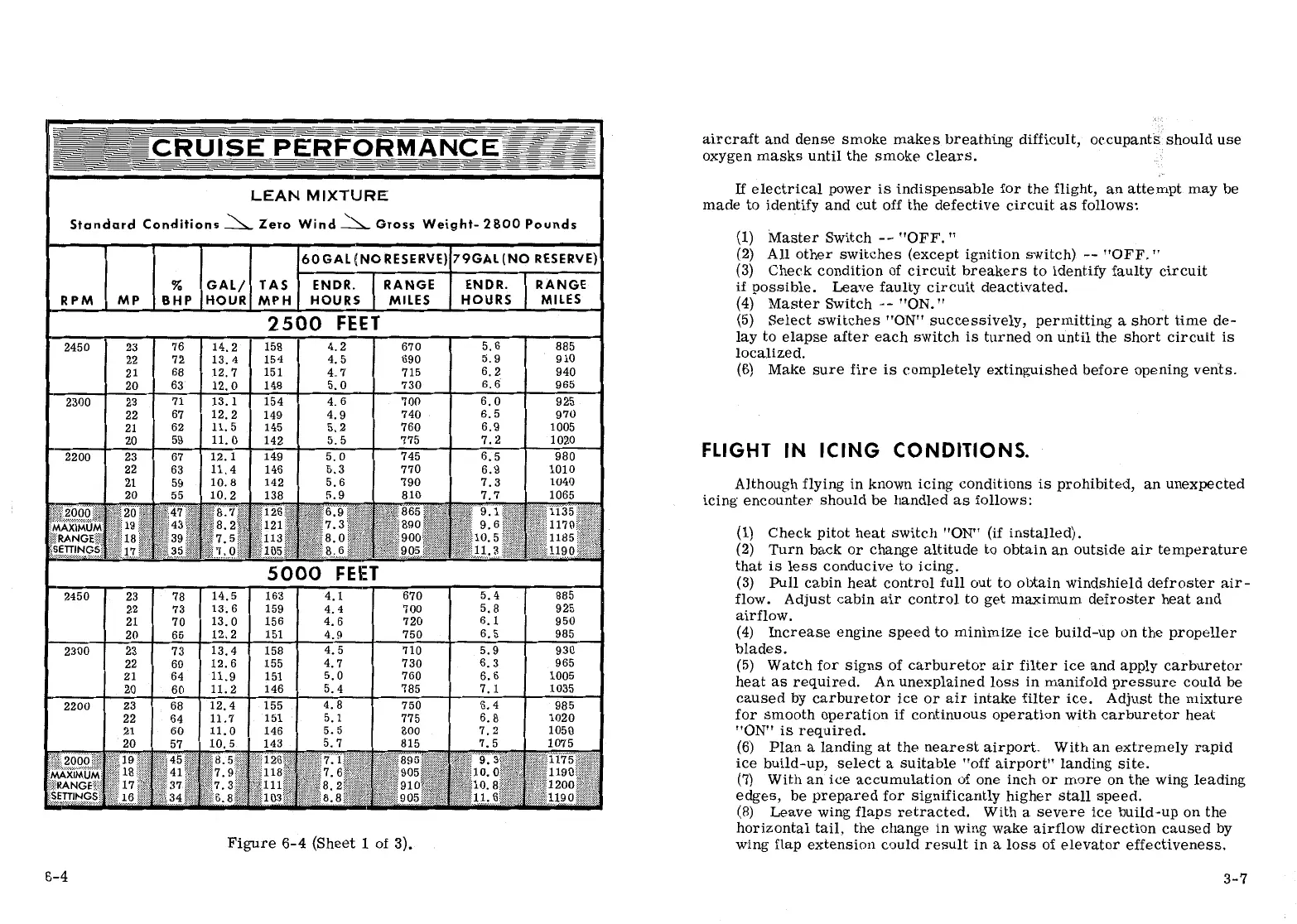
CRU
ISEPER FO RM A
NC
En
aircraft
and dense smoke
makes
breathing difficult,
occupants
should use
oxygen masks until the smoke clears.
LEAN MIXTURE
If
electrical
power
is
indispensable
for
the
flight,
an attempt
may
be
made
to
identify
and cut off the defective
circuit as follows:
Standard Conditions Zero Wind Gross
Weight-2800
Pounds
(1)
Master Switch
--
"OFF."
bOGAL(NORESERVE) 79GAL(NO
RESERVE)
(2)
All
other switches (except ignition
switch)
--
"OFF."
(3) Check condition of circuit breakers to
identify faulty
circuit
%
GAL/ TAS
ENDR. RANGE
ENDR.
RANGE
if possible.
Leave
faulty
circuit
deactivated.
RPM
MP
BHP HOUR
MPH
HOURS MILES
HOURS
MILES
(4) Master Switch
--
"ON."
2500
FEET
(5) Select switches
"ON"
successively,
permitting
a
short
time
de-
lay
to
elapse
after
each switch is turned
on
until
the short
circuit is
2450
23
76
14.2
158 4.2 670
5.6
885
22 72 13.4
154 4.5 690
5.9
910
localized.
21
68
12.7
151 4.7
715
6.2
940
(6)
Make sure fire
is
completely extinguished before
opening vents.
20
63
12.0
148 5.0 730
6.6
965
2300 23
71 13.1 154
4.6 700 6.0
925
22
67
12.2 149 4.9
740 6.5
970
21
62
11.5 145 5.2
760 6.9
1005
20
59 11.0 142 5.5 775 7.2 1020
2200
23 67 12.1
149 5.0
745
6.5
980
FLIGHT
IN
ICING CONDITIONS.
22
63
11.4
146
5.3
770
6.9 1010
21
59
10.8
142
5.6 790
7.3
1040
Although flying
in known
icing
conditions is
prohibited,
an unexpected
20
55 10.2
138
5.9
810
7.7
1065
icing encounter should be handled as follows:
2000 20
47
8.7
126
.
G.9 865
9.1 1135
G L
7
1
8
1
(1) Check
pitot
heat switch
"ON"
(if
installed).
SETTINGS
17 35
7.0
105
8.0 905
11.3
1190
(2)
Turn
back
or
change
altitude to obtain
an
outside
air
temperature
5000 FEET
that
is less
conducive
to
icing.
(3)
Pull cabin heat control full
out
to obtain
windshield
defroster
air-
2450
23 78
14.5
163 4.1
670 5.4
885
flow. Adjust cabin air
control
to get maximum
defroster
heat and
22
73
13.6
159
4.4 700
5.8
925
21
70
13.0
156
4.6
720
6.1
950
RirflOW.
20
65
12.2
151
4.9
750
6.5
985
(4)
Increase
engine speed
to
minimize ice
build-up
on
the propeller
2300 23
73
13.4
158
4.5
710
5.9 930
blades.
22
69
12.6
155
4.7
730 6.3 965
(5)
Watch
for
signs of carburetor
air
filter ice
and
apply carburetor
6
11
2
456
40 7760
766 11003055
heat as required. An unexplained loss in
manifold
pressure
could be
2200
23
68
12.4
155
4.8
750
6.4
985
caused
by
carburetor
ice or air intake filter
ice.
Adjust
the mixture
22
64
11.7
151
5.1
775
6.8 1020
for smooth operation
if
continuous operation
with
carburetor
heat
21
60 11.0
146
5.5
800
7.2 1050
"ON"
is required.
20
57
10.5
143
5.7
815 7.5 1075
(6) Plan
a landing at the
nearest
airport. With
an
extremely rapid
2000
19
45 8.
5
126
7. 1
895
9.
3
1175)
ice
build-up,
select
a suitable "off
airport"
landing
site.
(7)
With
an
ice accumulation of one
inch
or more on the
wing leading
SETTJNGS
16
34
G.8
103
8.8 905 11.6 1190
edges, be
prepared
for
significantly
higher
stall
speed.
(8)
Leave
wing
flaps retracted.
With
a
severe
ice build-up
on the
horizontal
tail, the change in
wing
wake airflow direction caused by
Figure
6-4
(Sheet 1
of 3).
wing
flap
extension could
result in
a
loss of
elevator
effectiveness.
6-4
3-7



 To Next Page