4
Safety (continued)
Safety Installation Information
1. Vehicular gate systems provide convenience and security. Gate systems are comprised of many component
parts. The gate operator is only one component. Each gate system is specically designed for an individual
application.
2. Gate operating system designers, trained gate systems technicians/installers, and users must take into account
the possible hazards associated with each individual application. Improperly designed, installed, or maintained
systems can create risks for the user as well as the bystander. Gate system design and installation must reduce
exposure to potential hazards.
3. A gate operator can create high levels of force in its function as a component part of a gate system. Therefore,
safety features must be incorporated into every gate system design. Specic safety features include:
• Instructional and Precautionary Signage
• Photoelectric Sensors (non-contact)
• Edges Sensors (contact)
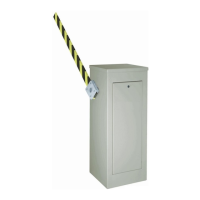
4. Install the barrier arm gate operator only when:
a. The barrier arm gate operator is appropriate for the construction and the usage class of the barrier arm.
b. All exposed pinch points are eliminated or guarded.
5. Do not install signage or anything other than the optional devices such as LEDs, foam edging, edge sensor, or
wireless transmitter recommended by the manufacturer, on the barrier arm.
6. The barrier arm gate operator is intended for installation only on passageways used for vehicles. Pedestrians
must be supplied with a separate access opening. The pedestrian access opening shall be designed to promote
pedestrian usage.
7. Locate the barrier arm gate operator such that persons will not come in contact with the barrier arm during the
entire path of travel of the barrier arm.
8. The barrier arm gate operator must be installed in a location so that enough clearance is supplied between the
barrier arm and adjacent structures when opening and closing to reduce the risk of entrapment. When the break
away arm bracket is utilized, ensure it does not open into pedestrian walkways.
9. Permanently mounted access controls intended for users to activate the barrier arm, must be located at least 6
feet (1.8 m) away from any moving part of the barrier arm gate operator system and where the user is prevented
from reaching over, under, around or through the gate system to operate the controls. Outdoor or easily
accessible controls shall have a security feature to prevent unauthorized use. Exception: Emergency access
controls, only accessible by authorized personnel (e.g. re, police, EMS), may be placed at any location in the line-
of-sight of the gate.
10. For a gate operator utilizing a Stop and/or Reset button, it must be located in the line-of-sight of the gate.
Activation of the reset control shall not cause the operator to start.
11. A minimum of two (2) WARNING SIGNS shall be installed in the area of the barrier arm. Each warning sign is to be
visible by persons located on the side of the barrier arm on which the sign is installed. Two (2) WARNING SIGNS
are provided with this operator. See page 40.
12. When a hard wired contact sensor is installed it shall be located and its wiring arranged so the communication
between the sensor and the gate operator is not subject to mechanical damage. A wireless edge transmitter kit
must be used with the contact edge sensor.
13. A wireless device such as one that transmits radio frequency (RF) signals to the gate operator shall be located
where the transmission of the signals is not obstructed or impeded by building structures, natural landscaping or
similar obstruction. A wireless device shall function under the intended end-use conditions.
Role of Dealers, Installers, and Trained Gate System Technicians
• Ensure entire barrier arm gate sytem is designed, manufactured and installed to meet all applicable standards and
codes including UL 325.
• Demonstrate the basic functions and safety features of the barrier arm gate system to owners/end users/general
contractors, including how to turn o power.
• Leave safety instructions, product literature, installation manual, and maintenance manual with end user.
• Explain to the end users and property owners the importance of testing by a trained gate system technician
that includes a routine re-testing of the entire system, including any safety devices, and explain the need for the
owners to ensure that this testing is performed monthly.


 To Next Page
 Loading...