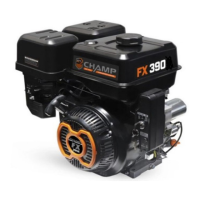
This document is an owner's manual for the Champ FX200 and FX200E engines, providing detailed information on operation, maintenance, and parts breakdown. The manual emphasizes safety, proper usage, and regular servicing to ensure optimal performance and longevity of the engine.
The Champ FX200 and FX200E are single-cylinder, forced air-cooled, 4-stroke, OHV (Overhead Valve) gasoline engines. The "E" designation likely indicates an electric start option, in addition to the standard recoil start. These engines are designed for a variety of applications, given their general-purpose nature and the inclusion of a PTO (Power Take-Off) shaft.
Important Technical Specifications:
- Model: FX200 (E)
- Bore x Stroke: 68 x 54 mm
- Displacement: 196 CC (Cubic Centimeters)
- Compression Ratio: 8.7:1
- Net Power: 4.1 Kw (5.5 HP) at 3600 RPM
- Net Torque: 11 N.m at 2500 RPM
- PTO Shaft Rotation: Counter Clockwise
- Ignition System: Transistorized magneto ignition
- Lubrication System: Forced splash
- Carburetor: Flat suction valve carburetor
- Governor System: Centrifugal mechanical
- Engine Type: Forced air-cooling 4 stroke, OHV
- Starting System: Recoil/Electric start (for FX200E)
- Fuel Tank Capacity: 3.6 Liters
- Engine Oil Capacity: 0.55 Liters
- Fuel Consumption: ≤380 g/Kw.h
- Dimensions (LxWxH): 390 x 320 x 345 mm
- Net Weight: 15/17 Kg (likely 15 Kg for FX200, 17 Kg for FX200E due to electric start components)
Usage Features:
The manual outlines a clear operational procedure for starting and stopping the engine.
- Pre-operation Check: Before starting, users must check the engine oil level and the air cleaner.
- Engine Oil: The manual recommends using 4-stroke oil, specifically a high-detergent, premium quality motor oil certified to meet or exceed U.S. automobile manufacturer's requirements for Service classification SG•SF/CC•CD. SAE 10W-30 is recommended for general, all-temperature use, with a chart provided for other viscosities based on average temperature. The oil level should be checked using the dipstick, ensuring it reaches the top of the oil filler neck without screwing in the dipstick. An Oil Alert System is integrated to stop the engine if oil levels fall below a safe limit.
- Air Cleaner: The air cleaner should be clean to prevent restricted airflow to the carburetor. Running the engine without the air cleaner can lead to rapid engine wear due to contaminants.
- Fuel: The engine is designed to use gasoline with an octane number of 86 or higher. Gasoline pumps at service stations normally display the pump octane number. Lead-free fuel is recommended to reduce engine and spark plug deposits. Users are warned against using stale or contaminated gasoline or an oil/gasoline mixture. Lower octane gasoline can cause "pinging" or "spark knock," leading to engine damage.
- Gasolines Containing Alcohol: The manual advises caution with gasolines containing alcohol (gasohol), noting that up to 10% ethanol is acceptable. It warns against using gasoline containing more than 5% methanol, as it can cause corrosion and operating problems. If issues arise with alcohol-containing fuels, switching to gasoline without alcohol is recommended.
- Starting the Engine:
- Turn the fuel valve to the ON position.
- Move the choke lever to the CLOSE position (unless the engine is warm or the air temperature is high).
- Move the throttle lever slightly to the left.
- For recoil start, turn the engine switch to ON, then pull the starter grip lightly until resistance is felt, and pull briskly.
- As the engine warms up, gradually move the choke lever to the OPEN position.
- Position the throttle lever for the desired engine speed.
- Stopping the Engine:
- Move the throttle lever fully to the right.
- Turn the engine switch to the OFF position.
- Turn the fuel valve to the OFF position.
Maintenance Features:
The manual provides a comprehensive maintenance schedule and instructions for key service items, emphasizing the importance of periodic maintenance for good operating condition.
- Safety First: All maintenance should be performed with the engine shut off. If the engine must run, it should be in a well-ventilated area due to poisonous carbon monoxide in the exhaust.
- Genuine Parts: Users are advised to use only genuine Champ parts or their equivalent to avoid engine damage.
- Maintenance Schedule: A table outlines the frequency for various checks and services:
- Each Use: Check oil level, reduction gear oil level, and air cleaner.
- 25 Hours: Change reduction gear oil.
- 50 Hours: Change engine oil, clean sediment cup, clean spark arrester.
- 100 Hours: Change air cleaner, clean spark plug, check valve clearance.
- 300 Hours: Change air cleaner, clean fuel tank strainer.
- Every 2 Years: Check fuel line.
- Note: More frequent service is required in dusty areas. Items marked with an asterisk should be serviced by an authorized dealer unless the owner is mechanically proficient.
- Change Oil: Drain oil while the engine is warm. Remove the oil filler cap and drain plug, then reinstall the drain plug securely. Refill with recommended oil and check the level. Warnings are given regarding skin contact with used motor oil and proper disposal.
- Air Cleaner Service: A dirty air cleaner restricts airflow.
- Unscrew the wing nut, remove the air cover and element.
- Wash the element in a solution of household detergent and warm water, or nonflammable/high flash point solvent. Rinse and dry thoroughly.
- Soak the element in clean engine oil and squeeze out the excess. (Initial smoke may occur if too much oil is left).
- Reinstall the element and cover.
- Warning: Never use gasoline or low point solvents for cleaning the air cleaner element due to fire/explosion risk.
- Sediment Cup Cleaning:
- Turn the fuel valve to OFF.
- Remove the sediment cup and O-ring, wash with nonflammable/high flash point solvent, dry, and reinstall securely.
- Turn the fuel valve ON and check for leaks.
- Warning: Gasoline is flammable and explosive; no smoking or sparks in the area.
- Spark Plug Service:
- Remove the spark plug cap and use a wrench to remove the plug.
- Inspect the plug for cracks/chips; clean with a wire brush if reusing.
- Measure the plug gap (0.7-0.8 mm / 0.028-0.031 in) with a feeler gauge.
- Check the washer, thread the plug in by hand, then tighten with a wrench to compress the washer.
- Warning: Use only recommended spark plugs; improper heat range can damage the engine.
- Spark Arrester Maintenance (Optional Part): The muffler is hot after operation. Remove two 8mm nuts and one 4mm screw to remove the muffler from the cylinder. Remove three 4mm screws from the exhaust deflector and remove the deflector. Remove four 5mm screws from the muffler protector and remove the protector. Remove the 4mm screw from the spark arrester (optional) and remove the spark arrester from the muffler.
- Notice: Be careful not to damage the spark arrester screen.
Transporting & Storage:
- Transporting: To avoid burns or fire hazards, let the engine cool before transporting. Keep it indoors. Turn the fuel valve to the OFF position and keep the engine level to prevent fuel spillage.
- Storage:
- Store in an area free of excessive humidity and dust.
- Drain the fuel.
- Change the engine oil.
- Remove the spark plug and pour a tablespoon of clean engine oil into the cylinder. Crank the engine several revolutions to distribute the oil, then reinstall the spark plug.
- Pull the starter rope slowly until resistance is felt. Continue pulling until the notch on the starter pulley aligns with the hole on the recoil starter (see illustration). This closes the intake and exhaust valves, protecting the engine from internal corrosion.
- Cover the engine to keep out dust.
Troubleshooting:
A table provides common problems, possible causes, and probable solutions:
- Engine will not start: Out of fuel (add fuel), Engine Flooded (set choke to OPEN/RUN, pull starter handle).
- Engine stops suddenly: Low oil shutdown (fill engine oil), Fuel tank empty or impure/low quality gasoline (fill with fresh 90+ gasoline).
- Engine Knocks: Engine overload (do not exceed equipment's load rating).
Warranty Service:
Warranty service is available at the dealership where the equipment was purchased. For unresolved issues, users are advised to first discuss with the dealership's service department, then the service manager, and finally the owner or general manager. If the problem persists, the manual requests specific information (Name, Address, Phone, Engine Model, Date of Purchase, Dealer info, Nature of Problem) to assist further.
Parts Breakdown:
The manual includes detailed exploded diagrams and parts lists for various engine subassemblies, including:
- Head Subassembly, Cylinder/Spark Plug
- Crankcase/Gear Assy/Governor
- Cover Subassembly Crankcase
- Rod Crankshaft
- Ring Set Oil/Rod Crankshaft
- Valve Train/Camshaft Subassembly
- Starter Recoil
- Electric Start Motor (200E)
- Carburetor Assembly
- Air Cleaner
- Muffler Assembly
- Fuel Tank Assembly
- Flywheel/Impeller/Starter Pulley/Ignition Coil
- Throttle Control Assembly
Each part list includes a reference number, part number (e.g., CH78305, FX200-003), description, and quantity. This section is crucial for identifying and ordering replacement parts.

 Need help?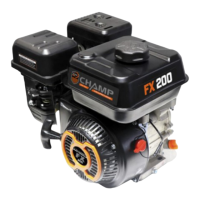

 To Next Page
 General