The Checkme O2 Max is a smart wrist pulse oximeter designed for measuring, displaying, and storing pulse oxygen saturation (SpO2), pulse rate, and motion. It is intended for use in home or healthcare facilities environments. The device works in conjunction with an accompanying app that can show real-time SpO2 and pulse rate, as well as retrieve, display, and report recorded results.
Function Description
The primary function of the Checkme O2 Max is to monitor blood oxygen saturation (SpO2) and pulse rate. It is a pre-check screening device, and the data it provides, whether through the app or optional PC software, is not intended for diagnosis or treatment. Users should always consult their doctor for any health condition. The device also tracks motion, which can influence the accuracy of SpO2 measurements.
The device is designed to determine the arterial oxygen saturation percentage of functional hemoglobin. Factors that may degrade its performance or affect measurement accuracy include excess ambient light, excessive motion, electrosurgical interference, blood flow restrictors (such as arterial catheters, blood pressure cuffs, or infusion lines), moisture in the sensor, improperly applied sensors, incorrect sensor types, poor pulse quality, venous pulsations, anemia or low hemoglobin concentrations, cardiogreen and other intravascular dyes, carboxyhemoglobin, methemoglobin, and dysfunctional hemoglobin.
Usage Features
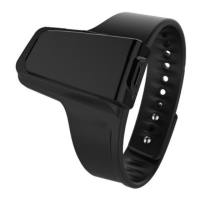
The Checkme O2 Max consists of a main unit, a wristband, a ring sensor, and a charging cable.
- Power On/Off: To turn on the device, press the power button for 1 second. The device will automatically power off after 2 minutes if there is no measurement, no operation, or no app connection. To manually power off, press the button for about 2 seconds.
- Wearing the Device: For the first recording, users should wear the monitor watch on their left wrist and place the ring sensor on the thumb. If the sensor feels too tight, another finger can be used, but it's important to avoid a loose fit. During recording, it's crucial to avoid excessive motion of the sensed finger and strong ambient light conditions to ensure accurate readings.
- Recording: After wearing the device and ring sensor and powering it on, the device will begin recording in a quiet environment. If the working time is less than 1 minute, the data will not be saved. Once a recording is complete, taking off the ring sensor (and the device) will initiate a countdown, after which the recording will be saved. If the sensor is worn again during the countdown, the record will resume.
- Data Storage: The device can collect and store a maximum of 4 recordings. When a 5th recording is initiated, the first recording will be overwritten. The duration of a single recording can range from 1 minute to 10 hours.
- Screen Display: The device's screen displays various items, including SpO2, pulse rate, an icon indicating to wear the sensor, time, remaining battery capacity, and alert status (on/off). It also shows an icon for Bluetooth connection status.
- Alerts: The monitor supports vibration reminders when it detects low blood oxygen or an abnormal pulse rate. These vibration reminders can be customized after the monitor is powered on, or the vibration intensity can be configured using the app. Sound reminders can only be configured through the app.
- App Connectivity (ViHealth App): The Checkme O2 Max connects to the ViHealth App via Bluetooth. Data can be synced to the app after the recording countdown or the next time the device is turned on. The app allows users to view data, display results, and generate reports. The device's Bluetooth is automatically enabled when the device is on. It's important not to pair the device directly in the smart device's settings. The app is compatible with iOS versions 9.0+ (iPhone 4s/iPad 3 or above) and Android versions 5.0+ (with Bluetooth 4.0 BLE).
- PC Software (O2 Insight Pro): Optional PC software, O2 Insight Pro, is available for Windows PC and Mac. Users can download data from the device to the software via a supplied USB cable. With the PC software, users can view and print reports, which can also be exported as PDF or CSV files. For Mac users, the device connects by turning on the device and the Bluetooth of the Mac, then using the "Connect" and "Download" functions within the O2 Insight Pro software.
- Time Synchronization: The monitor's time is automatically synchronized with the network time on the smart device once connected to the app.
- Serial Number: The serial number of the device can be found by detaching the main unit from the wristband and flipping it over; the number is printed on the product label.
Maintenance Features
- Charging: The battery should be charged before use. The device can be charged using the supplied charge cable connected to a computer's USB port or a USB charging adapter. The device will automatically power off once fully charged.
- Battery Maintenance: To maintain the battery in good condition, it should be charged every 6 months when the device is not in use.
- Cleaning: The device surface can be cleaned using a soft cloth moistened with water or alcohol.
- Sensor Care: It is crucial not to squeeze the sensor or apply excessive force to the sensor and cable. The device should never be submerged in water or other liquids. Cleaning the device with acetone or other volatile solutions is prohibited. The device should not be placed in pressure vessels or gas sterilization devices.
- Continuous Monitoring: Prolonged continuous SpO2 monitoring may increase the risk of skin irritation, reddening, blistering, or burns. The SpO2 sensor application site should be checked every 6-8 hours to assess sensor positioning, circulation, and skin sensitivity. For patients with poor peripheral blood circulation or sensitive skin, the sensor site should be inspected more frequently.
- Accessory Use: Only cables, sensors, and other accessories specified in the manual should be used. Using unauthorized accessories may lead to increased electromagnetic emission or decreased electromagnetic immunity.


 To Next Page
 General