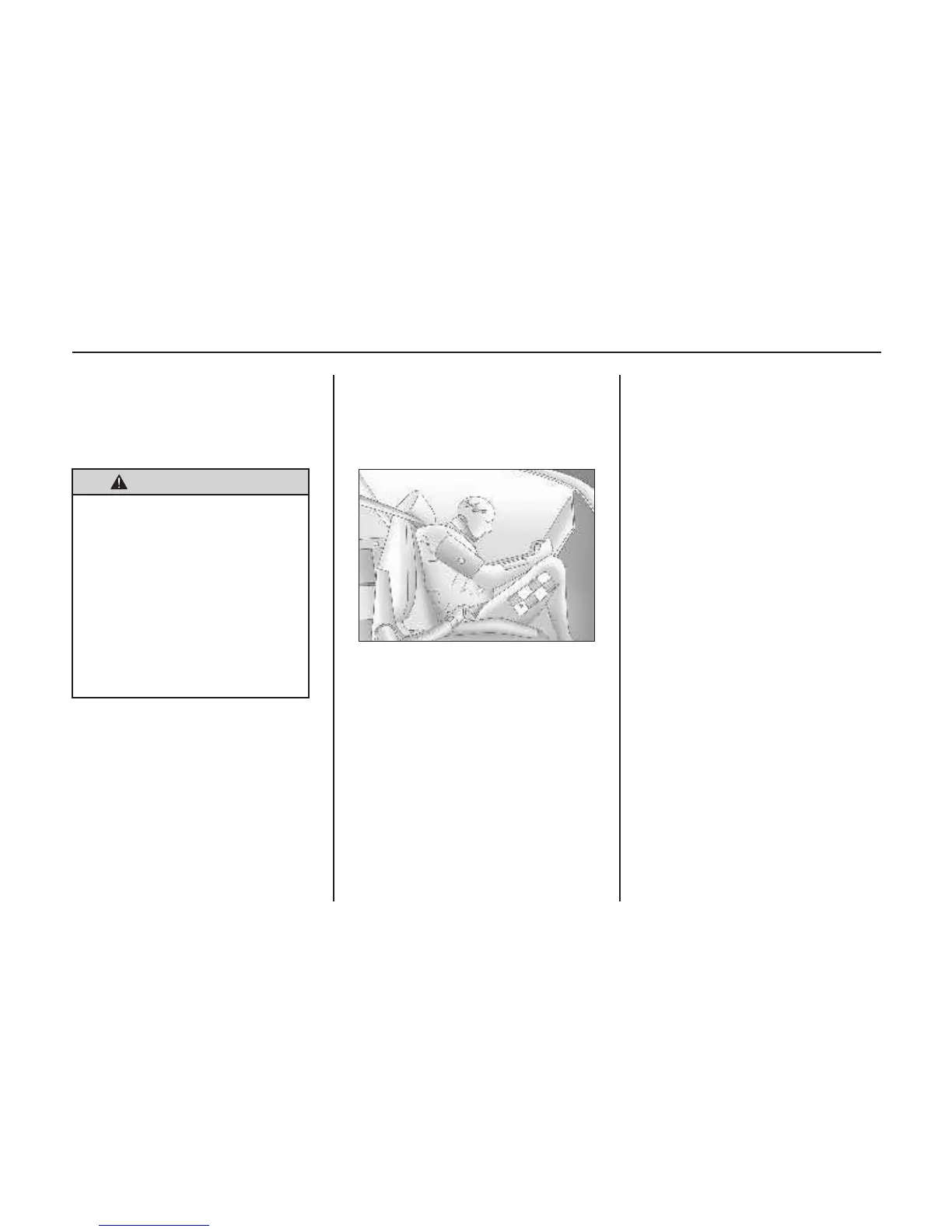
Why Safety Belts Work
When riding in a vehicle, you travel as
fast as the vehicle does. If the vehicle
stops suddenly, you keep going until
something stops you. It could be the
windshield, the instrument panel, or the
safety belts!
When you wear a safety belt, you and
the vehicle slow down together. There
is more time to stop because you stop
over a longer distance and, when worn
properly, your strongest bones take the
forces from the safety belts. That is why
wearing safety belts makes such good
sense.
Questions and Answers About Safety
Belts
Q: Will I be trapped in the vehicle
after a crash if I am wearing a
safety belt?
A: You could be - whether you are
wearing a safety belt or not. Your
chance of being conscious during
and after a crash, so you can
unbuckle and get out, is much
greater if you are belted.
Q: If my vehicle has airbags, why
should I have to wear safety
belts?
A: Airbags are supplemental systems
only, so they work with safety belts
- not instead of them. Whether or
not an airbag is provided, all
occupants still have to buckle up to
get the most protection.
Also, in nearly all regions, the law
requires wearing safety belts.
Seats and Restraints 2-15
It is extremely dangerous to ride in a
cargo area, inside or outside of a
vehicle. In a collision, passengers
riding in these areas are more likely
to be seriously injured or killed. Do
not allow passengers to ride in any
area of the vehicle that is not
equipped with seats and safety belts.
Always wear a safety belt, and check
that all passenger(s) are restrained
properly too.
This vehicle has indicators as a remi-
nder to buckle the safety belts. See
Safety Belt Reminder on page 4-16 for
additional information.
Warning (Continued)
ION
UP-SHIFT LIGHT
The vehicle may have an up-shift light.
When this light comes on, shift to the
next higher gear if weather, road, and
traffic conditions allow.



 To Next Page