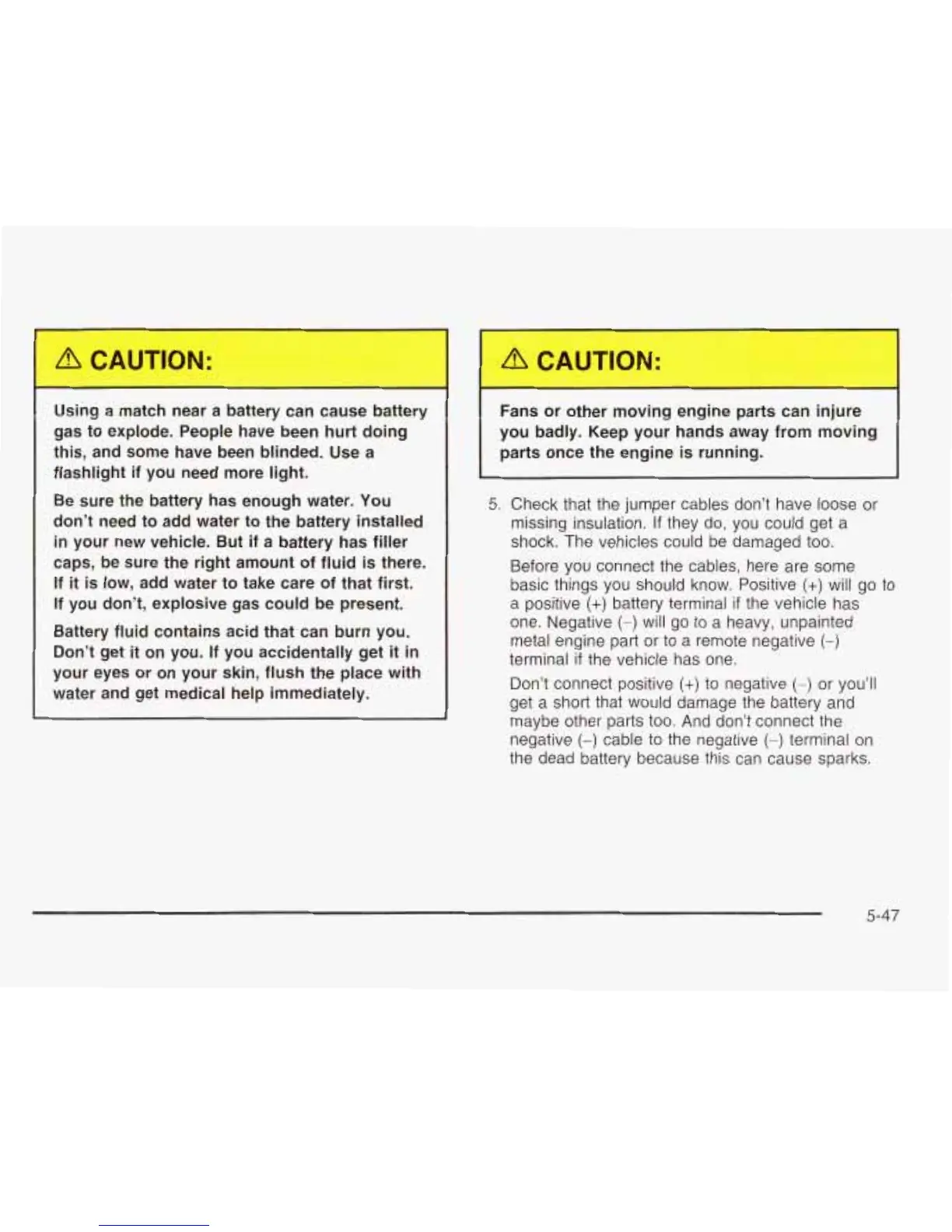
Using
a
n.xh near a battery can cause bL2ery
gas to explode. People have been hurt doing
this, and some have been blinded. Use a
flashlight
if
you need more light.
Be sure the battery has enough water. You
don’t need to add water to the battery installed
in
your new vehicle. But
if
a battery has filler
caps, be sure the right amount of fluid is there.
If
it
is
low, add water to take care of that first.
If you don’t, explosive gas could be present.
Battery fluid contains acid that can burn you.
Don’t get
it
on you.
If
you accidentally get
it
in
your eyes or on your skin, flush the place with
water and get medical help immediately.
Fans
c
)ther moving engine parts can
ir
re
you badly. Keep your hands away from moving
parts once the engine is running.
5.
Check that the jumper cables don’t have loose or
missing insulation. If they do,
you
could get a
shock. The vehicles could be damaged too.
Before you connect the cables, here are some
basic things you should know. Positive
(+)
will go to
a positive
(+)
battery terminal
if
the vehicle has
one. Negative
(-)
will go
to
a heavy, unpainted
metal engine part or
to
a remote negative
(-)
terminal
if
the vehicle has one.
Don’t connect positive
(+)
to
negative
(-)
or
you’ll
get a short that would damage the battery and
maybe other parts
too.
And don’t connect the
negative
(-)
cable
to
the negative
(-)
terminal on
the dead battery because this can cause sparks.
5-47







 To Next Page