
 Need help?
Do you have a question about the Chicago Pneumatic CPVS 30 and is the answer not in the manual?
Provides technical specifications for standard CP compressor models, including pressure, flow, and power.
How to adjust the factory-set maximum delivery pressure to meet specific requirements.
Information regarding fire safety protocols and the appropriate use of CO2 extinguishers.
Description of the air and oil flow paths and components within the compressor.
Explanation of the automatic on/off control system and pressure regulation.
Overview of the ES 3000 electronic controller's display, buttons, and functions.
Specific safety rules and warnings applicable to CPVS models, particularly concerning the inverter.
Steps for commissioning CPVS models, covering start-up, rotation check, and pressure settings.
Detailed procedure for checking and changing the compressor oil and oil filter.
Instructions for checking the condition and replacing the air filter cartridge.
Lists common compressor defects, their likely causes, and recommended solutions for repair.
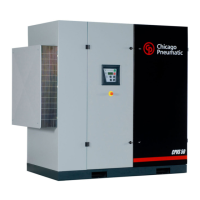
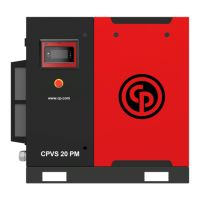
The Chicago Pneumatic Compressor is a self-contained, complete, and fully tested assembly, designed for industrial use. It is driven by an electric motor and enclosed in an acoustic canopy, which also ensures proper cooling of the internal components. This compressor is an oil-cooled, single-stage, helical screw-type unit, featuring a vertical mounted receiver for pre-separating and storing oil and air. The air-oil mixture is then further separated by means of a separator cartridge. Both the compressor and the motor are directly fixed on the frame using anti-vibration pads to minimize noise and vibration during operation.
The compressor's primary function is to provide compressed air for various industrial applications. Air is drawn into the compressor through a filter, where it is mixed with oil during compression. Inside the tank, the compressed air is separated by shocks and then flows through an oil separator. Subsequently, it passes through a minimum pressure valve, which includes a check valve, a final cooler, and a condensate separator, before being delivered to the distribution pipes via an outlet valve (not supplied).
The oil circuit ensures proper lubrication and cooling. Oil, under discharge pressure, flows from the bottom of the tank through a cooler and an oil filter, which retains solid particles, before entering the compressor. During cold starts, a thermostatic valve short-circuits the oil cooler to quickly achieve the optimum operating temperature. After leaving the compressor element, the oil returns to the tank. Any oil mist suspended in the air passes through the oil separator, where it agglomerates into large droplets and returns to the tank by gravity. The remaining oil, separated by the last stage of the oil separator, is drawn up by a dip tube and dispatched back to the compressor.
The compressor is equipped with an ES 3000 electronic controller, which manages its operation and provides control and diagnostic information. This controller allows for precise adjustment of delivery pressure and facilitates parallel operation with other compressors. It also includes safety features such as thermal protection for the motor, an air temperature sensor to prevent overheating, and a pressure sensor to prevent excessive pressure buildup.
For variable speed models (CPVS), the ES 3000 controller adjusts the motor and compressor speed based on the system pressure. If the mains pressure is weaker than the set point, the motor accelerates to increase pressure. Conversely, if the mains pressure is stronger, the motor slows down to reduce pressure. This variable speed control ensures accurate adjustment of the compressor's flow rate to match compressed air demand, optimizing energy efficiency. For low flow rates, the machine uses time-delayed START/STOP controls, running at minimum speed until the pressure reaches an "Indirect shutdown" threshold, then stopping and entering stand-by mode.
The compressor is designed for operation in a frost-free environment with ambient temperatures between 36°F and 104°F. It requires a minimum of 1 meter space around it for cleaning and maintenance. Proper ventilation is crucial, with sufficient fresh air supply and provisions for discharging warm air outside if ambient temperatures exceed 104°F. In dusty environments, pre-filtering the room's air intake and using a special filter on the machine's ventilation inlets are recommended.
The unit does not require special foundations, only a stable industrial floor capable of supporting its weight. The air discharge piping should have a diameter at least equal to 1" NPT of the gas piping, and a lockable valve must be installed at the compressor outlet for isolation during servicing.
Electrical connections must comply with specified voltage and current ratings (208V/60Hz, 230V/60Hz, 460V/60Hz) and include an earth socket and a clearly visible manual isolating switch to cut all three phases. The electric current must be cut off before any maintenance work.
The ES 3000 electronic controller features a control keyboard and a display for main safety and control indications. It allows users to view compressor pressure, temperature, total operating hours, and hours charged. It also provides warnings for maintenance requirements, such as replacing oil or air filters, and indicates operational status through LED lights (RED for alarms, YELLOW for warnings, GREEN for normal operation). The controller is programmed for Energy Saving, switching off the compressor after an unloaded period to minimize idle running.
For variable speed units (CPVS), the phase controller option provides permanent verification of the rotation direction of the machine via an LED, preventing start-up in case of phase reversal or disconnected phases, thus avoiding physical damage.
Regular maintenance is essential for the compressor's efficiency and longevity. The maintenance schedule includes weekly, 150-hour, 500-hour, 2,000-hour (Service A), 4,000-hour (Service B), 8,000-hour (Service C), and 12,000-hour operations.
Key maintenance tasks include:
The ES 3000 controller assists in maintenance by displaying operating hours for components requiring service and allowing users to reset maintenance meters after tasks are completed.
For decommissioning, the compressor must be stopped, disconnected from the electric supply, unloaded, and drained of oil and condensates before being disconnected from the air network and condensate draining system. All used components (waste oil, filters, separators) and the machine as a whole must be disposed of according to national and local regulations to ensure environmental protection.
 General
| Brand | Chicago Pneumatic |
|---|---|
| Model | CPVS 30 |
| Category | Air Compressor |
| Language | English |


 To Next Page
