EasyManua.ls Logo

Cincinnati 175 CB - Types of dies

Default Icon
32 pages
Print Icon
To Next Page IconTo Next Page
To Previous Page IconTo Previous Page
Loading...
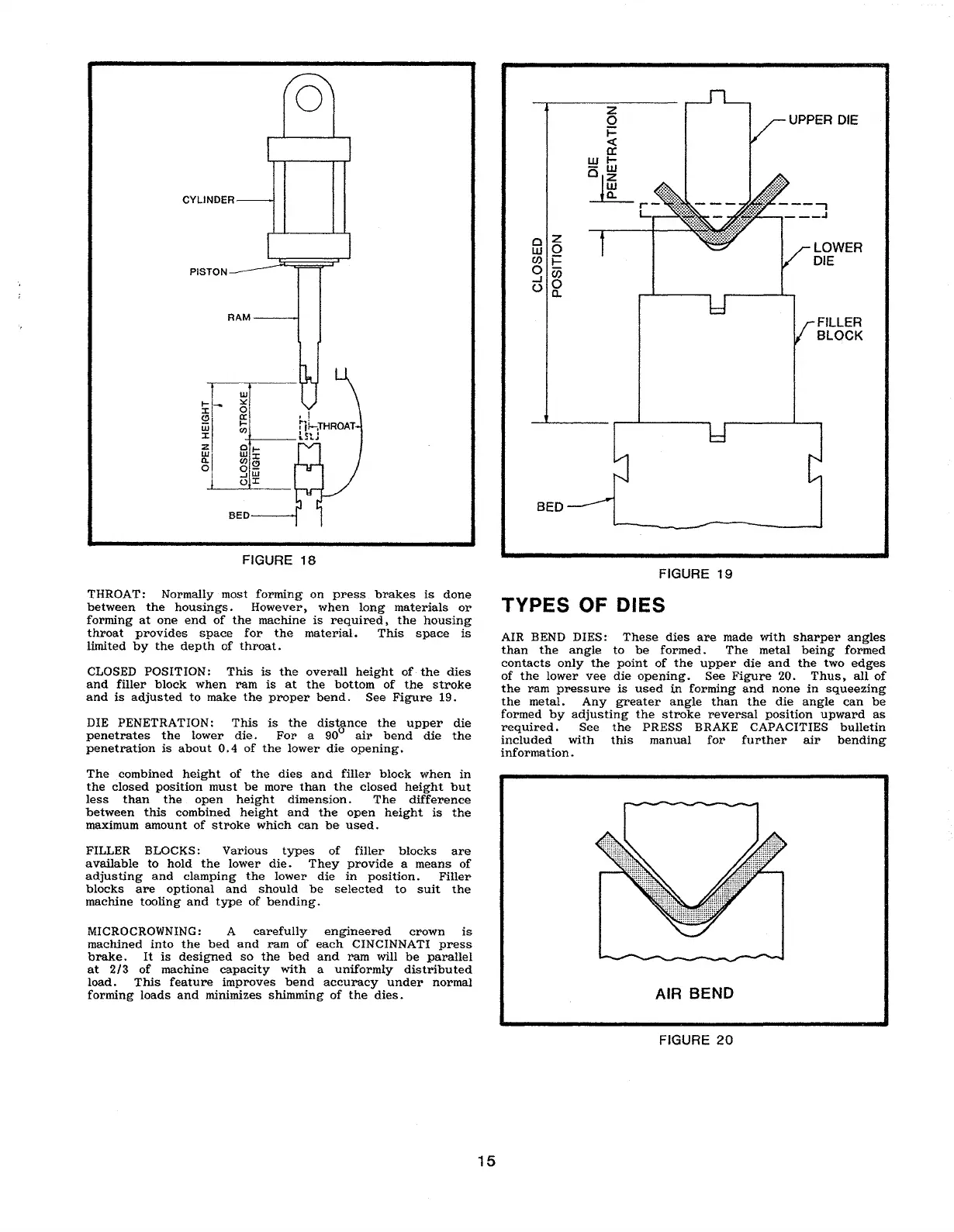
CYLINDER
RAM
FILLER
BLOCK
LOWER
DIE
UPPER
DIE
o Z
W 0
(J)i=
°00
..J 0
0a.
PISTON
o
BED
BED
rr-;;r-,,_
~
~r
~l
~,!
Wi
~
,,~;rHROAT
J:
-+--
l StJ
ffi·
~
....
0..
(f)J:
o
g~
OJ:
FIGURE
18
FIGURE
19
THROAT:
Normally
most
forming
on
press
brakes
is
done
between
the
housings.
However,
when
loltg
materials
or
forming
at
one
end
of
the
machine
is
required,
the
housing
throat
provides
space
for
the
material.
This
space
is
limited
by
the
depth
of
throat.
CLOSED
POSITION:
This
is
the
overall
height
of·
the
dies
and
filler
block
when
ram
is
at
the
bottom
of
the
stroke
and
is
adjusted
to
make
the
proper
bend.
See
Figure
19.
DIE PENETRATION:
This
is
the
distance
the
upper
die
penetrates
the
lower
die.
For
a
90°
air
bend
die
the
penetration
is
about
0.4
of
the
lower
die
opening.
The
.
combined
height
of
the
dies
and
filler
block
when
in
the
closed
position
must
be
more
than
the
closed
height
but
less
than
the
open
heigh
t
dimension.
The
difference
between
this
combined
height
and
the
open
height
is
the
maximum
amount
of
stroke
which
can
be
used.
FILLER BLOCKS:
Various
types
of
filler
blocks
are
available
to
hold
the
lower
die.
They
provide
a
means
of
adjusting
and
clamping
the
lower
die
in
position.
Filler
blocks
are
optional
and
should
be
selected
to
suit
the
machine
tooling
and
type
of
bending.
MICROCROWNING: A
carefully
engineered
crown
is
machined
into
the
bed
and
ram
of
each
CINCINNATI
press
brake.
It
is
designed
so
the
bed
and
ram
will
be
parallel
at
2/3
of
machine
capacity
with
a
uniformly
distributed
load.
This
feature
improves
bend
accuracy
under
normal
forming
loads
and
minimizes
shimming
of
the
dies.
TYPES OF DIES
AIR BEND
DIES:
These
dies
are
made
with
sharper
angles
than
the
angle
to
be
formed.
The
metal
being
formed
contacts
only
the
point
of
the
upper
die
and
the
two
edges
of
the
lower
vee
die
opening.
See
Figure
20.
Thus,
all
of
the
ram
pressure
is
used
in·
forming
and
none
in
squeezing
the
metal.
Any
greater
angle
than
the
die
angle
can
be
formed
by
adjusting
the
stroke
reversal
position
upward
as
required.
See
the
PRESS
BRAKE
CAPACITIES
bulletin
included
with
this
manual
for
further
air
bending
information.
AIR BEND
FIGURE
20
15

Related product manuals