EasyManua.ls Logo

Cincinnati 175 CB - Punching Capacity; Stripping Capacity

Default Icon
32 pages
Print Icon
To Next Page IconTo Next Page
To Previous Page IconTo Previous Page
Loading...
BOTTOMING
DIES:
The
primary
purpose
of
bottoming
dies
is
to
provide
greater
accuracy
than
air
bend
dies.
They
can
also
be
used
to
obtain
a
relatively
sharp
inside
corner.
They
are
made
in
matched
pairs,
according
to
the
thickness
of
the
stock
to
be
formed
and
radius
required.
See
Figure
21.
These
dies
require
three
to
ten
times
as
much
pressure
as
air
bend
dies.
Other
types
of
bottoming
dies
are
coining
dies,
used
to
obtain
a
sharp
inside
radius,
multiple
bend
and
channel
dies,
and
radius
bend
dies.
DIE
SETS
Special
care
should
be
taken
when
operating
die
sets
with
guide
pins
and
bushings.
The
top
stop
position
should
be
set
so
the
bushings
never
leave
the
guide
pins
when
the
ram
makes
an
UP
STROKE.
Re-entry
of
the
guide
pins
in
to
the
bushings
may
be
difficult,
if
not
impossible.
PUNCHING
CAPACITY
CINCINNATI
Hydraulic
Press
Brakes
are
rated
to
perform
punching
loads
up
to
66%
of
the
maximum
machine
capacity
when
punching
mild
steel
using
self-contained
units
on
an
occasional
basis.
When
punching
is
to
be
performed
on
a
continuous
production
basis,
with
dedicated
die
sets
or
high
tensile
(70,000
PSI)
material
is
to
be
processed,
the
punching
capacity
is
reduced
to
50%
of
the
maximum
machine
capacity,
Figure
23.
Additional
punching
capacity
can
be
obtained
by
stepping
the
punches
(Figure
24)
on
multiple
levels.
For
special
punching
applications,
where
die
sets
or
special
machine
features
(for
example,
wide
bed,
deep
throat,
etc.)
are
required,
consult
CINCINNATI
INCORPORATED.
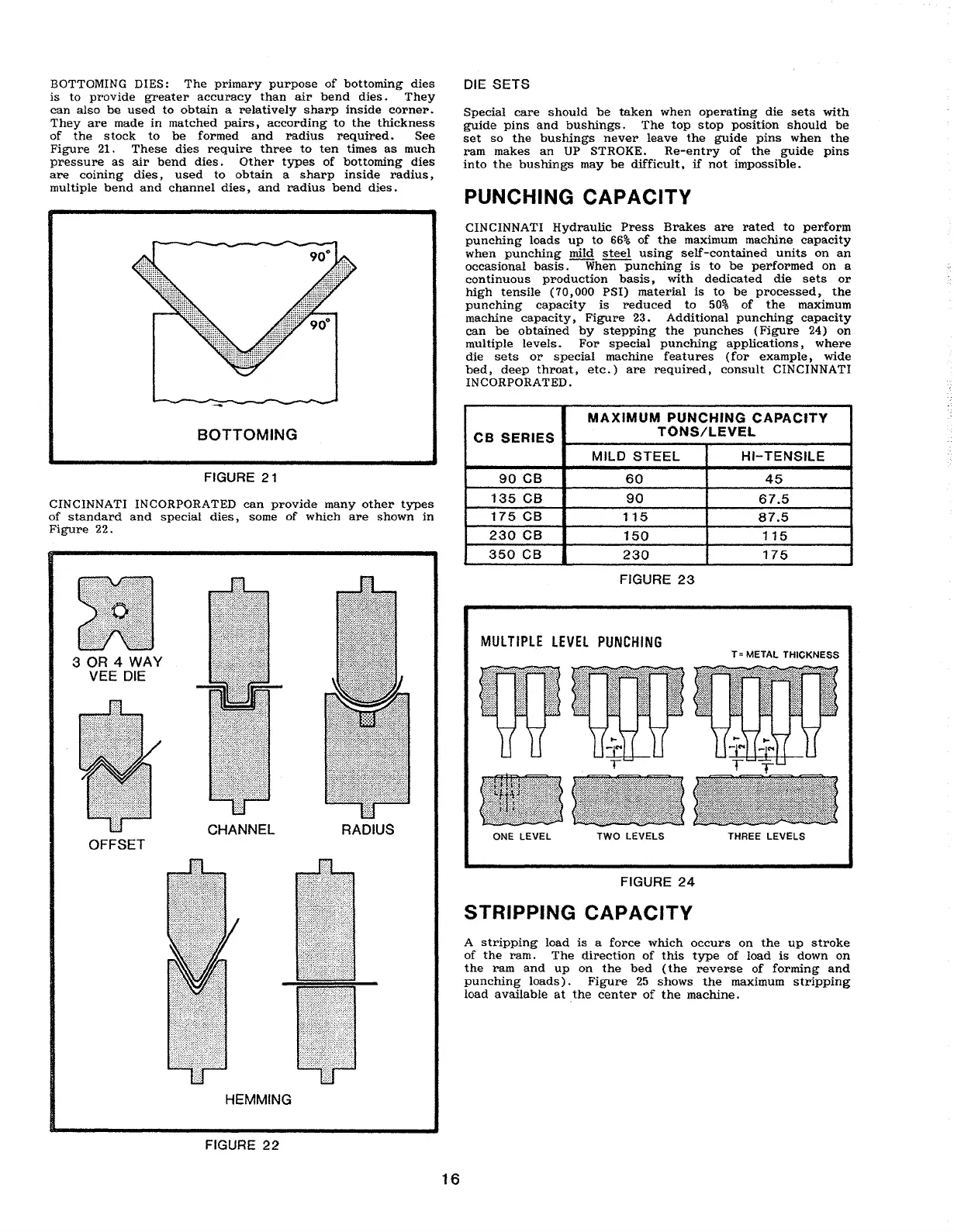
BOTTOMING
FIGURE 21
CINCINNATI
INCORPORATED
can
provide
many
other
types
of
standard
and
special
dies,
some
of
which
are
shown
in
Figure
22.
MAXIMUM
PUNCHING
CAPACITY
CB
SERIES
TONS/LEVEL
MILD
STEEL
HI-TENSILE
90
CB
60
45
135
CB
90
67.5
175
CB
115
87.5
230
CB
150
115
350
CB
230
175
T=
METAL THICKNESS
THREE
LEVELS
TWO
LEVELS
ONE
LEVEL
FIGURE
23
MULTIPLE
lEVEL
PUNCHING
RADIUSCHANNEL
OFFSET
3 OR 4
WAY
VEE DIE
FIGURE
24
STRIPPING
CAPACITY
A
stripping
load
is
a
force
which
occurs
on
the
up
stroke
of
the
ram.
The
direction
of
this
type
of
load
is
down
on
the
ram
and
up
on
the
bed
(the
reverse
of
forming
and
punching
loads).
Figure
25
shows
the
maximum
stripping
load
available
at
the
center
of
the
machine.
HEMMING
FIGURE
22
16

Related product manuals