EasyManua.ls Logo

Cincinnati 175 CB - Tilt Limit Switches

Default Icon
32 pages
Print Icon
To Next Page IconTo Next Page
To Previous Page IconTo Previous Page
Loading...
7.
Repeat
Steps
4,
5
and
6
until
both
ends
of
machine
have
the
same
indicator
reading
at
the
ram
reversal
point.
8.
If
necessary,
replace
the
tilt
adjusting
~nob
graduated
decal
aligning
its
zero
position.
Also
adjust
the
tilt
pointer
to
its
zero
position.
REPLACING
THE
LEVELING
BAND:
1.
Block
the
ram
so
it
is
parallel
to
bed.
2.
Turn
OFF
all
power
to
the
machine
and
lock
the
electrical
disconnect.
3.
Remove
the
old
leveling
band
and
cut
the
new
band
to
the
same
length
as
the
old
one.
4.
A
ttach
the
new
leveling
band
to
the
anchor
point
on
the
adjusting
knob
screw.
5.
Pass
the
leveling
band
over
the
sheaves
and
through
the
protective
tube
on
the
rear
of
the
ram.
6.
A
ttach
the
left
end
of
the
leveling
band
to
the
servo
valve
anchor,
pulling
the
band
as
tight
as
possible.
7.
Tighten
the
band
by
turning
the
tilt
adjusting
knob
(clockwise)
until
.040"
clearance
is
provided
between
the
servo
valve
anchor
collar
and
the
bottom
of
the
servo
valve
mounting
block.
This
is
the
zero
point
or
neutral
position
for
the
servo
valve.
8.
The
tilt
adjusting
knob
screw
should
be
recessed
approximately
5/S
n
(+1/8")
from
the
end
of
the
knob
when
the
servo
valve
is
in
the
neutral
position.
Repeat
Steps
6
and
7
until
this
dimension
is
obtained.
9.
Check
the
level
of
the
bed
and
ram
per
the
previous
instructions.
REPLACING
SERVO
VALVE:
1.
Block
ram
at
both
ends.
Turn
OFF
all
power·
to
machine
and
LOCK
disconnect
s\Yitch
on
main
electrical
enclosure.
2.
Remove
cover
and
old
servo
valve
from
servo
valve
housing.
3.
Place.
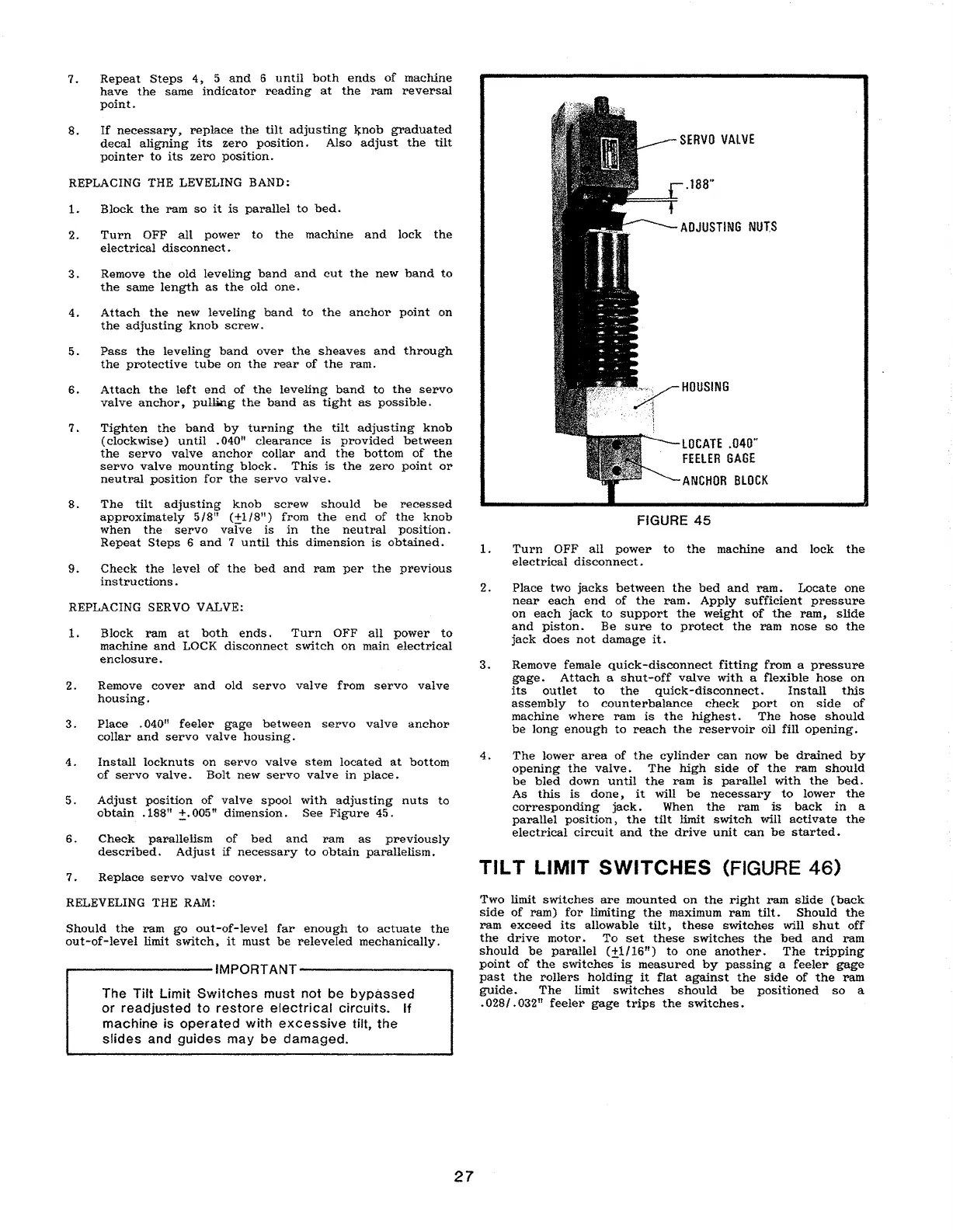
040"
feeler
gage
between
servo
valve
anchor
collar
and
servo
valve
housing.
4.
Install
locknuts
on
servo
valve
stem
located
at
bottom
of
servo
valve.
Bolt
new
servo
valve
in
place.
5.
Adjust
position
of
valve
spool
with
adjusting
nuts
to
obtain
.188
tt
±.005"
dimension.
See
Figure
45.
6.
Check
parallelism
of
bed
and
ram
as
previously
described.
Adjust
if
necessary
to
obtain
parallelism.
7.
Replace
servo
valve
cover.
RELEVELING
THE
RAM:
Should
the
ram
go
out-of-level
far
enough
to
actuate
the
out-of-Ievel
limit
switch,
it
must
be
releveled
mechanically.
..---------IMPORTANT---------
The
Tilt
Limit
Switches
·must
not
be
bypassed
or
readjusted
to
restore
electrical
circuits.
If
machine
is
operated
with
excessive
tilt,
the
slides
and
guides
may
be
damaged.
27
SERVO
VALVE
ADJUSTING
NUTS
HOUSING
LOCATE
.040"
FEELER
GAGE
ANCHOR
BLOCK
FIGURE
45
1.
Turn
OFF
all
power
to
the
machine
and
lock
the
electrical
disconnect.
2.
Place
two
jacks
between
the
bed
and
ram.
Locate
one
near
each
end
of
the
ram.
Apply
sufficient
pressure
on
each
jack
to
support
the
weight
of
the
ram,
slide
and
piston.
Be
sure
to
protect
the
ram
nose
so
the
jack
does
not
damage
it.
3.
Remove
female
quick-disconnect
fitting
from
a
pressure
gage.
Attach
a
shut-off
valve
with
a
flexible
hose
on
its
outlet
to
the
quick-disconnect.
Install
this
assembly
to
counterbalance
check
port
on
side
of
machine
where
ram
is
the
highest.
The
hose
should
be
long
enough
to
reach
the
reservoir
oil
fill
opening.
4.
The
lower
area
of
the
cylinder
can
now
be
drained
by
opening
the
valve.
The
high
side
of
the
ram
should
be
bled
down
until
the
ram
is
parallel
with
the·
bed.
As
this
is
done,
it
will
be
necessary
to
lower
the
corresponding
jack.
When
the
ram
is
back
in
a
parallel
position,
the
tilt
limit
switch
will
activate
the
electrical
circuit
and
the
drive
unit
can
be
started.
TILT
LIMIT
SWITCHES
(FIGURE
46)
T.wo limit
switches
are
mounted
on
the
right
ram
slide
(back
SIde
of
ram)
for
limiting
the
maximum
ram
tilt.
Should
the
ram
exceed
its
allowable
tilt,
these
switches
will
shut
off
the
drive
motor.
To
set
these
switches
the
bed
and
ram
sh?uld
be
para~lel
(±~/16tt)
to
one
another.
The
tripping
pOInt
of
the
sWltches
IS
measured
by
passing
a
feeler
gage
past
the
rollers
holding
it
flat
against
the
side
of
the
ram
guide.
The
limit
switches
should
be
positioned
so
a
.028/
.032
Jt
feeler
gage
trips
the
switches.

Related product manuals