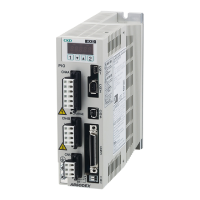
The ABSODEX AX Series (H Type/GH Type) is a direct drive indexing unit designed for flexible and accurate intermittent operation of turntables and similar components in industrial assembly and testing machines. This instruction manual is exclusively for the H and GH type drivers.
Function Description
The ABSODEX driver, with its integrated controller system, allows for free setting of actuator rotation angle, moving time, and timer settings. It also facilitates communication with an external sequencer (PLC) via M code output. The driver can store up to 256 NC programs, selectable through external I/O ports. The program memory capacity is 16 KB, which may limit the number of programs stored if they are long.
The actuator's rotation direction is defined as clockwise (+) when viewed from the top of the output axis, and counterclockwise (-) for reverse direction. The system uses a G92 User Coordinate System, ranging from -9,999,999 to +9,999,999 pulses (approximately ±18 rotations) for positioning. The Actuator Coordinate System has a pulse range of 0 to 540,671 for one rotation. The home position of the G92 user coordinate system is set by parameter 3, which defines the offset from the actuator's home position.
Operation modes include automatic, single block, MDI (manual data input), jog, servo-off, and pulse string input. The automatic mode is typically used with a sequencer (PLC) and also supports pulse string inputs via NC code G72. Communication codes M1 through M6 allow switching between these modes. Programs and parameters can be rewritten up to 100,000 times.
Important Technical Specifications
- Power Supply:
- H Type: 200VAC±10% (3-phase, standard), 100VAC±10% (single-phase, optional), 220VAC-10% to 230VAC+10% (3-phase, J2 option). Models with 50N-m or smaller maximum output torques can operate with single-phase power.
- GH Type: 200VAC-10% to 230VAC+10% (3-phase).
- Power Frequency: 50/60Hz.
- Configuration: Open modular type (driver and controller).
- Ambient Temperature and Humidity:
- Operating: 0 to 50°C (H Type) / 0 to 45°C (GH Type), 20 to 90%RH, no condensation.
- Storage: -20 to 80°C, 20 to 90%RH, no condensation.
- Anti-noise: 1000V (P-P), pulse width 1µsec, startup 1nsec.
- Anti-vibration: 4.9m/s².
- Elevation: Less than 1000m for operation, less than 3265m for transport.
- Mass: Approximately 4kg.
- Degree of Protection: IP00 (H Type/GH Type), IP65 (IEC60529), IP55 (IEC60034-5) for AX8000 Series.
- Number of Controlled Axes: 1 axis.
- Resolver Resolution: 540,672 pulses/rotation.
- Angle Setting Unit: Degree, pulse, and number of indexes.
- Angle Setting Minimum Unit: 0.001°, 1 pulse (≈ 0.00067 degrees).
- Speed Setting Unit: sec, rpm.
- Speed Setting Range: 0.01 to 100sec, 0.01 to 100rpm.
- Number of Indexes: 1 to 255.
- Maximum Instruction Value: 7-digit input ±9,999,999.
- Timer: 0.01 to 99.99sec.
- Programming Language: NC language.
- Programming Method: Data setting through RS-232C port using a dialog terminal or PC.
- Operation Mode: Auto, MDI, jog, single block, servo off, pulse string input.
- Coordinate: Absolute and incremental.
- Acceleration Curve: Five types: Modified sine (MS), Modified constant velocity (MC, MC2), Modified trapezoid (MT), Trapecloid (TR).
- Status Display: LED power lamp display.
- Alarm Display: 7-segment LED.
- Communication Interface: Meets RS-232C specification.
- I/O: Home positioning instruction, reset, start, stop, continuous rotation stop, emergency stop, answer, program number selection, brake release, program number setting, pulse string input (inputs). Alarm 1 and 2, positioning completion, in-position, standby for start input, M code 8 points, Timing, M code strobe, segment position strobe, output during indexing 1, 2 (outputs).
- Program Capacity: About 6000 characters (256 pcs.).
- Electronic Thermal: Estimates actuator temperature.
Usage Features
- Safety First: Before operation, users must read the instruction manual, especially safety-related descriptions. Equipment design and electrical control must ensure system safety.
- Rigid Installation: The ABSODEX unit and its load must be securely fixed to the machine to achieve designed performance and prevent resonance or oscillation.
- Dummy Inertia Plate: For machines lacking sufficient rigidity, a dummy inertia plate can be installed near the actuator to reduce resonance.
- Brake System (Pneumatic/Electromagnetic):
- Pneumatic Brake (AX5000 and AX8000 Series): Air clamp type with built-in air valve. Requires clean compressed air at 0.5MPa and 24V DC±10% power to CN3. NC codes (M68/M69) control brake application/release. The brake reinforces retention when stopped; it should not be used for braking during rotation.
- Electromagnetic Brake (AX4000 Series optional): Increases retention force of the stopped output axis. Not for decelerating or stopping a rotating output axis. Requires external 24VDC power supply. Non-magnetic materials (e.g., SUS303) should be used for shafts passing through the hollow hole to avoid magnetization and iron powder accumulation.
- Gain Adjustment: Essential for optimal performance. Adjusted via DIP switches (G1 and G2) on the front panel. G1 adjusts convergence time, and G2 adjusts according to the load. Gradual adjustment is recommended, especially for large inertia loads or less rigid equipment.
- Home Position Determination: The home position can be set arbitrarily using the dialog terminal's offset function.
- I/O Signal Control: CN3 connector handles I/O signals for communication with a programmable logic controller. Signals include program number selection, reset, home positioning, start, program stop, continuous rotation stop, answer input, emergency stop, and brake release.
- Pulse String Input: Supports pulse and direction, up and down, and A/B phases (90° phase difference). DIP switch SW1 allows changing input modes.
- Parameter Setting: Various parameters can be set to define motion conditions, cam curves (Modified Sine, Modified Constant Velocity, Modified Trapezoid, Trapezoid), acceleration/deceleration times, software limits, and filter settings.
- Filters: Built-in digital filters (low pass and notch) help reduce resonance in low-rigidity load equipment.
- Integral Limiter: Controls overshooting and improves stability for loads with large inertia.
- Integral Gain Multiplier: Adjusts the integral gain for stability and convergence time.
Maintenance Features
- Periodical Inspection: Recommended once or twice a year. Includes checking for dust, loose connections, heat discoloration, fan operation, clogged vents, abnormal noise, cable damage, power voltage, air pressure (for pneumatic brake), air filter, brake condition, and blown fuses.
- Fuse Replacement: No periodic replacement needed, but replace if blown. Always check wiring for leaks or short circuits if a fuse blows.
- SELEX Valve Replacement (for pneumatic brake): Estimated life cycle of 10,000,000 motions. Located in the connector base on the side of the actuator.
- Cooling Fan Replacement: Recommended every 20,000 hours. Involves removing the driver's side and front covers, and the circuit board.
- Electrolytic Capacitor Replacement: Electrolysis type capacitors deteriorate over time. In air-conditioned spaces, they may last about ten years under daily operation. Request CKD for replacement if solution leaks or the pressure relief valve opens.
- Troubleshooting Guide: The manual provides a comprehensive troubleshooting table for various alarms and symptoms, offering probable causes and countermeasures.
- System Initializing: Clears all NC programs and resets parameters to default values. Requires a dialog terminal or PC. Users are advised to back up data before performing this procedure.

 Need help?
 General

 To Next Page