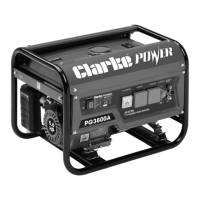
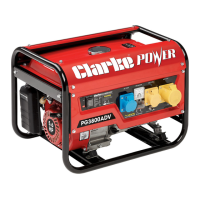
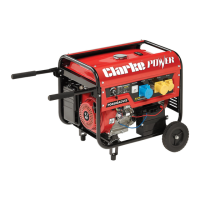
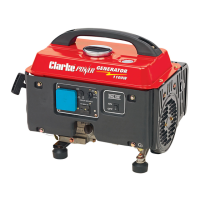
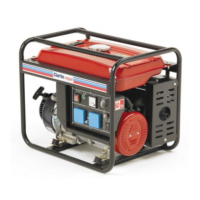
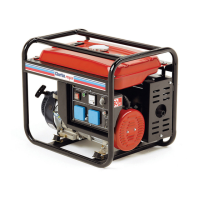
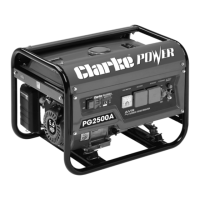
This document is an operation and maintenance manual for the CLARKE PG2500A 2.2 kVA Petrol Generator.
Function Description
The CLARKE PG2500A is a petrol-powered generator designed to supply both 230V AC and 12V DC power. It can be used for prime duty or as an emergency standby power source for businesses, homes, and leisure activities. The generator is equipped with an Automatic Voltage Regulation (AVR) system to ensure stable power output. It is suitable for powering various electrical appliances and for charging car batteries.
Important Technical Specifications
- Engine Model: PT170F-1
- Fuel Type: Petrol (unleaded recommended)
- Displacement: 212 cc
- Max. Power Output: 5.6 hp @ 3000 rpm
- Start System: Hand recoil
- Fuel Tank Capacity: 15 L
- Fuel Consumption: 1.6 L/hr.
- Maximum Run Time @ 75% Load: 10.6 hours
- Engine Oil Type: SAE15W/40
- Engine Oil Capacity: 0.6 L
- Guaranteed Sound Power (LWA dB): 94 dB
- Rated Frequency: 50 Hz
- AC Output Voltage: 230V @ 13A
- DC Output Voltage: 12V (Max 8.3A)
- Maximum Rated Power: 2200 W
- Dimensions (L x W x H): 595 mm x 430 mm x 430 mm
- Unpacked Weight: 39.4 kg
Usage Features
Safety First:
- Always operate the generator in a well-ventilated area, positioning the exhaust outlet away from people.
- Never use indoors or in a confined space due to the danger of exhaust fumes.
- Maintain at least a 1m gap between the generator and surrounding structures.
- Ensure the generator is on a solid, flat surface and the surrounding area is free from flammable materials.
- Never move or tilt the generator while it is switched on.
- Always ground the generator by connecting a suitable grounding wire to the earth point and a copper or brass grounding rod driven into the earth. Failure to do so can result in electrocution.
- Do not use the generator in wet conditions unless adequately protected and ventilated.
- Never operate with wet hands or use water/liquids to clean it.
- Ensure the applied load does not exceed the generator rating to prevent serious damage from overloading.
- Allow the generator to reach operating speed before connecting a load.
- Never allow the generator to run out of fuel with a load connected, as this can cause serious damage.
- Do not transport the generator with fuel in the tank.
- Do not connect to a commercial or residential power supply (e.g., ring main).
- Never allow the generator air vents to become blocked.
Starting the Engine:
- Remove all connections from AC sockets.
- Set the fuel valve to the 'ON' position.
- Ensure the AC breaker is set to the 'OFF' (down) position.
- Move the choke lever to the 'Choke' position.
- Set the engine switch to 'ON'.
- Hold the generator steady and pull the starting handle lightly until resistance is felt, then pull sharply to start the engine. Release the handle slowly once the engine starts to avoid injury/damage.
- Once the engine has warmed up, move the choke lever to the 'Run' position.
Connecting Electrical Appliances (AC Power):
- Start the engine.
- Set the AC Breaker to the 'ON' (up) position.
- Connect the appliance to the generator, ensuring the appliance is turned off first.
- The voltmeter displays the supplied voltage.
- If the AC Breaker activates due to overload, remove connected devices, wait a few minutes, then reset the breaker to 'ON' and reconnect devices, ensuring not to exceed maximum capacity.
- Be aware that devices with inductive loads (e.g., motors) may require more current on startup.
Connecting Electrical Appliances (DC Power) / Charging Car Batteries:
- Start the generator.
- Ensure the appliance is turned off before connecting.
- Connect the 12V DC appliance (max 8.3A) to the generator.
- For charging car batteries, connect the red lead to the positive (+) terminal and the black lead to the negative (-) terminal of the battery. Then connect the charging leads to the generator.
- Monitor battery voltage and disconnect when it reaches 14.4 volts.
- Do not allow clamps to touch each other while connected to the generator.
- When disconnecting, always remove the negative (black) lead first.
- If the DC overload protector activates, wait a few minutes and press the reset button.
Shutting Down the Generator:
- Turn off and disconnect all electric devices.
- Set the AC breaker to the 'OFF' (down) position.
- Set the engine switch to '0' (OFF).
- Set the fuel valve to the 'OFF' position.
Maintenance Features
Guarantee and Environmental Policy:
- The product comes with a 12-month guarantee against faulty manufacture, requiring proof of purchase. The guarantee is invalid if the product is abused, tampered with, or not used for its intended purpose.
- Customers are obligated to dispose of Waste Electrical and Electronic Equipment (WEEE) in accordance with regulations, at a recognized disposal facility, not with general household waste.
Before First Use:
- Attach a suitable earth lead to a good earthing point.
- Check the generator's condition for any damage, fuel/oil spillage.
- Ensure correct positioning.
- Verify the fuel system is intact and free of leaks.
- Always use a funnel for refuelling to prevent spills.
Checking Engine Oil Level:
- Place the generator on level ground with the engine switched off.
- Turn the dipstick anti-clockwise and remove. Wipe clean.
- Insert the dipstick back into the oil fill tube (do not screw in) and remove.
- If the oil level is at or below the 'L' mark, add SAE15W/40 oil until it reaches the threads in the oil fill tube (capacity 0.6 L).
- Replace the oil filler cap.
Checking Fuel Level:
- Check the fuel gauge (red indicates fuel, white indicates decreasing level).
- Open the fuel filler cap.
- Slowly add standard unleaded petrol (maximum 15 L), watching the gauge.
- Refuel in a well-ventilated area, away from heat sources, and allow the unit to cool down first.
- Do not overfill the fuel tank.
- Replace the fuel filler cap securely.
Changing the Engine Oil:
- Allow the engine to warm up slightly for easier draining.
- Turn the dipstick anti-clockwise and remove.
- Place an oil collection tray under the drain plug.
- Unscrew the drain plug to drain the used oil from the crankcase.
- Replace the drain plug.
- Fill the crankcase with new SAE15W/40 oil until it reaches the threads in the oil fill tube.
- Replace the dipstick.
- Dispose of used oil responsibly, not with domestic rubbish.
Changing the Spark Plug:
- Allow the engine to cool before removing the spark plug.
- Remove the spark plug cap.
- Use the supplied spanner to remove the spark plug.
- Remove any carbon from the electrode.
- Check the spark plug gap (a) – it should be between 0.7 and 0.8 mm; adjust if necessary.
- Check for erosion or pitting and replace if necessary.
- Reinstall the spark plug and cap.
Checking the Air Filter:
- Do not use the generator without the air filter fitted, as this can cause damage.
- Unclip and remove the air filter cover and element.
- Check if the air filter is clean and undamaged. Replace if damaged.
- If dirty, wash in warm water and mild detergent, rinse thoroughly, dry completely, then immerse in clean engine oil and squeeze out excess oil.
- Do not use flammable solvents or petrol to clean the air filter.
- Replace the filter and cover.
Cleaning the Fuel Valve Filter / Draining the Fuel Tank:
- Set the fuel supply valve to 'OFF'.
- Unscrew and remove the cup, then remove the valve filter and 'O' ring.
- Wash these parts in a non-flammable solvent. Ensure the filter is not damaged.
- Place an approved petrol storage container under the fuel valve and set the fuel supply valve to 'ON' to drain the fuel.
- Replace the 'O' ring and valve filter, then tighten the cup.
Troubleshooting:
- Generator fails to start: Check ignition switch ('on'), oil level (add if low), fuel level (add if low), spark plug (change if faulty).
- Generator fails to generate electricity: Check if the device being powered is faulty, or if the AC breaker is switched off (switch on).
- Generator is difficult to start: Check if the air filter is dirty (clean), or if the fuel filter is blocked (clean).
- For persistent problems, contact the CLARKE service department.


 To Next Page
 General