Need help?
Do you have a question about the Clarke PG3800A and is the answer not in the manual?
Details the 12-month guarantee policy for manufacturing defects.
Outlines the policy for the disposal of Waste Electrical and Electronic Equipment.
Ensures safe operation by specifying ventilation and proximity requirements.
Provides guidelines for safe placement and stability of the generator.
Details essential precautions to avoid fire hazards during operation and refueling.
Advises on measures to prevent electric shock hazards during use.
Lists crucial rules for safe generator operation and load management.
Explains the meaning of various safety icons used in the manual.
Identifies key parts of the generator with numbered descriptions.
Ensures all items are present after unpacking and checking for damage.
Lists essential checks before operating the generator for the first time.
Explains the importance and procedure for grounding the generator.
Details the procedure for checking and topping up engine oil.
Describes how to check and add fuel to the generator.
Specifies the type of fuel suitable for the generator.
Provides step-by-step instructions for starting the generator engine.
Details how to connect electrical appliances to the AC outlets.
Explains the role and reset procedure for the AC breaker.
Describes how to use the generator's 12V DC output for appliances.
Provides instructions and warnings for charging car batteries.
Explains the DC overload protector and its reset function.
Outlines the correct steps to safely turn off the generator.
Details the process for draining and refilling engine oil.
Explains how to remove, inspect, and replace the spark plug.
Guides on inspecting, cleaning, and replacing the air filter.
Details cleaning and draining procedures for the fuel valve filter.
Lists common problems, their causes, and solutions.
Provides detailed technical data for the generator.
Illustrates the generator with an exploded view of its parts.
Lists part numbers and descriptions for replacement components.
Contains declarations of conformity with relevant directives and standards.
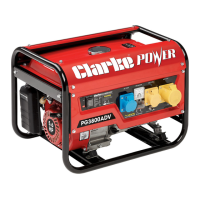
This document outlines the operation and maintenance instructions for a CLARKE 3kVA Petrol Generator, Model No: PG3800A. This generator is designed to provide both 230V AC and 12V DC power, making it suitable for various applications, from powering electrical appliances to charging car batteries.
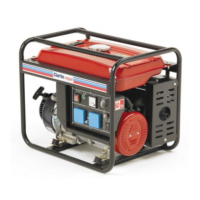
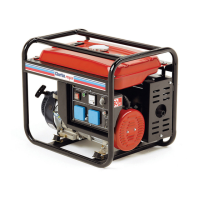
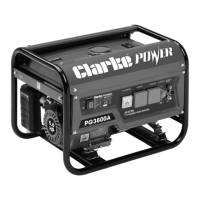
The CLARKE 3kVA Petrol Generator is a portable power source designed to supply electricity in situations where mains power is unavailable. It operates on standard unleaded petrol and features a hand recoil start system. The generator is equipped with a control panel that includes a voltmeter, AC230V sockets, an AC breaker, and a DC output. An Automatic Voltage Regulation (AVR) system is integrated to ensure a stable power supply. The generator's robust frame provides protection and portability, while anti-vibration feet help reduce noise and movement during operation.
Before operating the generator, it is crucial to ensure proper setup and safety. The generator must always be used in a well-ventilated area, at least 1 meter away from any surrounding buildings or structures, and on a solid, flat surface. Exhaust fumes are extremely dangerous if inhaled, so the exhaust outlet must always be positioned away from people, and the generator should never be used indoors or in confined spaces. It is also essential to attach a suitable earth lead to a good earthing point, such as a water pipe or ground spike, to prevent electrocution.
Fueling the generator requires careful attention to safety. Only standard unleaded petrol should be used, and refuelling must always be done with the engine switched off, in a well-ventilated area, and away from any heat sources. Smoking is strictly prohibited during refuelling. Any spilled fuel must be wiped clean, and the generator allowed to dry before attempting to start. The fuel level can be checked via the fuel gauge, which changes from red to white as the fuel level decreases. A fuel filter inside the tank helps catch contaminants during refuelling. It is important not to overfill the fuel tank.
Starting the engine involves a few steps. First, ensure all connections are removed from the AC sockets. Set the fuel valve to the 'ON' position and the AC breaker to the 'off' (down) position. Move the choke lever to the 'Choke' position and set the engine switch to 'ON'. To start, hold the generator steady and pull the starting handle lightly until resistance is felt, then pull sharply. It may be necessary to repeat this process. Once the engine starts, release the handle slowly to prevent injury or damage from recoil. If the overload indicator lights up for more than 5 seconds after starting, stop the engine and contact a CLARKE dealer. After the engine has warmed up, move the choke lever to the 'Run' position.
When connecting electrical appliances, ensure the generator is running and the AC breaker is set to the 'ON' (up) position. Appliances should be turned off before connecting them to the generator. The voltmeter displays the voltage being supplied. It is critical not to exceed the generator's maximum rated load, as overloading can cause serious damage and activate the AC breaker. If the AC breaker activates, disconnect all devices, wait a few minutes, reset the breaker to 'ON', and then reconnect devices, ensuring the maximum capacity is not exceeded. Devices with inductive loads, such as motors, may require more current on startup.
The generator can also charge car batteries via its 12V DC output. For safety, connect the battery charging leads to the battery first, ensuring the red wire is clamped to the positive (+) terminal and the black wire to the negative (-) terminal. Then, connect the leads to the generator. The battery will begin to charge. Monitor the battery voltage regularly and disconnect when it reaches 14.4 volts. Do not allow the clamps to touch each other while connected to the generator. When disconnecting, always remove the negative (black) lead first. This generator is intended for 'topping up' batteries; attempting to charge a completely flat battery may blow the fuse. A DC overload protector is included; if it activates, wait a few minutes and press the reset button.
To shut down the generator, first disconnect all electric devices. Set the AC breaker to the 'off' (down) position. Set the engine switch to the '0' (OFF) position, and finally, set the fuel valve to the 'OFF' position. In an emergency, simply setting the engine switch to 'OFF' will stop the generator.
Regular maintenance is essential for the longevity and safe operation of the generator.
Prolonged exposure to used engine oil is dangerous, so hands should be thoroughly washed after handling. To change the oil, first unscrew and remove the oil filler cap/dipstick. Place an oil collection tray under the drain plug. Unscrew the drain plug and allow the used engine oil to drain from the crankcase into the tray. It is recommended to drain the oil when the engine is warm for faster flow. Replace the drain plug, then fill the crankcase with SAE15W40 oil until it reaches the threads in the oil fill tube. The oil capacity is specified in the manual. Finally, replace the dipstick. Used engine oil should be disposed of responsibly at a local waste disposal site, not with domestic rubbish or down drains.
This check should be performed with the generator on level ground and the engine switched off. Care should be taken not to touch hot parts of the generator. Turn the dipstick anti-clockwise and remove it, wipe it clean, then reinsert it without screwing it in. Remove it again to check the level. If the oil level is at or below the 'L' mark, add SAE15W40 oil until it reaches the threads in the oil fill tube. Replace the oil filler cap.
Allow the engine to cool before removing the spark plug. Remove the spark plug cap, then use the supplied spanner to remove the spark plug. Clean any carbon accumulated around the electrode. Check the spark plug gap, which should be between 0.7 and 0.8 mm, and adjust if necessary. Inspect the spark plug for erosion or pitting and replace if needed. Reinstall the spark plug and replace the cap.
Never use the generator without the air filter fitted, as this can cause damage. Unclip and remove the air filter cover, then remove the air filter element. Ensure the filter is clean and undamaged; if damaged, contact CLARKE spare parts for a replacement. If the filter is dirty, wash it in a solution of warm water and mild detergent, rinse thoroughly, and allow it to dry completely. Once dry, immerse it in clean engine oil and squeeze to remove excess oil. Do not use inflammable solvents or petrol to clean the air filter. Replace the filter in its original position and replace the cover.
Set the fuel supply valve to 'OFF'. Unscrew and remove the cup, then remove the valve filter and 'O' ring. Wash these parts in a non-inflammable solvent, ensuring the valve filter is not damaged. To drain the fuel tank, place an approved petrol storage container under the fuel valve and set the fuel supply valve to 'ON'. The fuel will drain into the container. After draining, replace the 'O' ring and valve filter, and tighten the cup as far as possible.
Troubleshooting tips are provided for common issues such as the generator failing to start (ignition switch off, low oil, no fuel, faulty spark plug) or failing to generate electricity (faulty device, AC breaker off). It also covers difficulties in starting (dirty air filter, blocked fuel filter). For problems not resolved by these steps, contact the CLARKE service department.
 General
| Model | PG3800A |
|---|---|
| Type | Portable Generator |
| Maximum Output | 3.8 kW |
| Voltage | 230V |
| Frequency | 50Hz |
| Fuel Type | Petrol |
| Starting Method | Recoil |
| Weight | 45 kg |
| Engine Type | 4-stroke |
| Fuel Tank Capacity | 15L |

 To Next Page