9
21. Cleaning
When an instrument is returned for service and repair
i
t would be advisable to clean it with a suitable cotton
cloth using a disinfectant (diluted, following
the manufacturer’s instructions on the bottle, for
surface cleaning).
When cleaning, particular attention should be shown
to the following:
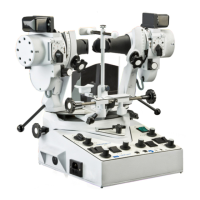
Forehead rest (106),
Chinrest (105),
Handles for adjustment of horizontal angle (108)
and Breathshield (107).
Scope of action
Non-immersion manual cleaning methods are
appropriate for low risk items (those items that come
into contact with intact skin or do not contact the
patient) where soaking in aqueous solutions,
e.g. electrical and electronic equipment, will
compromise the device.
Alcohol wipes should be used to clean electrical contacts
on equipment (avoid contact with plastic parts or
enclosures as alcohol is a solvent).
Equipment required
• A warm water/detergent solution at correct dilution.
• A clean, disposable, absorbent, non-shedding cloth
for application of detergent solution.
• A clean, disposable, absorbent, non-shedding.
• An appropriate chemical neutraliser, first aid kit and
eyewash bottle, in case of splashing with detergent.
Procedure
If the item is electrical; ensure that it is disconnected
from the mains supply before commencing the
cleaning procedure.
Make sure that the device/lamps have cooled down
before cleaninng.
Wearing protective clothing, immerse the cleaning cloth
in the detergent solution and wring thoroughly.
Commencing with the upper surface of the item, wipe
t
horoughly ensuring that detergent solution does not
enter electrical components.
Periodically rinse the cloth in clean water and repeat the
above steps.
Surfaces should be carefully hand-dried using a cloth.
Note: Non-immersion, manual cleaning is not a
disinfection process, but where an alcohol wipe is used
to dry surfaces, this may have a disinfecting effect.
Safely dispose of cleaning materials and alcohol wipes, if
used.
Monitoring and Control
• Staff training
• Physical application
• Nature of soil
• Accessibility of cleaner to item/part of equipment
• Detergent concentration
Safety precautions
• Always wear protective waterproof clothing, robust
gloves and eye protection if splashing is likely to occur.
• After removing protective clothing, wash and dry hands
thoroughly.
• Avoid splashing.
Precautions should be taken when using alcohol, as it is
flammable.
The ‘pooling’ of alcohol on equipment should be
avoided and alcohol evaporation ensured, if necessary
by forced air-drying. Care should also be taken to ensure
that alcohol does not enter the item e.g. via ventilation
slots.
The above was written with reference to; Sterilization,
Disinfection and cleaning of Medical Devices &
Equipment: Guidance on Decontamination from the
Microbiology Advisory Committee to the Department of
Health Medical Devices Agency (MAC manual section 2
page 20 updated April 2005)
Synoptophore Instructions


 To Next Page