STATEMENT of LIMITED LIABILITY
A mathematical model is used by this Product to calculate physiological
effects of SCUBA diving related to use of compressed air or other
breathing mixtures while at depth. Such effects specifically relate to
nitrogen absorption into and elimination from body tissues, as well as
effects of oxygen used in Enriched Air Nitrox breathing mixtures.
However, because of the number of variables and the varying degrees to
which they may affect individuals engaged in SCUBA diving, COCHRAN
DOES NOT GUARANTEE THAT USE OF THIS PRODUCT WILL
PREVENT DECOMPRESSION SICKNESS OR ANY OTHER CONDITION
OR INJURY INCURRED WHILE USING THIS PRODUCT.
These influencing variables may include, but are not limited to,
dehydration, obesity, age, old injuries, or other physical conditions on the
part of the diver, or environmental extremes of heat or cold, or poor
training, or diving practices, any of which may promote the onset of
decompression sickness or other harmful effects.
This Product is sold and intended to be used only as a guide, providing the
TRAINED and CERTIFIED diver the information needed to make safe
diving decisions. It is expressly understood that by buying and/or using
this Product the Diver assumes ALL RISK as to its operability, reliability,
quality, performance, accuracy, and suitability for his diving style.
Furthermore, Diver recognizes that this Product is an electronic instrument
being used in a hostile environment and is subject to failure, which may
manifest itself in a number of ways. COCHRAN and its distributors and
retailers will not be held liable for any personal injuries or other damages
resulting from its use, even if COCHRAN has been advised of such
occurrences or damages.
These products must be handled with care and properly maintained to
assure the optimum performance. Users must possess the proper training
for SCUBA diving activities and should be fully educated in the operation
of this product. Users are encouraged to possess and utilize a redundant
(backup) computer for their dive planning and execution. Divers are
always encouraged to dive with a buddy at all times.
COCHRAN strongly supports and agrees with maximum depth limits of
130 feet for recreational SCUBA diving, as established by recognized
training and certification agencies, and in no way encourages diving
beyond these or any prudent lesser limits as may be necessitated by
environmental, diver-specific, or other conditions.
THE WARRANTY AND REMEDIES SET FORTH ABOVE ARE
EXCLUSIVE AND IN LIEU OF ALL OTHERS, WHETHER ORAL OR
WRITTEN, EXPRESSED OR IMPLIED. COCHRAN UNDERSEA
TECHNOLOGY SPECIFICALLY DISCLAIMS ANY AND ALL IMPLIED
WARRANTIES, INCLUDING, WITHOUT LIMITATION, WARRANTIES OF
MERCHANTABILITY AND FITNESS FOR A PARTICULAR PURPOSE.
No Cochran Undersea Technology dealer, agent, or employee is
authorized to make any modification, extension, or addition to this
warranty.
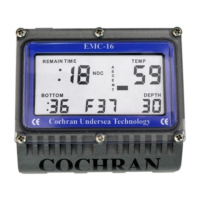
USER & ENVIRONMENTAL ADAPTATION: The EMC-16 is one of the
new breed of Dive Computers that adapts its algorithm to the users diving
environment and style as originally pioneered by COCHRAN. All of
COCHRAN’s newer dive computers incorporate this capability. The factors
that are used for this “Adaptation” in the EMC-16 are:
Water Temperature Salt/Fresh Water Compensation
Microbubble Altitude Acclimatization
User Conservatism Previous Dive Profiles
WATER TEMPERATURE: Diving in cold water can lead to a lower diver
core and skin temperature which can affect the gas exchange rate of the
body’s tissues. The EMC-16 features two modes of Temperature
Compensation, Normal or Reduced. The EMC-16 progressively makes its
nitrogen algorithms more conservative as the water temperature declines
below 75 degrees F. Above this water temperature, there is no
temperature compensation. In the Reduced Mode, the algorithms are
made more conservative by approximately one-half the amount of the
Normal Mode. If the diver is wearing an insulated dry suit and is relatively
warm even in cold water, this temperature compensation factor may be set
to Reduced Mode at the divers discretion using the Analyst
®
PC software.
MICROBUBBLE: There are several theories regarding the exact method
by which a nitrogen bubble forms from a microbubble which was formed
from micronuclei. Currently the predominant theory states that more rapid
ascents accelerate bubble formation. The EMC-16 comprehends and
adjusts for this phenomenon.
USER CONSERVATISM: Current dive computers cannot tell if the diver is
dehydrated, tired, smokes, overweight, or has some other physical issue
that may require additional conservatism in the nitrogen algorithm. The
EMC-16 allows the diver to input an added degree of conservatism to the
nitrogen algorithm from 0 to 50 percent in one-percent increments. This
can be done via the Touch Contact Programming Mode or with the
Analyst
®
Personal Computer Interface.
PREVIOUS DIVE PROFILES: Under some circumstances, recent dive
activity can have an effect on nitrogen loading, particularly if the diver
engages in inverted profile diving. This occurs when a deep dive is
followed by an even deeper dive. This recent dive history is used to
compensate the nitrogen loading for the current dive. This can be enabled
or disabled with the Analyst
®
Personal Computer Interface.
SALT/FRESH WATER COMPENSATION (High/Low Water
Conductivity): There is approximately a three percent difference in depth
readings taken in salt water versus fresh water. Some dive computers are
calibrated in feet of fresh water and some are calibrated in feet of
seawater. Diving in a medium different from what the dive computer is
calibrated for will cause apparent depth errors. Only COCHRAN dive
computers, including the EMC-16, actually determine the type of diving
medium and compensate the depth reading accordingly. This is
accomplished by measuring the conductivity of the water during a dive.
Caution must be taken in interpreting this reading since some apparent
fresh water is actually high in minerals or contaminants and is correctly
compensated as salt water (High Conductivity). This commonly occurs in
some caves, springs, and lakes.
ALTITUDE ACCLIMATIZATION: Driving or flying to a dive site
significantly higher in altitude requires special modifications to the "sea
level" algorithm. The EMC-16 regularly samples the ambient barometric
pressure to determine these changes in altitude whether the unit is On or
Off. Accordingly, the decompression algorithm is changed to reflect these
barometric pressure changes. Note that temperature and weather systems
also affect barometric pressure and hence, apparent altitude. Using the
Time-To-Fly digits, the number of hours required to “adapt” to the new
altitude is immediately known to the diver. If a significant altitude change
occurs, a minimum of one hour should pass before diving to allow the unit
to adapt to this new altitude. Rapid changes in altitude should be avoided.
The dive computer may interpret a rapid change from a higher altitude to a
lower altitude as a dive. Should this occur, removing the batteries for ten
minutes will reset the computer, however, all tissue nitrogen loading will
also be lost.
Should it be desired to initiate a dive PRIOR to completing the adaptation
time, the EMC-16 will treat this dive as a repetitive dive in its algorithm,
taking into account the "residual" nitrogen present due to travel to altitude.
There are two methods of compensating for altitude. Via the Analyst
®
PC
Interface, ZONE or SEAMLESS altitude compensation may be selected.
In ZONE all altitudes less than 2,000 feet above sea level use the sea-level
algorithm. At altitudes greater than this, altitude compensation is
“seamless”; literally, every small fraction of gained altitude is considered in
adjusting the algorithm. ZONE will reduce the occurrences of obtaining
slightly different altitude readings and corresponding no-decompression
(NDC) limits when diving within a given area. However, ZONE reduces the
accuracy of the altitude compensation for the first 2,000 feet above sea
level, since all altitudes below 2,000 feet are treated as sea level. The
advantage in ZONE is that changes in apparent altitude due to
temperature or weather changes at sea level will not affect the NDC
computations.
In SEAMLESS, the algorithm is adjusted for extremely small changes in
altitude. However, a difference in altitude may be seen from day-to-day at
a given dive site due to temperature or weather systems and their effect on
barometric pressures. SEAMLESS will provide the most accurate altitude
compensation algorithm, but normal variations in atmospheric barometric
pressure may affect the no-decompression time which is more
predominantly seen in the Pre-dive Prediction forecast.
CAUTION: The EMC-16 will not perform Altitude Acclimatization if the
touch contacts are shorted or bridged. Rinse the unit with clean
fresh water and dry it with a towel after each dive. Transporting
and storing the unit in its case will help prevent the possibility of
the contacts being shorted or bridged.
WARNING: While your EMC-16 will automatically adjust its no
decompression algorithm for altitude, you should NOT attempt
to dive at altitudes greater than 1,000 feet above sea level
without first completing a sanctioned altitude diving course from
a recognized training agency for recreational diving. The EMC-
16 should not be used for this type of diving by anyone without
this important training.
12


 To Next Page
 Loading...