22
3.4 Signal inputs
The LINUS14/14D amplier oers three dierent input signal sources:
Analog
In this mode the analog signals connected to the XLR input connectors will be used as input signal.
LiNET
With the LINET setting the input signals are taken from the LINET Digital Audio interface.
DANTE
With the DANTE setting the input signals are taken from the DANTE Digital AudioInterface.
3.4.1 Analog input
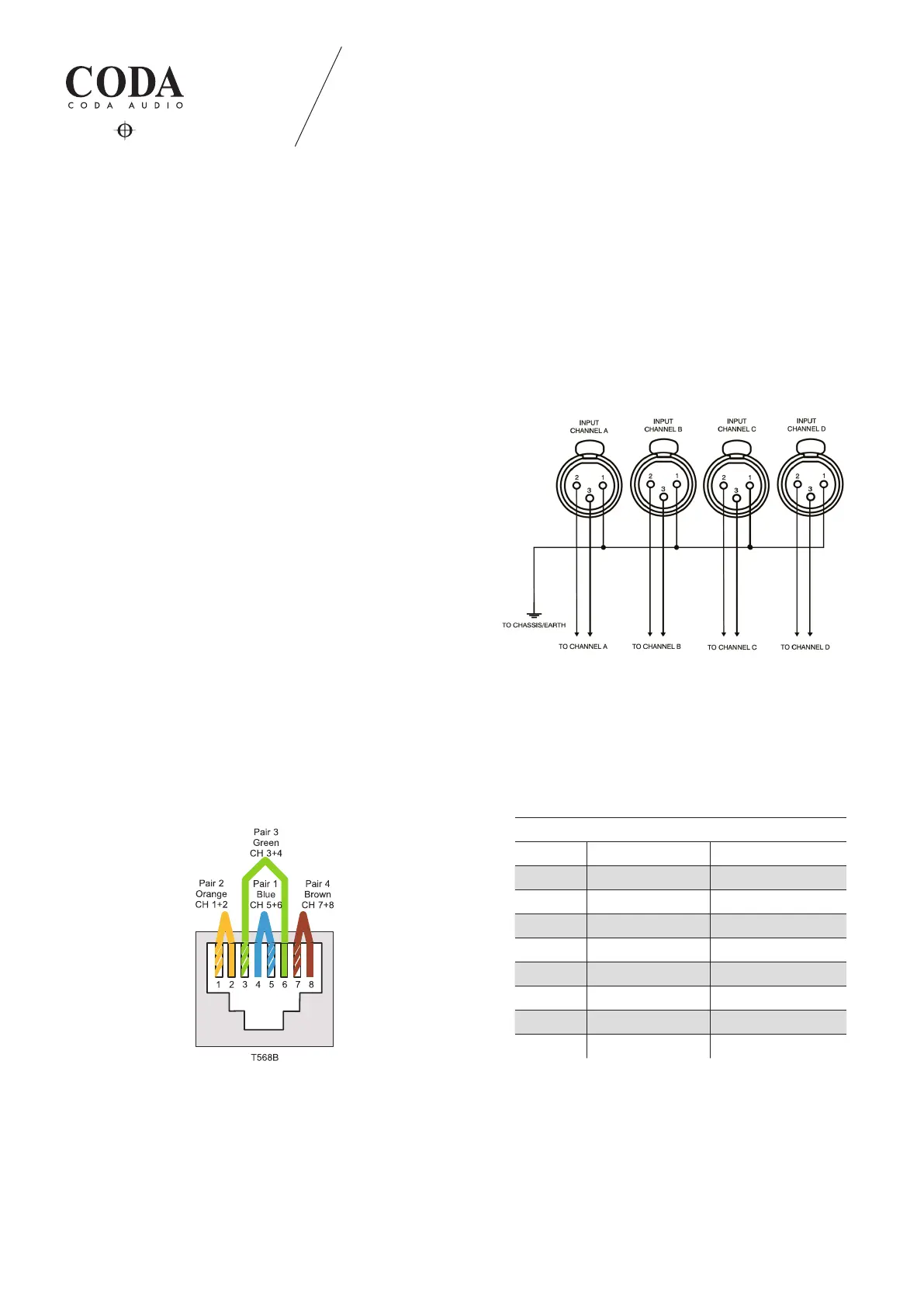
XLR:
Pin 1 = Ground (lifted via 15 0 resistor to chassis/ earth)
Pin 2 = Hot (in polarity, "+")
Pin 3 = Cold (out of polarity, "- ")
We suggest to always use symmetrically (balanced) shielded
cable to connect the amplier.
3.4.2 LiNET AES/EBU input/output
The AES/EBU input and output connectors allow you to receive and send multichannel digital audio streams to other AES/
EBU-compatible devices (like other LINUS14/14D ampliers for example). Please note that although the AES/EBU and
Ethernet connectors use the same connector type (RJ45), the physical transmission protocols are dierent. So any direct
connection between the AES/EBU connectors and standard Ethernet con nectors will not work.
LINUS14/14D 3. INSTALLATION
LiNET AES/EBU RJ45 pin wiring
RJ45-Pin Colour Channel (polarity)
1 orange-white 1/2 (+)
2 orange 1/2 (-)
3 green-white 3/4 (+)
4 blue 5/6 (-)
5 blue-white 5/6 (+)
6 green 3/4 (-)
7 brown-white 7/8 (+)
8 brown 7/8 (-)
3.4.3 DANTE
The DANTE input connector (LINUS14D only) allows you to receive unicast or multicast digital audio streams from any
DANTE enabled transmitter. Please note, that LINUS devices are only receivers and therefore third-party software and hard-
ware is needed to build a DANTE network. For further information regarding DANTE please visit www.audinate.com.


 To Next Page