EasyManua.ls Logo

Coleman 7600 - Air Requirements; Combustion Air

Coleman 7600
39 pages
Print Icon
To Next Page IconTo Next Page
To Previous Page IconTo Previous Page
Loading...
l2
13.
14.
l5
l6
t8
INSTALLATION
INSTRUCTIONS
ll. Slide the
furnace
out of the
closet
or alcove
and
lay
it
on
its btrck.
Rernove
the nuts
I'rom the
studs around
the
flue
at the top
of the
furnace.
To
remove the burner
from
the
furnace, remove
the six
screws
from
the
plate
behind
the control
valve that
lastens
it
to
the furnace.
'filt
the burner
end
down out
of the
heat exchanger
and
withdraw
burner
from combustion
air tube.
Remove
the
nuts lrom the
studs that
are
located
inside the combustion
air
tube and
at
its very back.
Remove the
mid-panel
that separates
the
upper
and
lower areas
of the
furnace.
Remove
the cover
plate
from the
electrical
control
box.
Remove
the two screws
in
the
control
box that
are
located along
the side
nearest
the
furnace wall.
Remove the
internal
front
panel
of
the
lurnace by
removing the screws
from around
its sides.
Lift
both
the
furnace's
internal
panel
and
the
heat
ex-
changer
out of
the furnace
body.
Remove the
screw
from the
view
plate
on
the
internal
panel
and
detach the
panel
from the
heat
11.
exchanger.
19. lnstall the
new heat exchanger,
gaskets
and
other
lurnace
parts
by using
the above
procedures in re-
verse order.
20. Use the
installation
instructions
lor correct
pro-
cedure
in re-installing the
furnace.
AIR
REQUIREMENTS
The
proper
operation
of
any
Mobile
Home
furnace
is
dependent
upon satisfying
the
requirements
for four
types
of air.
l.
Comhustion
air
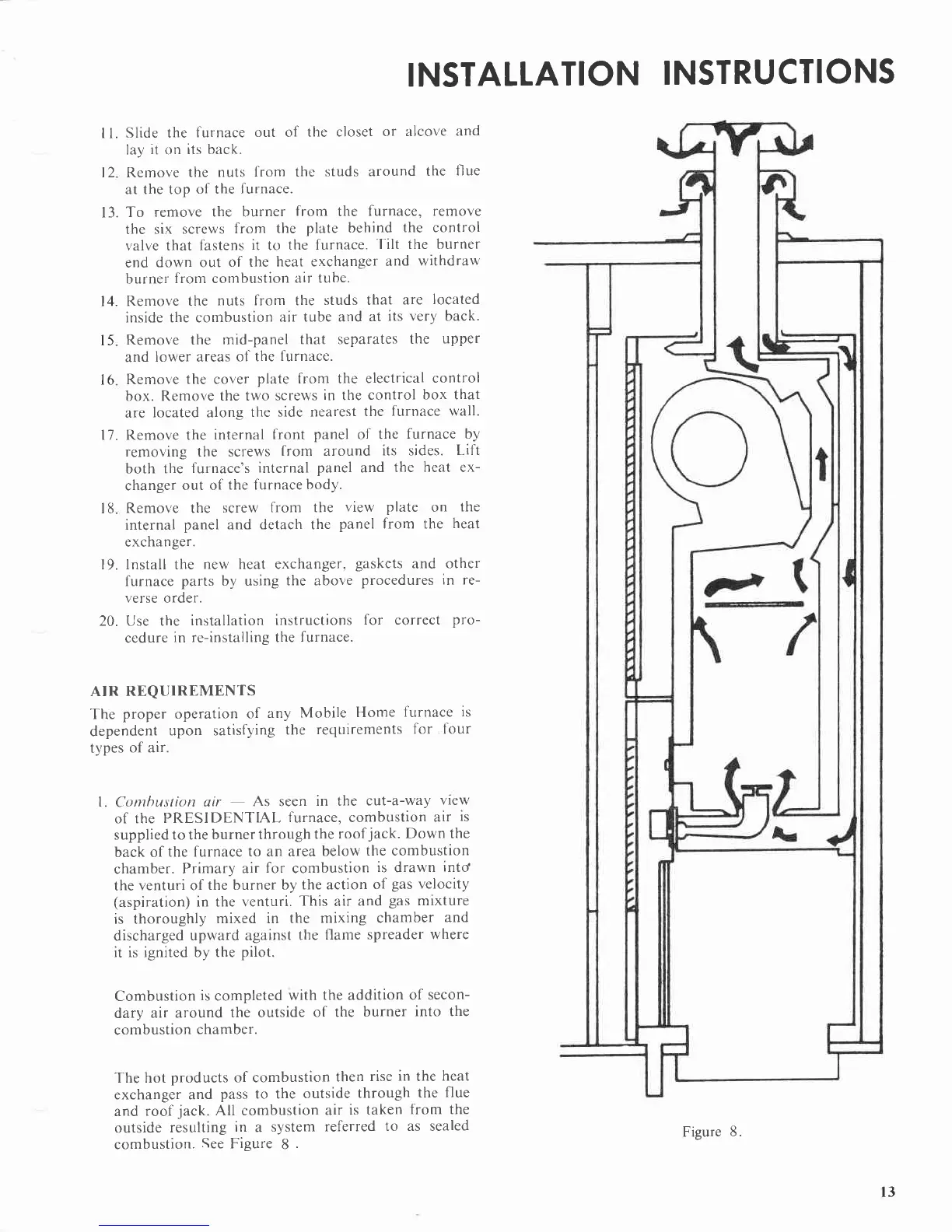
As seen
in the
cut-a-way
vlew
of the
PRESIDENTIAL
furnace, combustion
air
is
supplied to the
burner through
the
roof
jack.
Down the
back of
the furnace
to an area
below
the combustion
chamber.
Primary
air
for
combustion
is
drawn
into'
the
venturi of
the burner by
the action
of
gas
velocity
(aspiration)
in the venturi.
This
air
and
gas
mixture
is thoroughly
mixed in the
mixing chamber
and
discharged
upward against
the
flame
spreader where
it is ignited by the
pilot.
Combustion
is
completed
with the addition
of secon-
dary
air around
the outside
of the
burner
into the
combustion
chamber.
The hot
products
of combustion
then
rise
in
the
heat
exchanger and
pass
to the
outside
through
the
flue
and
roof
jack.
All combustion
air
is taken
from the
outside
resulting
in
a
system
referred
to as sealed
combustion.
See
Figure
8
.
l3
Figure
8.

Related product manuals