NOTICE: Automotive batteries should never be used for "deep cycle" application, as their useful life will be
very short.
Install surge arrestors on incoming AC power lines. Surge arrestors will help protect electrical/electronic
components in the charger and vehicle from all but direct or “close proximity” lightning strikes.
Damaged or corroded battery terminals should be replaced or cleaned as necessary. Failure to do so may
cause overheating during operation.
Do not attempt to recharge batteries with a charger not designed for your vehicle.
Only trained technicians should service the Delta Q charger. Contact your Columbia Dealer for assistance.
4.2 BATTERY INSPECTION & MAINTENANCE
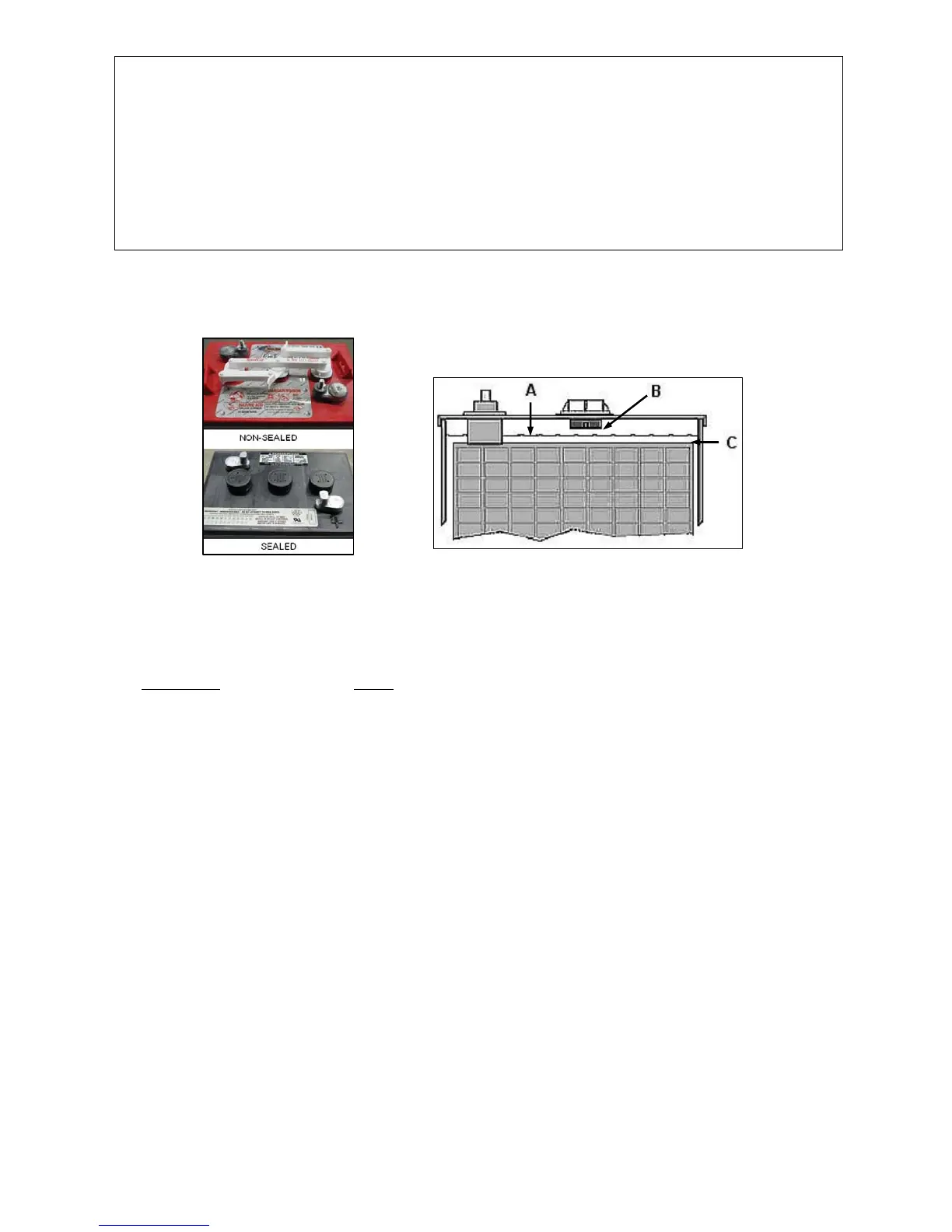
Do not attempt to remove caps from sealed batteries. See Figure 4.2.1
Figure 4.2.2
Figure 4.2.1
F
or non-sealed batteries, check the electrolyte level on new batteries before they are put into service, and, at a
minimum, once a week thereafter. Water use increases as batteries age. (See Section 4.11 if vehicle is equipped with
a Single Point Battery Watering System.)
See Figure 4.2.2. Never allow the electrolyte level (A) to fall below the top of the plates (C). If the plates are exposed,
add only enough to cover the plates before charging. After batteries are fully charged, fill cells to just below the
bottom of the cell vents (B), approximately 1/8” to 1/4”. Electrolyte level should not touch the bottom of the cell vents.
Do not overfill batteries. Electrolyte expands and can overflow during charging. Water added to replace the spillage
dilutes the electrolyte and reduces its specific gravity.
Use only distilled water. Vehicle batteries may use up to 16 quarts of water during their useful life and non-distilled
water may contain harmful minerals which will have a cumulative adverse effect on battery performance and life.
Be sure battery hold downs are properly tightened. A loose hold down may allow the battery to become damaged
from vibration or jarring. A hold down that is too tight may buckle or crack the battery case.
Weekly inspect battery posts, clamps and cables for breakage, loose connections and corrosion. Replace any that
are damaged. Check to see that battery cap vent holes are clear. Plugged vent holes will not permit gas to escape
from the cell and could result in battery damage. Batteries and connections must be clean and dry. See Section 4.3.
2012 Summit
4-2


 To Next Page