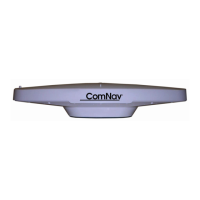
ComNav Vector G2 & G2B Installation & Operation Wiring
The information on pages 2 – 13 in this document replaces the Wiring information on
pages 16 – 18 in Revision 1.6.
Wiring
A single cable, included with the Vector G2, supplies power to it, and also carries
NMEA 0183 data & control signals from & to it. The G2 end of the cable is an
environmentally sealed, mechanically-keyed/locking connector; the other end is
un-terminated, and requires field stripping and tinning.
The cable should be wired to your vessel’s autopilot, and/or other equipment of your choice
that can use NMEA 0183 data. Some typical examples are shown in Figure
1, Figure 3 and
Figure
4.
When choosing a route for the cable:
• Keep the cable well away from rotating machinery
• Avoid running the cable in areas of excessive heat
• Keep the cable away from corrosive chemicals
• Do not run the cable through door or window jams
• Do not excessively bend, or crimp, the cable
• Secure the cable along the route using plastic tie wraps as necessary
Cables & Extensions
There are two standard cable lengths supplied with the Vector G2: 15 metres & 30 metres.
If the standard-length cable supplied with your kit is too long, you may shorten it as required.
If the standard-length cable is too short for your installation, longer cables are available on
special order (contact your ComNav dealer for details).
Alternatively, you can route the cable into a customized break-out box with internal terminal
strips, to a simple set of strips mounted on a bulkhead or other surface, or use good-quality
soldered or crimped, marine-grade, wire-to-wire connection techniques.
Or, if you are using the G2 with a Navigator G2 GPS Compass Display, the latter’s
Distribution Unit has a terminal strip for connecting an extension cable.
But, no matter which extension cable connection method you use:
• The cable should be similar to the standard cable (shielded, marine grade).
• The extension’s serial data (both RS-232 & RS-422) & alarm wires should be at least 20
AWG, and the respective pairs of signals (see Table 2) should be twisted in pairs.
⇒ The total length of RS-232 signal wires (cable plus extension) should be no
longer than industry standards for such cables, although the specific maximum
length may depend on what equipment you are wiring them to; for example, PCs
(especially laptops) often can not handle more than about 25 metres of RS-232
wiring.
⇒ The RS-422 signal wires can support much longer cable runs than the RS-232
wires, since that standard provides for more immunity to noise and attenuation.
• The extension’s power input wires should be at least 18 AWG, to ensure that there is
minimal additional voltage drop in the extension.
Document PN 29010078 V1.6 (Addendum #1) - 2 -


 To Next Page
 Loading...