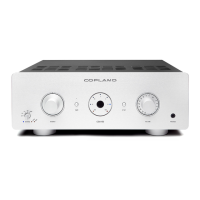
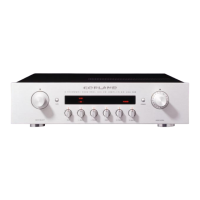
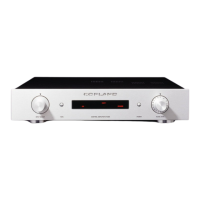
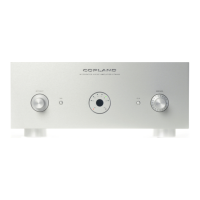
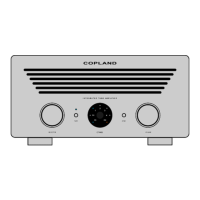
The Copland CSA100 is an integrated amplifier designed to deliver high-quality audio performance. It combines a tube line stage with solid-state amplification, aiming to offer a blend of sonic characteristics often associated with both technologies. The device is intended for audiophiles and music enthusiasts who seek a versatile amplifier capable of handling various audio sources, including digital, analog, and phono inputs, while also providing headphone output and pre-out functionality.
Function Description
The CSA100 serves as the central hub for an audio system, taking signals from multiple sources, amplifying them, and sending them to loudspeakers or headphones. Its core function is to provide clean, powerful, and accurate sound reproduction. The amplifier incorporates a tube in its line stage, which is a key design choice influencing its sonic signature. This tube is operated at a reduced power level to extend its lifespan.
The amplifier features a comprehensive set of inputs to accommodate a wide range of audio components. For analog sources, it includes a dedicated Phono/RIAA section for turntables with MM magnetic pickups, two standard analog inputs (A1, A2), and a balanced analog input. Additionally, there's a Tape In connection for tape recorders. On the digital side, the CSA100 offers a coaxial S/PDIF input, two optical S/PDIF inputs (TOSLINK), and a USB input for connecting to computers. An optional aptX HD Bluetooth board is also available for wireless streaming.
Output options include speaker terminals for connecting left and right channel loudspeakers, a Tape Out (Line Out) for recording, and a Pre-Out for connecting to an active subwoofer or an external power amplifier. A headphone output is also provided on the front panel for private listening.
The CSA100's digital-to-analog converter (DAC) section is designed to handle high-resolution audio files, supporting up to 32-bit files with a 384 kHz signal frequency via its asynchronous USB converter module. This module has its own power supply and transformer secondary winding, indicating a focus on minimizing interference and ensuring stable operation for digital audio processing.
Usage Features
Operating the CSA100 involves a combination of front panel controls and, for certain digital functionalities, interaction with a connected computer.
Front Panel Controls:
- Digital Source Selector: This rotary switch allows users to choose between the various digital input sources (Coaxial, Optical 1, Optical 2, USB). LEDs indicate the active digital source, whether a digital signal is locked, and if an incoming DSD signal is detected.
- Source Selector: Another rotary switch for selecting analog input sources (Phono, Balanced, Analog 1, Analog 2).
- Tape Monitor: A button that, when engaged, allows listening to a connected tape recorder's input, bypassing the main source selector. This is also useful for integrating external processors like equalizers. A red lamp indicates when Tape Monitor is active.
- Display: A central display shows the currently selected source input (e.g., PH for Phono, B. for Balanced, 1. for Analog Input 1, 2. for Analog Input 2, D. for Digital Source). It also indicates power status (On/Stand By) and provides feedback during the startup sequence.
- Power Switch (ST.BY): This button cycles the amplifier between operational mode and standby mode. A flashing 'ON' lamp during startup indicates a 30-second initialization period, followed by an additional 20 seconds before the sound stages become fully operational.
- Volume Control: A rotary knob to adjust the audio level. Turning it clockwise increases the volume.
- Headphone Output: A standard jack for connecting headphones.
Rear Panel Connections:
- Phono/RIAA Section: RCA inputs for a turntable.
- Ground: A terminal for grounding external devices to minimize hum.
- Analog Inputs (A1, A2, Tape In): RCA inputs for various analog sources.
- Balanced Input: XLR inputs for balanced analog sources.
- Tape Out (Line Out): RCA outputs for connecting to a recording device.
- Pre-Out: RCA outputs for connecting to an external power amplifier or active subwoofer.
- Speaker Output Terminals: Binding posts for connecting loudspeakers. It's important to note that the absolute signal phase at these terminals is inverted (180 degrees) due to the tube line stage design. Users are advised to connect speaker wires opposite to the color indication (red speaker wire to black amplifier connector, black to red amplifier connector) to ensure in-phase sound.
- Digital Inputs (Coaxial, Optical 1, Optical 2, USB): Connectors for digital audio sources.
- Reset Button: (Optional Extra for Bluetooth board)
- Antenna: (Optional Extra for Bluetooth board)
- AC Power Connector: Inlet for the main power cord. Users must ensure the supply voltage matches the indication on the back panel.
USB Playback with Computers:
- MAC OS: No driver installation is required. The CSA100 (identified as "Amanero Combo module") should appear as an audio output device in MAC OS preferences after connection. Users can select the sample rate via the MIDI SETTINGS.
- PC (Windows): A specific driver is required. This driver should be installed before connecting the DAC USB to the PC. The driver, identified as "Amanero Technologies USB Driver" or "Amanero Combo module," will appear in the PC's audio device settings. Users can select the sample rate through the "Digital outputs properties" in the sound settings.
General Usage Notes:
- Shielded cables are recommended for signal connections to minimize hum.
- Cables should be run parallel or loosely twisted and kept away from speaker leads and AC power cords.
- When using an active subwoofer with the Pre-Out, setting the subwoofer's phase selector to 180 degrees is recommended as a starting point due to the amplifier's inverted output phase.
- After switching off the amplifier, it's advised to wait half a minute before powering it on again.
- For USB connections, only use USB 2.0 rated cables with a maximum length of 3 meters.
- The amplifier's high-resolution playback capability does not necessitate upsampling; listening to recordings at their original resolution is recommended.
Maintenance Features
The CSA100 is designed for longevity, but certain aspects require attention to ensure continued optimal performance.
- Ventilation: Adequate ventilation is crucial. The amplifier should not be placed on surfaces that obstruct airflow, such as carpets. A minimum ventilation space of 50 cm wide and 40 cm high is recommended to prevent the build-up of high internal temperatures, which can cause deterioration and shorten the amplifier's trouble-free life.
- Tube Life: The heart of the line amplifier is a vacuum tube, which has a finite lifespan, similar to a light bulb. While the tube is operated at approximately 25% of its nominal power to extend its life expectancy, it will eventually affect the amplifier's performance. The expected lifespan of the tube is at least 4000 hours, assuming typical daily on/off cycles. Replacement of the tube should be considered after this period or if performance degrades.
- Fuse: The CSA100 incorporates a 20 mm glass fuse circuit breaker located inside the amplifier on a PCB-fuse socket. The fuse value is 3.15 A.F (6.3 A.F for USA). If the amplifier fails to power on, checking and potentially replacing this fuse might be necessary. However, opening the cabinet should only be done after disconnecting the mains power cord, and repairs or internal maintenance should ideally be carried out by qualified service personnel.
- General Care: The manual advises against subjecting the amplifier to high mechanical vibration, as the tube is sensitive to this. Also, to prevent fire or shock hazards, the unit should not be exposed to rain or moisture. No user-serviceable parts are inside, emphasizing the need for professional service for any internal issues. If liquid is spilled into the amplifier, it should be immediately disconnected from the mains and a qualified service technician consulted.
- Warranty: Copland provides a three-year warranty to the first purchaser. Warranty work is typically handled by Copland agencies in the country of purchase, though arrangements can be made for service in another country with Copland's consent.

 Need help?
 General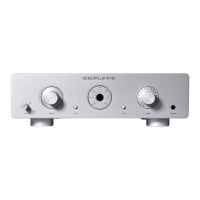

 To Next Page