which could become stuck in the tracks and cause them to break.
Upon start-up, adjust the number of engine revolutions to the desired level
by operating the accelerator lever, according to the power required (when the
machine is loaded, it will be necessary to bring the lever to more than half the
stroke between the minimum and maximum).
In certain conditions, especially with the machine loaded or when moving
uphill, a loss of drive torque may occur due to an overload of the engine,
which can also result in its stopping. In this case, slowly release the drive
levers, adjusting the speed to a level that no longer causes the engine to
overload.
As the machine is equipped with a hydrostatic transmission, the engine
revolutions do not need to be set to maximum for translation. Allowing the
engine to run at maximum rpm does not improve the functionality of the
machine but undoubtedly (and unnecessarily) increases fuel
consumption: it is therefore advisable to increase the engine rpm only where
it is strictly necessary (to move at maximum speed, to tackle considerable
climbs at full load, etc.).
3.5.1.
DRIVING POSITION
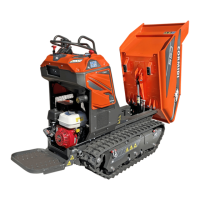
When driving the machine and during work, always use the driving
platform in the lowered position (see fig. 35), to prevent accidents. Close the
platform only after use.
To use the platform, position it correctly (see fig. 2):
•
Pulling the spring pin on the right side of the platform, it unlocks;
•
Rotate the platform to the horizontal position;
•
Once in position it will be automatically locked by the spring pin.


 To Next Page