The Cortex FT10 Free Weight Functional Trainer is a versatile piece of fitness equipment designed for a comprehensive full-body workout. It allows users to perform a wide range of exercises targeting various muscle groups, making it suitable for both beginners and experienced fitness enthusiasts. The functional trainer utilizes free weights, providing a more natural and challenging resistance compared to fixed-path machines, which helps in developing strength, stability, and coordination.
Function Description:
The Cortex FT10 Functional Trainer is primarily designed to facilitate strength training exercises using a cable and pulley system. It features two independent weight stacks (though this model appears to use free weights, as indicated by "Free Weight" in the title and the absence of traditional weight stacks in the diagrams, suggesting plate-loaded functionality or compatibility with external free weights), allowing for unilateral and bilateral movements. The adjustable pulley positions enable users to target muscles from various angles, mimicking real-life movements and improving functional strength.
Key functions include:
- Cable Crossovers: For chest and back development.
- Rows and Pulldowns: To strengthen the back and biceps.
- Presses: For chest, shoulders, and triceps.
- Squats and Lunges: To work the lower body and core.
- Rotational Movements: For core strength and stability.
- Accessory Exercises: Bicep curls, tricep extensions, lateral raises, and more, using various attachments.
The design emphasizes smooth operation of the cables and pulleys, ensuring a consistent and effective resistance throughout the entire range of motion. The robust frame construction provides stability and safety during intense workouts.
Important Technical Specifications (Derived from parts list and assembly instructions):
While specific dimensions and weight capacities are not explicitly stated in the provided pages, the parts list and assembly diagrams offer insights into the trainer's construction and components:
- Frame Material: The components appear to be constructed from heavy-duty steel tubing and plates, suggesting durability and stability. Parts like "Right bottom framework," "Left bottom connection frame," "Right beam frame," and "Top connection frame" indicate a multi-piece, bolted-together frame structure.
- Pulley System: The trainer incorporates numerous pulleys (e.g., Part 21, 22, 23, 24) of various sizes (e.g., L=4550, L=3680 for cables/pulleys, and specific pulley diameters like Φ89 for Part 34). These pulleys are crucial for the smooth operation of the cable system. The presence of multiple pulleys suggests a complex cable routing designed to offer a wide range of motion and exercise options.
- Cable System: The cable system is integral, with cables (e.g., Part 21, 22) routed through various pulleys. The lengths L=4550 and L=3680 likely refer to the lengths of the cables, indicating the extensive reach and versatility of the system.
- Fasteners: A variety of bolts, nuts, and washers are used for assembly, including:
- M10X85 Bolt (Part 33, 4 PCS)
- M10X80 Bolt (Part 34, 2 PCS)
- M10X65 Bolt (Part 35, 54 PCS)
- M12X100 Bolt (Part 38, 4 PCS)
- M6X10 Bolt (Part 41, 2 PCS)
- M10 Washer (Part 31, 1 PCS)
- M12 Washer (Part 36, 29 PCS)
- M6 Washer (Part 39, 4 PCS)
- M10 Nut (Part 32, 1 PCS)
- M12 Nut (Part 37, 14 PCS)
- Spring wings Φ25 (Part 42, 2 PCS)
- Spring wings Φ50 (Part 43, 6 PCS)
- Screw M10X75 (Part 44, 6 PCS)
- Screw M6X10 (Part 45, 6 PCS)
The large number of M10X65 bolts (54 PCS) suggests extensive use in securing various frame components and pulley brackets. The presence of different bolt lengths and diameters indicates specific structural requirements for different parts of the trainer.
- Adjustability: The design includes components like "Adjust the tube" (Part 29) and "Sliding plane" (Part 16), which imply adjustable features for pulley height or other exercise configurations, enhancing the trainer's versatility.
- Accessories: The manual shows various handles and attachments (e.g., Part 17, 18, 19, 20), which are essential for performing different exercises. Part 17 (2 PCS) and Part 18 (1 PCS) are shown as handles, while Part 19 (1 PCS) and Part 20 (1 PCS) appear to be specialized attachments.
- Reinforcement: "Reinforcing plate" (Part 31) indicates structural elements designed to enhance the stability and load-bearing capacity of critical connection points.
- Weight Plate Storage/Loading: While not explicitly detailed, the "Free Weight" designation suggests either integrated plate storage pegs or a design that accommodates standard Olympic or regular weight plates directly onto a loading mechanism, rather than traditional selectorized weight stacks. The diagrams show a mechanism for loading weights (e.g., Part 11, 12, 16, 25, 26, 27, 28) that interacts with the cable system, implying a plate-loaded design.
Usage Features:
- Versatile Exercise Options: The functional trainer's core strength lies in its ability to support a vast array of exercises for all major muscle groups, from strength training to rehabilitation and athletic conditioning.
- Adjustable Pulley Positions: While not explicitly detailed, the nature of a "functional trainer" typically includes adjustable pulley heights, allowing users to customize the angle of resistance for different exercises and target specific muscle fibers. This enhances the effectiveness and safety of workouts.
- Independent Cable Systems: The presence of two separate cable systems (implied by the symmetrical design and dual handles) allows for unilateral training, which helps correct muscle imbalances and improves overall coordination and stability.
- Smooth Operation: The multiple pulleys and cable routing are designed to provide a smooth and consistent resistance, minimizing friction and ensuring a fluid exercise experience.
- Compact Footprint (Implied): While a large piece of equipment, functional trainers are often designed to offer a comprehensive gym experience within a relatively compact space compared to multiple individual machines.
- Safety Features: The robust frame and secure fastening mechanisms contribute to user safety during workouts. The "WARNING" section emphasizes the importance of proper installation, usage, and supervision.
Maintenance Features:
The manual provides general safety and maintenance guidelines, which are crucial for the longevity and safe operation of the equipment:
- Regular Inspection: Users are advised to "Read all instructions carefully before using this product" and to "Retain this owner's manual for future reference." This implies the need for regular checks of all components, especially moving parts and fasteners.
- Lubrication (Implied): While not explicitly stated, cable and pulley systems typically require periodic lubrication to ensure smooth operation and prevent wear.
- Tightening Fasteners: The extensive use of bolts and nuts suggests that users should regularly check and tighten all fasteners to maintain the structural integrity and stability of the frame. The assembly instructions detail numerous connection points that would require attention.
- Cleanliness: Keeping the machine clean and free from dust and debris is generally recommended for all fitness equipment to prevent wear and tear on moving parts.
- Professional Assistance: For complex issues or repairs, the warranty section directs users to contact customer support, indicating that some maintenance or repair tasks may require professional expertise.
- Spotter Recommendation: The manual explicitly states, "A spotter is recommended during exercise," highlighting a safety-conscious approach to using the equipment, especially with free weights.
- Proper Lifting Techniques: "Care must be taken when lifting or moving the equipment so as not to injure your back. Always use proper lifting techniques and/or seek assistance if necessary." This is important during assembly and any potential relocation of the heavy equipment.
Overall, the Cortex FT10 Free Weight Functional Trainer is a comprehensive and robust piece of fitness equipment designed to provide a challenging and versatile workout experience, emphasizing functional strength and stability through its cable and pulley system and free-weight resistance. Proper assembly, regular maintenance, and adherence to safety guidelines are essential for maximizing its benefits and ensuring user safety.

 Need help?
 General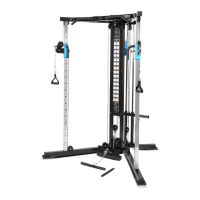

 To Next Page