SECTION PAGE
Warranty ., .................................................. ............. 2
Product Specifications ..................................... _ ............... 2
Safety instructions ........................................................ 3
Accessories and Attachments ............................................... 6
Carton Contents .......................................................... 6
Know Your BeBt/Disc Sander ................................................ 8
Assembly and Adjustments ................................ ................. 9
Operation ............................................................... 14
Maintenance ............................................................ 16
Troubmeshoofing guide .................................................... 17
Parts .................................................................... 18
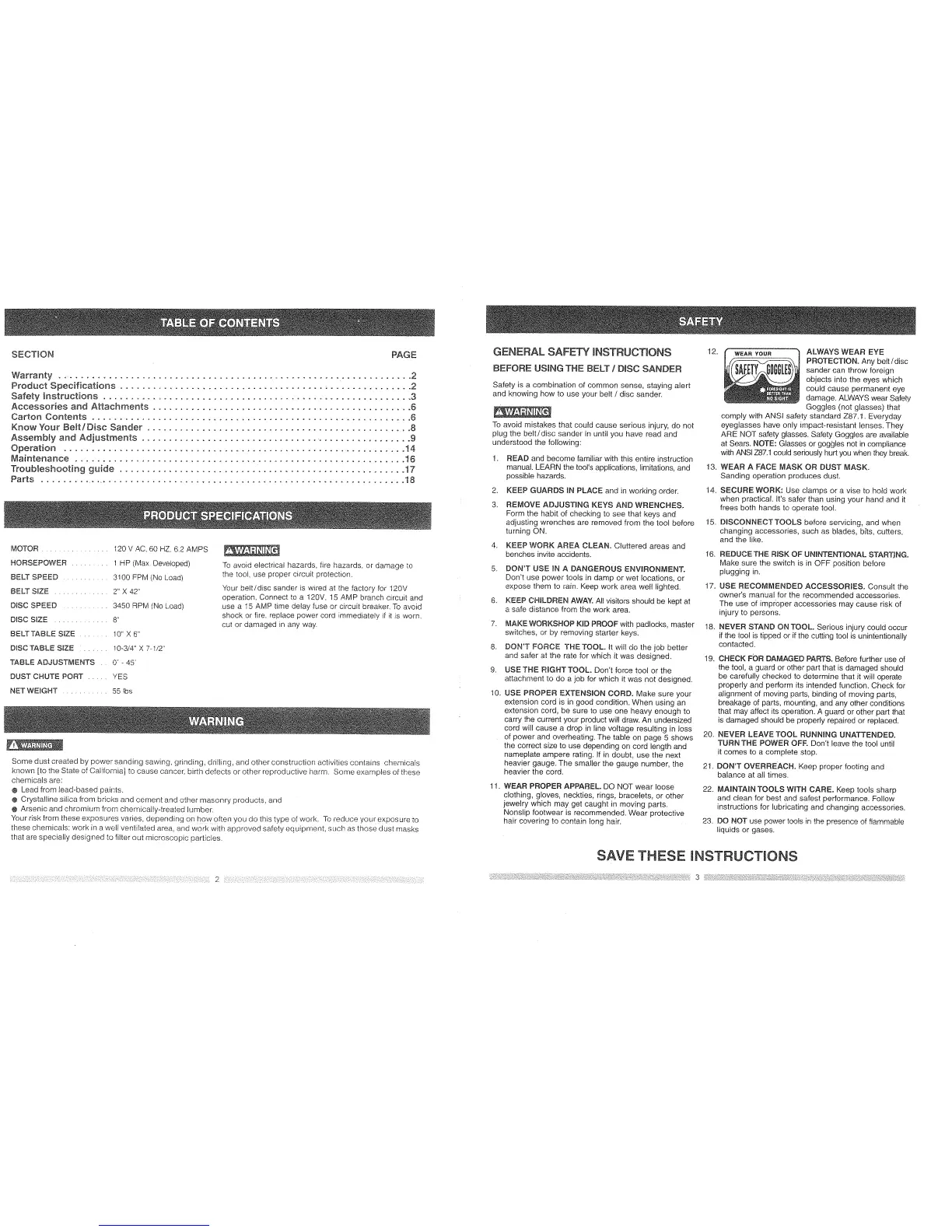
MOTOR ................ 120 V AC, 60 HZ. 6.2 AMPS
HORSEPOWER ......... 1 HP (Max. Developed)
BELT SPEED ........... 3100 FPM (No Load)
BELT SIZE ............. 2" X 42"
DISC SPEED .......... 3450 RPM (No Load)
DISC S_ZE ............. 8'_
BELTTABLE SIZE ....... !0" X 6"
DlSCTABLE SiZE : ...... 10-3/4" X 7_I/2"
TABLE ADJUSTMENTS .. 0 ° - 45"
DUST CHUTE PORT ..... YES
NET WEIGHT ........... 55 Ibs
To avoid electrical hazards, fire hazards, or damage to
the tool, use proper circuit protection.
Your belt/disc sander is wired at the factory for 120V
operation. Connect to a 120V, 15 AMP branch circuit and
.use a 15 AMP time delay fuse or circuit breaker. To avoid
shock or fire. replace power cord immediately if it is worn.
cut or damaged in any way.
Some dust created by power sanding sawing, grinding, drilling, and other construction activities contains chemicals
known [to the State of California] to cause cancer, birth defects or other reproductive harm, Some examples of these
chemicals are:
® Lead from lead-based paints.
@ Crystalline.silica from bricks and cement and other masonry products, and
® Arsenic and chromium from chemically-treated lumber.
Your risk from these exposures varies, depending on ................how often you do this type of work. To reduce you r eXposure to
these chemicals: work in a well ventilated area, and work with approved safety equipment, such as [hose dust masks
that are specially designed to filter out microscopic particles.
GENERAL SAFETY NSTRUCT ONS
BEFORE USING THE BELT / D_SC SANDER
Safety is a combination of common sense, staying alert
and knowing how to use your belt / disc sander.
To avoid mistakes that could cause serious injury, do not
plug the belt/disc sander in until you have read and
understood the following:
,
READ and become familiar with this entire instruction
manual. LEARN the tool's applications, limitations, and
possible hazards.
2. KEEP GUARDS IN PLACE and in working order.
.
,
,
.
.
.
.
t0.
11.
REMOVE ADJUSTING KEYS AND WRENCHES,
Form the habit of checking to see that keys and
adjusting wrenches are removed from the tool before
turning ON.
KEEP WORK AREA CLEAN. Cluttered areas and
benches invite accidents.
DON'T USE IN A DANGEROUS ENVIRONiVIENT.
Don't use power tools in damp or wet locations, or
expose them to rain. Keep work area welt lighted.
KEEP CHILDREN AWAY. Al! visitors should be kept at
a safe distance from the work area.
MAKE WORKSHOP KiD PROOF with padlocks master
switches, or by removing starter keys.
DON'T FORCE THE TOOL. It will do the job better
and safer at the rate for which it was designed.
USE THE R_GHT TOOL. Don't force tool or the
attachment to do a job for which it was not designed.
USE PROPER EXTENSION CORD. Make sure your
extension cord is in good condition. When using an
extension cord, be sure to use one heavy enough to
carry the current your product will draw. An undersized
cord wilt cause a drop in fine voltage resulting in loss
of power and overheating. The table on page5 shows
the correct size to use depending on cord length and
nameplate ampere rating. If in doubt, use the next
heavier gauge. The smaller the gauge number, the
heavier the cord.
t2,
t3.
14.
15.
16.
I7.
18.
t9.
WEARYOUR ALWAYS WEAR EYE
PROTECTION. Any belt/disc
sander can throw foreign
objects into the eyes which
could cause permanent eye
damage. ALWAYS wear Safety
Goggles (not glasses) that
comply with ANSI safety standard Z87.1. Everyday
eyeglasses have only impact-resistant lenses. They
ARE NOT safety glasses. Safety Goggles are available
at Sears. NOTE: Glasses or goggles not in compliance
with ANSI7_87.1could seriously hurt you when they break,
WEAR A FACE MASK OR DUST MASK.
Sanding operation produces dust.
SECURE WORK _.Use clamps or a vise to hold work
when practical. It's safer than using your hand and it
frees both hands to operate tool.
DISCONNECT TOOLS before servicing, and when
changing accessories, such as blades, bits, cutters,
and the like.
REDUCE THE RISK OF UNINTENTIONAL STARTING.
Make sure the switch is in OFF position before
plugging in.
USE RECOMMENDED ACCESSORIES, Consult the
owner's manual for the recommended accessories.
The use of improper accessories may cause risk of
injury to persons.
NEVER STAND ON TOOL. Serious injury could occur
if the tool is tipped or if the cutting tool is unintentionally
contacted.
CHECK FOR DAMAGED PARTS. Before further use of
the tool, a guard or other part that is damaged should
be carefully checked to determine that it wii! operate
properly and perform its intended function. Check for
alignment of moving parts, binding of moving parts,
breakage of parts, mounting, and any other conditions
that may affect its operation. A guard or other part that
is damaged should be properly repaired or replaced.
20. NEVER LEAVE TOOL RUNNING UNATTENDED,
TURN THE POWER OFF. Don't leave the tool until
it comes to a complete stop.
2t, DON'T OVERREACH. Keep proper footing and
balance at all times,
WEAR PROPER APPABEL DO NOT wear loose 22.
clothing, gloves, neckties, rings, bracelets, or other
jewelry which may get caught in moving parts.
Nonslip footwear is recommended. Wear protective
hair covering to contain long hair. 23.
MAINTAIN TOOLS WiTH CARE. Keep tools sharp
and clean for best and safest performance. Follow
instructions for lubricating and changing accessories.
DO NOT use power tools in the presence of flammable
liquids or gases.
SAVE THESE NSTRUCTIONS
3


 To Next Page
 Loading...