
 Need help?
Do you have a question about the Craftsman 358.34110 and is the answer not in the manual?
Explains kickback reaction and how to prevent it.
Techniques to minimize kickback and ensure stable operation.
Proper procedure for setting and checking chain tension.
Instructions for filling and using the oil system for lubrication.
Identifies common issues and provides remedies.
Concise overview of key safety rules, preparation, and operating steps.
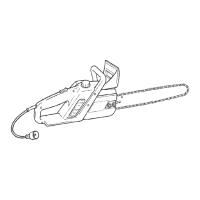
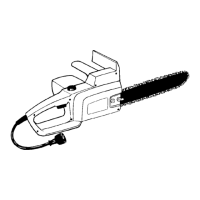
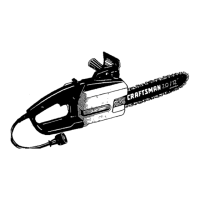
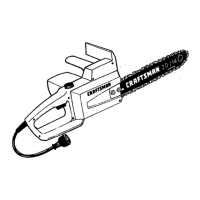
This document is an operator's manual for a Sears/Craftsman 2.0/14" Electric Chain Saw, model number 358.34110. It provides comprehensive instructions for assembly, operation, and maintenance, emphasizing safety precautions to prevent serious injury.
The Sears/Craftsman Electric Chain Saw is a high-speed wood-cutting tool designed for occasional use. Its primary function is to cut wood, including felling small and large trees, bucking (cutting fallen trees into desired log sizes), and debranching/pruning. The saw is powered by an electric motor and features a chain that rotates around a guide bar, equipped with cutting teeth for efficient wood removal. It is designed to be operated with both hands, maintaining a firm grip for control.
The chain saw incorporates several safety features to reduce the risk of kickback, a dangerous reaction that can lead to serious injury. These include a Reduced-Kickback Guide Bar with a small radius tip and a Low-Kickback Chain with a contoured depth gauge and guard link. A handguard is also present to prevent accidental contact with the chain. The saw is double insulated to protect against electric shock, meaning it has two separate layers of electrical insulation.
To operate the saw, the user must first connect it to a proper electric power source. Starting the saw involves pushing a lockout button with the thumb and then squeezing the trigger switch with the index finger. The lockout button prevents unintentional starting. The saw should always be operated with the chain moving at full speed before starting a cut, and turned off only after leaving the material to avoid damage to the trigger switch.
When cutting, the saw frame and spikes should be pressed against the log, allowing the chain to cut with light downward pressure. For tree felling, the manual describes a "notch method" for larger trees, involving a notch cut on the side of the desired fall direction and a felling cut on the opposite side, leaving a hinge of uncut wood to control the fall. Bucking techniques involve making a first cut one-third of the way through the log and finishing with a two-thirds cut on the opposite side, paying attention to logs under strain to prevent pinching. Debranching and pruning should be done after a tree is cut down, starting from the base and working towards the top, removing small limbs with a single overcut. Pruning is limited to limbs at or below shoulder height.
The saw is equipped with a manual oiler actuator/cap that supplies oil to the bar and chain. This oiler should be used regularly and often enough to maintain a thin film of oil on the bar and chain while cutting. An oil level indicator allows the user to check when the tank needs refilling.
A good maintenance program is crucial for increasing the saw's service life and maintaining its safety and performance. Before any servicing or accessory changes, the saw must be unplugged from the power source to avoid accidental starting. Daily cleaning and inspection are recommended after each use. This involves removing the bar and chain, cleaning debris and sawdust from the air inlet and exhaust slots, wiping the saw clean, and removing sawdust and oil from the drive sprocket and bar-mounting pad area. Water, gasoline, kerosene, or other cleaning fluids should not be used on the housing to prevent short circuits and material deterioration.
The guide bar and cutting chain require continuous lubrication and proper tension. The chain tension should be checked frequently, especially when the chain is new or warms up. A loose chain can cause wear, jump off the bar, or damage the saw, while a tight chain can cause damage or breakage. The manual provides detailed instructions for adjusting chain tension using the adjusting screw.
Chain sharpening is a key maintenance task. The chain should be sharpened when wood chips are small and powdery, when the saw has to be forced through the cut, or when it cuts to one side. Before sharpening, the chain should be cleaned of tree sap by soaking it in a petroleum-based solvent or detergent and water solution, then dried and immersed in light oil. Sharpening involves using a file holder, round file, and depth gauge tool to ensure correct hook angle and depth gauge filing. All cutters should be kept the same length and filed from inside toward outside on the forward stroke only.
The guide bar also requires maintenance. Oil holes should be cleaned regularly, and sawdust should be removed from the guide bar groove. Burrs on the side edges of the guide bar grooves should be filed square, and uneven rail tops restored with a flat file. The guide bar should be replaced if the inside groove is worn, or if it is bent or cracked. The sprocket/gear assembly should be cleaned daily and inspected regularly for wear, as a worn sprocket can cause erratic chain operation and shorten the life of the bar and chain. If worn, the sprocket should be replaced by a Sears Service Center.
For storage, especially for periods over 30 days, the saw should be unplugged, the oil tank drained, and the bar and chain removed, cleaned, and dried. The chain should be stored in an oil-filled container to prevent rust, and the bar coated with oil and wrapped. The saw should be stored in a dry place out of reach of children.
 General
| Engine Type | 2-Cycle |
|---|---|
| Bar Length | 18 inches |
| Weight | 13.2 lbs |
| Fuel Capacity | 10.1 fl oz |
| Oil Capacity | 6.8 fl oz |
| Type | Gas-powered |
| Fuel Tank Capacity | 10.1 fl oz |
| Oil Tank Capacity | 6.8 fl oz |
| Chain Gauge | 0.050 inches |




 To Next Page