10
• Pedal to Lower: This button enables the deep pedal tones to be played in the first
two octaves on the lower manual. The two center drawbars control the sound of the
pedal tones. Other than this feature, the only way to trigger the pedal tones in the
instrument is with a pedal board connected to the instrument via the MIDI IN
connector.
It has three states:
1) OFF – led off – pedalboard sound can only be played with an external midi
pedalboard
2) ON1 – led on – pedalboard sound + organ sound on first two octaves of lower
manual.
3) ON2 – led on – pedalboard sound without organ sound on first two octaves of
lower manual.
• Shift Button: This button enables the instrument’s “Edit” mode. Bonus Sounds,
transpose and rotary ON/OFF can be changed with this. For more information, see
Section 7: Edit and Programming Mode and section 8.
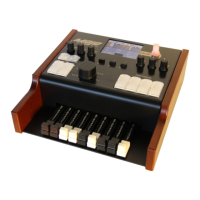
• Drawbars Section: The CRUMAR Mojo has 20 drawbars arranged into two
sections of nine for the upper and lower manuals and a central section of two for the
pedal tones. The drawbars correspond to the “Upper” or “Lower” sections with which
they are arranged. The nine drawbars in each section initially represent the length
of a pipe on a pipe organ and are arranged in the following colors:
Brown: 16', 5-1/3'
White : 8', 4', 2', 1'
Black: 2-2/3', 1-1/3', 1-3/5'
The drawbars allow the mixing of harmonics and the ability to set the volume on
each from minimum of 0 (closed) to a maximum of 8 (fully opened).
From left to right, each set is composed of the following:
In the middle of the two drawbars sets, there are two brown drawbars used to
control the 32’ and 16’ lengths when a MIDI pedal board is connected to the
instrument or when the “Pedal to Lower” function is active.
16'
One octave under the fundamental with repetition of first low
octave
5-1/3'
A fifth above the fundamental
8'
Fundamental
4'
An octave above the fundamental
2-2/3'
An octave and a fifth above the fundamental
2'
Two octaves above the fundamental with repetition of the
last upper octave
1-1/3'
Two octaves and a third above the fundamental
1-3/5'
Two octaves and a fifth above the fundamental
1'’
Three octaves above the fundamental with repetition of the
two last upper octaves



 To Next Page