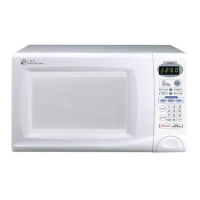
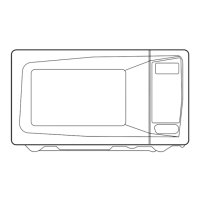
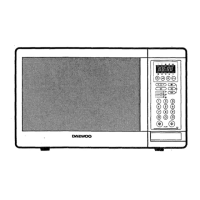
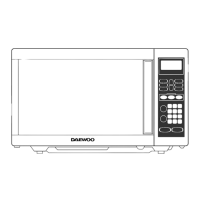
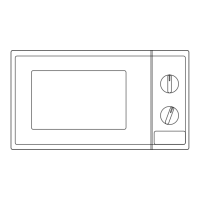
This document describes the Daewoo KOR-816T Microwave Oven, an edition-I model designed for counter-top use. It provides comprehensive operating instructions, safety precautions, technical specifications, and maintenance guidelines.
Function Description
The Daewoo KOR-816T is a microwave oven designed for food preparation. It offers various cooking modes including:
- Microwave Mode: Standard microwave cooking with adjustable power levels.
- Time Defrost: Defrosts food based on a set time.
- Weight Defrost: Defrosts food based on the weight of the food.
- Auto Cook: Pre-programmed settings for specific food types and quantities, simplifying cooking without manual time or power adjustments.
- Speedy Cook: Allows for quick cooking time increments, typically in 30-second intervals.
- Two-Stage Cooking: Enables programming two different power levels and durations consecutively for recipes requiring varied cooking stages.
- Child Safety Lock: A feature to prevent unintended operation, especially by children.
The oven's control panel includes function buttons for selecting desired operations (MICROWAVE, AUTOCOOK, DEFROST), a dial knob for setting time, weight, or quantity, and specific buttons like "+1 min." for increasing operating time, "Stop/Clear" to pause or clear settings, and "Start" to begin an operation. A digital display shows the time of day, cooking time, and other relevant information. Indicator lights on the display panel provide visual feedback on the current operating mode (e.g., MICROWAVE, WEIGHT DEFROST, TIME DEFROST, CHILD SAFETY LOCK, AUTO COOK, STAGE1, STAGE2).
Important Technical Specifications
- Power Supply: 230V~50Hz, single phase with earthing.
- Microwave Power Consumption: 1350 W.
- Output Power: 900 W (IEC 705).
- Frequency: 2450MHz.
- Outside Dimensions (W x H x D): 495 X 289 X 409 mm.
- Cavity Dimensions (W x H x D): 320 X 225 X 330 mm.
- Net Weight: Approximately 15 Kg.
- Timer: 60 min.
- Power Selections: 5 levels (900W, 700W, 500W, 350W, 150W).
- Current Requirement: Approximately 6 amperes.
- Power Supply Cord Length: Approximately 1.1 meters.
The oven is equipped with a glass cooking tray and a roller guide, which are essential for proper operation and even cooking. The door features a latch, seal, and viewing screen, with a safety interlock system to prevent microwave emission when the door is open.
Usage Features
The oven is designed for user-friendly operation with several convenient features:
- Clock Setting: Allows setting the time of day in either a 12-hour or 24-hour format. The clock display blinks when the oven is first plugged in or after a power failure, indicating it needs to be reset.
- Defrosting Options: Offers both time-based and weight-based defrosting, providing flexibility depending on the user's needs. For weight defrost, the digital weight can be set from 200g to 3000g.
- Multi-Stage Cooking: Users can program up to two consecutive cooking stages, each with a different power level and duration, suitable for complex recipes.
- Auto Cook Menus: Five pre-programmed auto cook menus (Beverage, Soup, Casserole, Vegetable, Fish Fillet) are available, each with multiple quantity options, eliminating the need for manual time and power settings. The "More/Less" button allows for adjusting programmed auto cook times by ±10%.
- Speedy Cook: Provides a quick way to start cooking at high power, incrementing time by 30 seconds with each press, up to 5 minutes.
- Child Safety Lock: Activated by pressing "STOP/CLEAR" for 3 seconds, this feature prevents accidental oven use.
- +1 min. Button: Adds one minute to the cooking time during operation, up to 60 minutes.
- Audible Feedback: A beep sounds with each button press, and a buzzer signals the end of cooking. If food is not removed after cooking, the buzzer will sound every minute.
- Door Operation: The oven stops operating immediately when the door is opened, and the time setting is maintained. Cooking can resume by closing the door and pressing "Start."
General guidelines for microwave cooking are provided, including tips on handling undercooked or overcooked food, defrosting techniques, considering food amount, starting temperature, composition, size, and shape, as well as the importance of stirring, turning, covering food, releasing pressure in foods, and standing time.
Maintenance Features
The manual emphasizes several key aspects for maintaining the oven and ensuring its longevity and safe operation:
- Earthing: The appliance must be properly earthed to reduce the risk of electric shock. Users are warned against improper use of the earthing plug and advised to consult a qualified electrician if unsure.
- Installation: Requires a steady, flat surface with adequate clearance around air vents to prevent overheating. It should be positioned away from radio/TV sets and heating appliances/water taps to avoid interference or damage. Users are advised to inspect the oven for damage upon unpacking and to allow it to reach room temperature before operation if delivered in cold weather.
- Cleaning: The sealing area should be wiped frequently with a mild detergent, rinsed, and dried. Abrasive powders or pads should not be used. The oven cavity should not be used for storage.
- Door Integrity: It is crucial that the oven door closes properly and that there is no damage to the door, hinges, latches, or door seals. Any damage to these components can result in excessive microwave energy leakage.
- Professional Repair: The oven should not be adjusted or repaired by anyone except properly qualified service personnel. The power supply cable is a special type and, if damaged, must be repaired with a cable of the same type, purchased from Daewoo and installed by a qualified person.
- Troubleshooting: A "Before Calling for Service" section provides a chart of common operating problems and their solutions, such as checking if the start button is pressed, the power cord is plugged in, the door is closed, or if approved cookware is used.
- Empty Operation: While not recommended, running the oven empty for a short time will not damage it. However, prolonged empty operation can cause damage.
- Ventilation: Steam accumulation on the door is normal due to the air flow pattern, and the oven vents should never be blocked during cooking. Smoke from the exhaust vent is also normal during cooking, especially if food is overcooked.
The manual also lists suitable cooking utensils, emphasizing that metal with trim, recycled paper products, and certain plastics (polyethylene, melamine, phenol) should not be used. Glass or ceramic heat-proof dishes are excellent, while wood or straw can be used for short periods. Aluminum foil should only be used in very small pieces for shielding and kept at least 2.5cm from oven side walls.

 Need help?
 General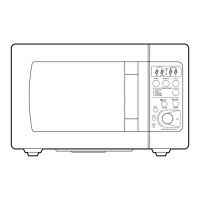

 To Next Page