EasyManua.ls Logo

DAHON Folder 1987 - 6.3.10 Sprockets, Chain, and Guards; 6.3.11 Hubs

DAHON Folder 1987
21 pages
Print Icon
To Next Page IconTo Next Page
To Previous Page IconTo Previous Page
Loading...
B.
Adjustment,
Trouble
Shooting
and
Maintenance
The two
locknuts
(C-124)
should be
periodically
inspected
and, when neces-
sary, adiusted
so
that
the
crank is held firmly,
but
not
so tight
that the crank re-
quires pounding
or excessive
pressure
to be
folded.
lf the
crank wobbles
easily
when unlatched,
the
pin
assembly
may
be
worn
and
should be replaced
if it is.
lf
wobbling
continues, take
to
a
dealer
for
specialized servicing.
When
the crank
is
latched,
if it sirs loose
in the crank
latch
(T-2110)
or if the
latch requires
excessive
strength to
close,
adjust
the
crank',depth,,by
turning
the
two
adjustment
screws
(c-1
1.1
)
with
a
philip
screw
driver
counter clockwise
(for
tightening)
or
clockwise
(for
loosening).
Caution: The
latch
should be closeable with ohly
moderate
force,
pounding
or
excessive force
will damaee
it.
6.3.4.
Saddle and
Seat
Post
System
(Excluding
Clamps)
A.
Disassembly
and
Assembly
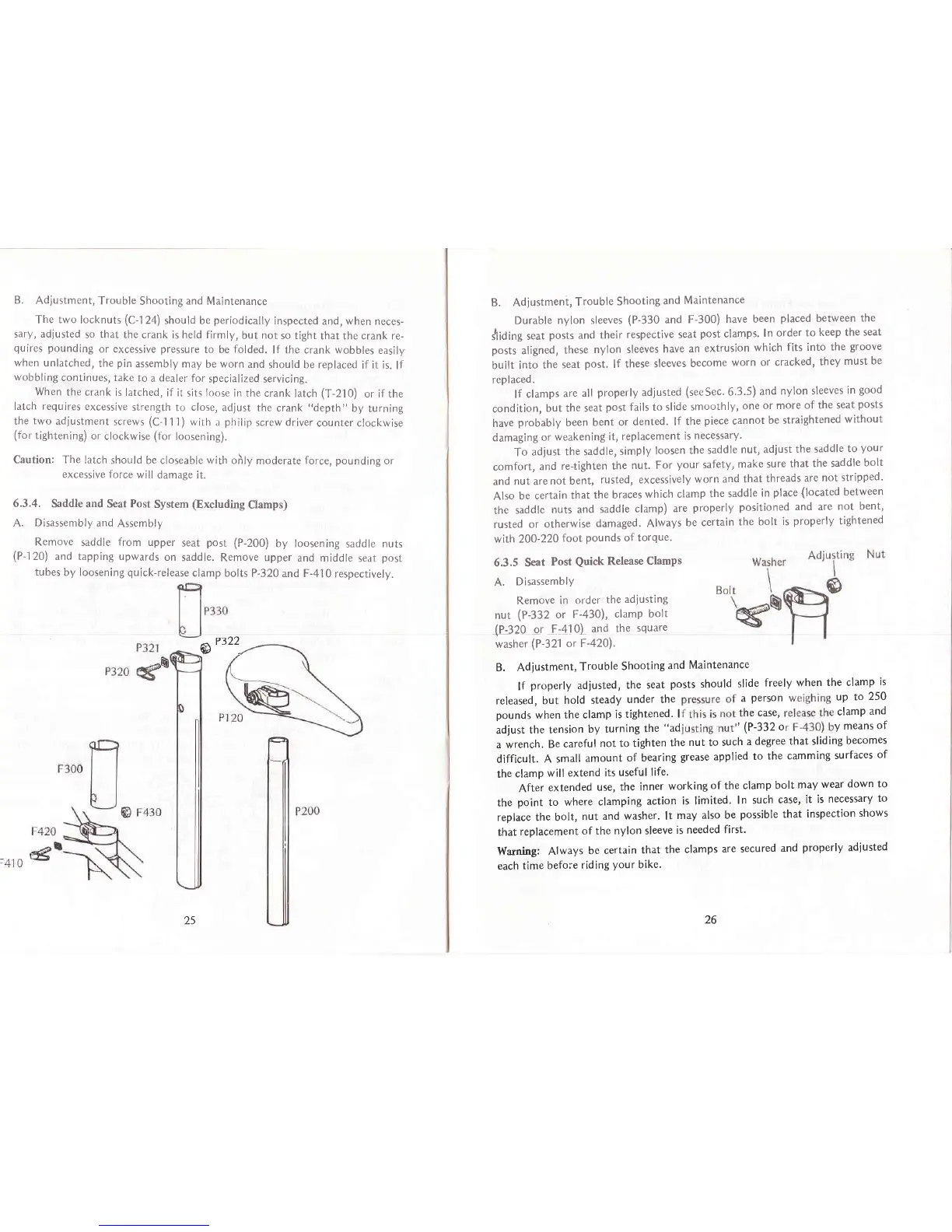
Remove
saddle
from
upper
seat
post
(P-200)
by
loosening saddle nuts
(P-1
20) and tapping
upwards
on
saddle.
Remove
upper
and middle
sear
posr
tubes
by loosening
quick-release
clamp
bolts P-320
and F-41
0 respectively.
@P322,
25
26
B. Ad
justment,
Trouble
Shooting
and
Maintenance
Durable
nylon sleeves
(P-330 and F-300)
have been
placed
between
the
stiding
seat
posts
and
their
respective seat
post
clamps'
In
order
to
keep
the seat
posts
aligned,
these
nylon sleeves
have
an
extrusion
which
fits
into
the
groove
built into
the
seat
post.
lf
these
sleeves
become
worn
or cracked,
they
must
be
replaced.
lf
clamps
are
all
properly
adjusted
(seesec.6.3.5) and
nylon
sleeves
in
good
condition,
but the seat
post
fails to slide
smoothly,
one
or
more
of
the seat
posts
have
probably
been
bent
or
dented. lf
the
piece
cannot
be straightened
without
damaging
or
weakenin$
it,
replacement
is
necessary'
To
adjust
the saddle,
simply
loosen
the
saddle
nut,
adlust
the
saddle
to
your
comfort,
and
re-tighten
the
nut. For
your
safety,
make sure
that
the saddle
bolt
and
nut are
not bent,
rusted, excessively
worn and
that
threads
are
not
stripped'
Also
be
certain
that
the
braces
which clamp
the saddle
in
place
(located
between
the
saddle
nuts and
saddle
clamp)
are
properly
positioned and are
not
bent'
rusted
or
otherwise
damaged. Always
be certain
the
bolt
is
properly
tightened
with
200-220
foot
pounds
of torque.
6.3.5 Seat
Post
Quick
Release
Clamps
A.
DisassemblY
Remove
in
order
the
adiusting
nut
(P-332
or
F-430),
clamp
bolt
1Pi20
or
l!10)
and
the
square
washer
(e3Zl
or F-420).
B. Adjustment,
Trouble
Shooting
and
Maintenance
lf
properly
adjusted,
the
seat
posts
should
slide
freely
when
the clamp
is
released,
but
hold
steady
under the
a
person
up to
250
pounds
when
the clamp
is
tightened.
I
the
case,
clamp
and
adjust
the tension
by turning
the
"ad
'
(P-332 o
y
means
of
a
wrench.
Be
careful
not to tighten
the
nut
to
such
a
degree that sliding
becomes
difficult.
A small
amount
of bearing
grease
applied
to
the
camming
surfaces
of
the
clamp
will
extend its
useful life.
After
extended
use, the
inner
working
of
the clamp
bolt
may
wear
down to
the
point
to
where
clamping
action
is limited.
In
such
case, it
is
necessary
to
replace
the bolt,
nut
and
washer. lt
may
also be
possible
that
inspection
shows
that
replacement
of the
nylon sleeve
is
needed
first'
Warning: Always
be
certain
that
the clamps
are secured
and
properly
adjusted
each
time
befo;e
riding
Your
bike.

Related product manuals