
 Need help?
Do you have a question about the Dahua Villa and is the answer not in the manual?
Connect VTO to switch, switch to router, and VTO to lock strike.
Assign static IP addresses to VTO and VTH according to router settings.
Guide through device boot, language selection, initialization, IP/time settings, and finalization.
Verify VTO and VTH status shows 'Online' via the VTO web interface.
Check door contact type and confirm P2P status is 'Online' in device settings.
Download and install the DMSS mobile application on your smartphone.
Log into VTO web, locate QR code, and scan with DMSS to add the VTO device.
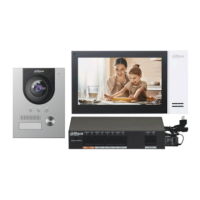
The Dahua Intercom Villa Kit KTP01 is a comprehensive video intercom system designed for residential use, offering a blend of security, communication, and convenience. This kit includes an outdoor station, an indoor monitor, and a Power over Ethernet (PoE) switch, providing all the essential components for a functional intercom setup. The system facilitates seamless communication between visitors at the outdoor station and residents inside the home via the indoor monitor, with additional capabilities for remote access and control through a mobile application.
The primary function of the Dahua Intercom Villa Kit KTP01 is to enable secure and convenient communication with visitors at the entrance of a villa or residence. The system allows residents to see and speak with visitors before granting access, enhancing security.
The Outdoor Station (DHI-VTO2202F-P) is the external component of the system, typically mounted at the entrance gate or door. It features a camera for video surveillance of the entrance area, a microphone for audio input, and a speaker for audio output, enabling two-way communication. It also includes a call button that visitors press to initiate a call to the indoor monitor. Crucially, the outdoor station integrates with door locks, allowing residents to remotely unlock the door for visitors. This integration supports various lock strike types (COM, NC, or NO), offering flexibility for different door lock mechanisms.
The Indoor Monitor (DHI-VTH2421FW-P) serves as the central control unit inside the residence. It features a screen to display video feeds from the outdoor station, a microphone, and a speaker for two-way audio communication. Residents can answer calls from the outdoor station, view live video, and remotely unlock the door directly from the indoor monitor. The indoor monitor is also responsible for managing the system's IP addresses when operating as a standalone intercom system without an external router. It provides a user-friendly interface for initial setup, language selection, and system configuration.
The PoE Switch (PFS3005-4ET-60) simplifies the wiring and power supply for the outdoor station and indoor monitor. PoE technology allows both power and data to be transmitted over a single Ethernet cable, reducing the complexity of installation and the number of cables required. This switch ensures that both the VTO and VTH receive stable power and network connectivity, which is essential for their operation.
Beyond basic intercom functions, the KTP01 kit extends its capabilities through network integration. When connected to a home router, the system enables remote access via a mobile application (DMSS). This feature allows residents to receive calls from the outdoor station on their smartphones, view live video, and unlock the door from anywhere with an internet connection. This is particularly useful for residents who are away from home but need to manage visitor access.
The Dahua Intercom Villa Kit KTP01 is designed for ease of use, from initial setup to daily operation.
Installation and Wiring: The wiring process is straightforward, requiring the VTO and VTH to be connected to the PoE switch. If remote app functionality is desired, the PoE switch is then connected to the home's router. The outdoor station's connection to the door lock strike is flexible, accommodating different lock types. This simplified wiring, thanks to PoE, makes installation less cumbersome.
Initial Configuration: The system guides users through an initialization process. Upon powering on the PoE switch, both the outdoor station and indoor monitor boot up. The indoor monitor's screen prompts for language selection and requires the user to set a six-digit password for security, with an email address for password recovery. A "quick configuration" option streamlines the setup, allowing the system to automatically detect and display all connected units.
Device Initialization and IP Assignment: Both the VTH and VTO require initialization. The VTH's password is a simple six-digit number, while the VTO requires a more robust 8-32 character password combining numbers, letters, and special characters for enhanced security. For network functionality, both devices need static IP addresses, which can be configured through the indoor monitor's interface. However, in a standalone setup without an external router, the VTH automatically manages IP addresses, simplifying the process. The system provides an intuitive interface to edit IP addresses, netmask, gateway, and time settings for both the indoor monitor and outdoor station.
One-Key Configuration: A "One-key Config" feature further simplifies the network setup, allowing the system to automatically configure network parameters for all connected devices, making the system ready for use quickly.
Web Interface Access: For advanced configuration and monitoring, users can access the VTO's web interface via a web browser. This interface provides detailed status information, including the online status of both the VTO and VTH, ensuring that all components are functioning correctly. It also allows for checking and adjusting the "Door Contact Type" and "Unlock Period," which are crucial for proper door lock operation.
Mobile App Integration (DMSS): The DMSS mobile application is a key feature for remote management. After downloading and installing the app, users can add the VTO by scanning a QR code found in the VTO's web interface. This links the outdoor station to the mobile app, enabling remote call answering, live video viewing, and door unlocking. The app also allows for enabling alarm subscriptions, ensuring that users receive notifications for incoming calls even when away from home. The app's interface provides access to device details, configuration settings, and notification management.
Daily Operation: Once configured, the system operates seamlessly. When a visitor presses the call button on the outdoor station, the indoor monitor rings, displaying the visitor's video feed. Residents can then engage in two-way audio communication and choose to unlock the door. If the mobile app is set up, the call is also routed to the smartphone, offering the same functionalities remotely.
While the manual primarily focuses on setup and usage, several aspects touch upon maintenance and system health.
Status Monitoring: The VTO's web interface provides a "Status" section where users can verify if both the VTO and VTH are "Online." This is a fundamental diagnostic tool to ensure all components are communicating correctly within the network. If a device is offline, it indicates a potential issue with power, network connection, or configuration that needs attention.
P2P Status Check: For users relying on the mobile app, checking the "P2P status" in the VTO's web interface is crucial. A "P2P Online" status confirms that the outdoor station is successfully connected to the cloud service, enabling remote access via the DMSS app. If the P2P status is not online, it suggests a network connectivity problem or an issue with the P2P service itself.
Firmware Updates (Implied): Although not explicitly detailed as a maintenance feature, network-connected devices like the VTO and VTH typically support firmware updates. These updates often introduce new features, improve performance, and address security vulnerabilities. Regular checks for and application of firmware updates are a common maintenance practice for such devices to ensure optimal operation and security.
Password Management: The system incorporates password recovery mechanisms (via email for the VTH) to prevent lockout situations. This is a practical maintenance feature, as forgotten passwords can be a common issue.
Network Configuration Adjustments: The ability to edit IP addresses, netmask, and gateway settings through the VTH or VTO web interface allows for network troubleshooting and adjustments if the home network configuration changes. This flexibility is important for maintaining connectivity in dynamic network environments.
Door Lock Configuration: The "Door Contact Type" and "Unlock Period" settings in the VTO's web interface allow for fine-tuning the door lock operation. If the door lock is not functioning as expected, these settings can be reviewed and adjusted to ensure proper access control.
In summary, the Dahua Intercom Villa Kit KTP01 is a robust and user-friendly intercom system that combines local and remote communication capabilities with essential security features. Its design emphasizes ease of installation and configuration, making it accessible for residential users, while offering advanced functionalities through network integration and mobile app support.
 General
| Video Compression | H.264 |
|---|---|
| Category | Villa Door Station |
| Audio Input | Built-in microphone |
| Audio Output | Built-in speaker |
| Network Protocol | TCP/IP |
| Power Supply | DC 12V |
| Audio Compression | G.711 |
| Ethernet | 10/100Mbps |
| Camera | 2MP CMOS |
| Night Vision | Yes, IR LED |
| Audio | Two-way audio |
| Connectivity | Wi-Fi |
| Operating Humidity | 10%–90% (RH) |




 To Next Page