IM 1287-6 • REBEL APPLIED ROOFTOP 58 www.DaikinApplied.com
Installing Ductwork
WARNING
Mold can cause serious illness or property damage. Materials such as
gypsum wallboard can promote mold growth when damp. Such materials
must be protected from moisture that can enter units during maintenance
or normal operation.
On bottom-supply/bottom-return units, if a Daikin Applied roof
curb is not used, installing contractor should make an airtight
connection by attaching eld fabricated duct collars to the
bottom surface of either the roof curb’s duct ange or the unit’s
duct opening. Do not support the total weight of the duct work
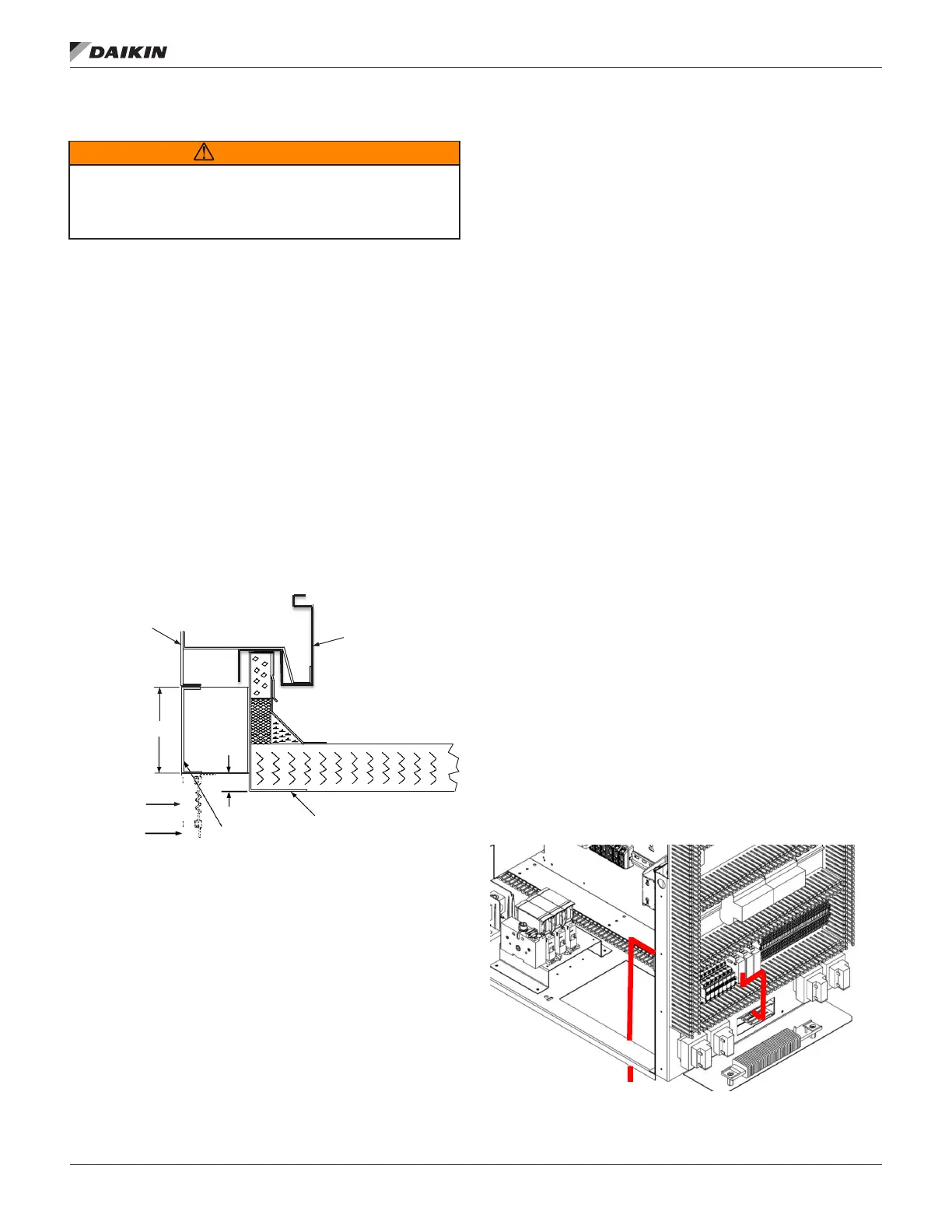
from the unit or these duct anges. See Figure 117.
Use exible connections between the unit and ductwork to
avoid transmission of vibration from the unit to the structure.
To minimize losses and sound transmission, design duct work
per ASHRAE and SMACNA recommendations.
Where return air ducts are not required, connect a sound
absorbing T or L section to the unit return to reduce noise
transmission to the occupied space.
Ductwork exposed to outdoor conditions must be built in
accordance with ASHRAE and SMACNA recommendations
and local building codes.
Figure 117: Installing Duct Work
Installing Duct Pressure Taps
Units that will operate as a VAV unit require a reading of the
duct static pressure. This requires that pressure taps be eld
installed and plumbed back to the pressure sensors in the unit.
There may be up to two duct static pressure sensors on a unit;
DSP1 is provided when the unit is built for VAV operation and
an additional sensor DSP2 is optional. When present, these
sensors are located within the Low Voltage Control Panel
shown in Figure 3 on page 6.
Carefully locate and install the eld provided pressure tap.
Improperly locating or installing the DSP1 or DSP2 tap may
cause unsatisfactory operation of the building VAV system.
Consider the following pressure tap location and installation
recommendations. The installation must comply with all
applicable local code requirements.
1. Install a tee tting with a leak-tight removable cap in each
tube near the sensor tting. This facilitates connecting a
manometer or pressure gauge if testing is required.
2. Dierentiate between the duct pressure (HI) and
reference pressure (LO) taps by using dierent
color tubing or by tagging the tubes. Daikin Applied
recommends 3/16ʺ I.D. plastic tubing.
3. Locate the duct pressure (HI) tap near the end of a long
duct to ensure that all terminal box take-os along the
run have adequate static pressure.
4. Locate the duct pressure tap in a non-turbulent ow area
of the duct. Keep it several duct diameters away from
take-o points, bends, neckdowns, attenuators, vanes, or
other irregularities that may create turbulent air ow.
5. Use a static pressure tip (Dwyer A302 or equivalent) or
the bare end of the plastic tubing for the duct tap. (If the
duct is lined inside, use a static pressure tip device.)
6. Install the pressure tap so that it senses only static
pressure (not velocity pressure). If a bare tube end is
used, it must be smooth, square (not cut at an angle) and
perpendicular to the airstream.
7. Locate the reference pressure (LO) tap somewhere near
the duct pressure tap within the building.
8. If the reference pressure tap is not connected to the
sensor, unsatisfactory operation will result.
9. Route the tubes between the curb and the supply
duct, feeding them into the Main Control Panel through
the Panel Entrance Plate. Connect the tubes to their
respective inlets on the appropriate pressure sensor in
the Low Voltage Control Panel. See Figure 118 for the
suggested routing for the tubing.
Figure 118: Recommended Tubing Route to Sensors
Unit duct opening
Unit base
9.76"
Flexible
connector
Ductwork
4.58"
Duct flanger
in roof curb
Roof curb


 To Next Page
 Loading...