18 | Piping installation
Installer and user reference guide
106
RXYSA8~12AMY1B
VRV 5-S system air conditioner
4P752782-1A – 2024.02
18.3.6 To insulate the refrigerant piping
After finishing the leak test and vacuum drying, the piping must be insulated. Take
into account the following points:
▪ Make sure to insulate the connection piping and refrigerant branch kits entirely.
▪ Be sure to insulate the liquid and gas piping (for all units).
▪ Use heat resistant polyethylene foam which can withstand a temperature of 70°C
for liquid piping and polyethylene foam which can withstand a temperature of
120°C for gas piping.
▪ Reinforce the insulation on the refrigerant piping according to the installation
environment.
Ambient temperature Humidity Minimum thickness
≤30°C 75% to 80% RH 15mm
>30°C ≥80% RH 20mm
Between outdoor and indoor unit
NOTICE
It is recommended that the refrigerant piping between indoor and outdoor unit is
installed in a ducting or the refrigerant piping is wrapped with finishing tape.
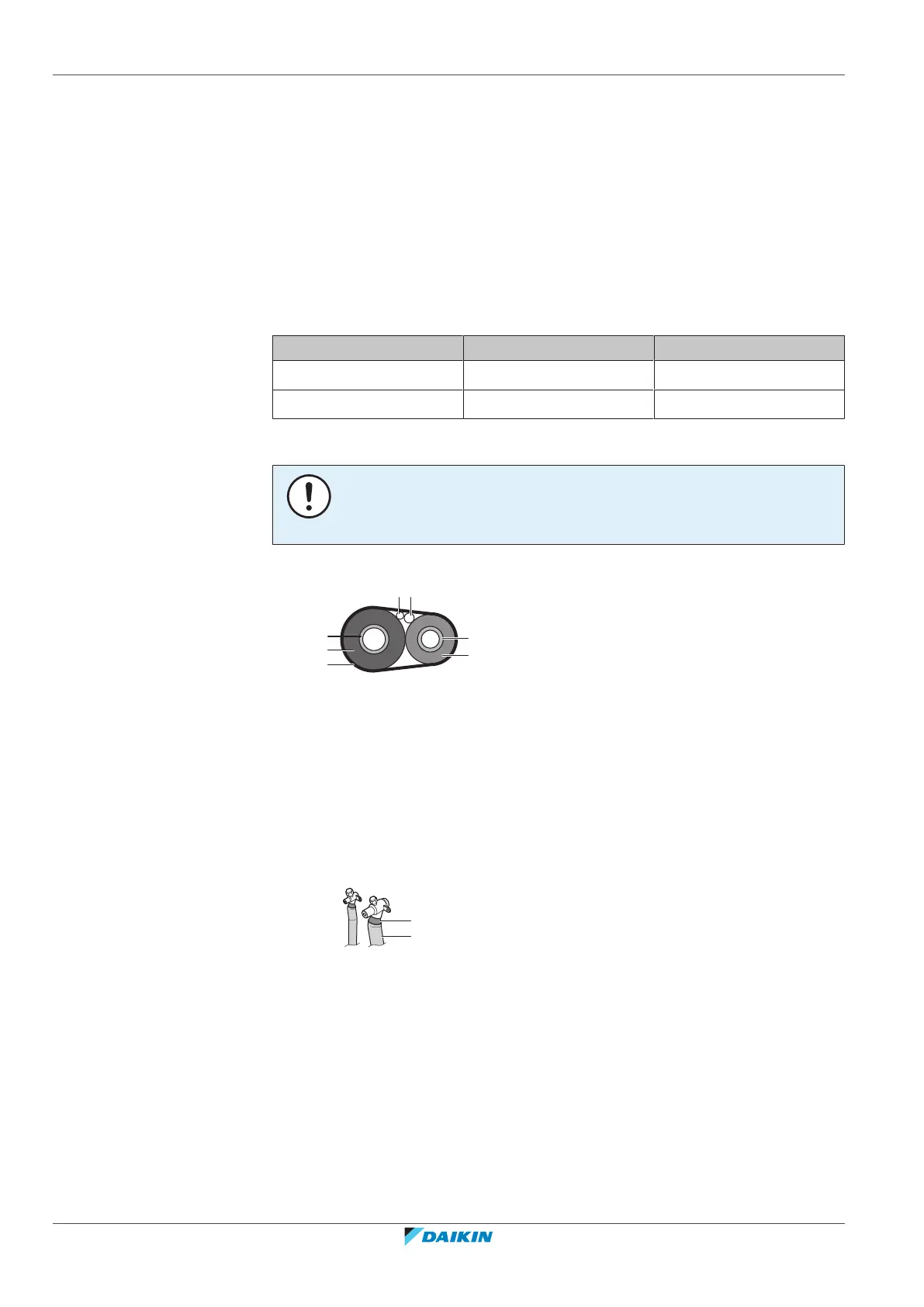
1 Insulate and fix the refrigerant piping and cables as follows:
a Gas pipe
b Gas pipe insulation
c Interconnection cable
d Field wiring (if applicable)
e Liquid pipe
f Liquid pipe insulation
g Finishing tape
2 Install the service cover.
Inside the outdoor unit
To insulate the refrigerant piping, proceed as follows:
a Insulation material
b Caulking etc.
1 Insulate the liquid and gas piping.
2 Wind heat insulation around the curves, and then cover it with vinyl tape.
3 Make sure the field piping does not touch any compressor components.
4 Seal the insulation ends (sealant etc.) (b, see above).
5 Where necessary, wrap the field piping with vinyl tape to protect the
insulation against sharp edges.
6 If the outdoor unit is installed above the indoor unit, cover the stop valves
with sealing material to prevent condensed water on the stop valves from
moving to the indoor unit.







 To Next Page