Need help?
Do you have a question about the Danfoss TE 5 and is the answer not in the manual?
Lists approved refrigerants and specifies maximum working and test pressures for TE valves.
Step-by-step instructions and considerations for installing valves via soldered connections.
Details the procedure and requirements for installing valves using flange connections.
Specifies torque values for connections and lists necessary tools like Allen and Torx keys.
Guidance on calculating and setting superheat, including static superheat values by range.
Presents tables of rated capacities for TE 5, TE 12, TE 20, and TE 55 valves across various refrigerants.
This document provides an installation guide for Danfoss thermostatic expansion valves, specifically the TE 5, TE 12, TE 20, and TE 55 types. These valves are designed to regulate the flow of refrigerant into evaporators, ensuring optimal performance in refrigeration systems.
Thermostatic expansion valves (TXVs) are crucial components in refrigeration and air conditioning systems. Their primary function is to control the superheat of the refrigerant at the evaporator outlet. Superheat is the difference between the actual temperature of the refrigerant vapor and its saturation temperature at the same pressure. By maintaining a constant superheat, the TXV ensures that the evaporator is fully utilized without allowing liquid refrigerant to return to the compressor, which could cause damage.
The TE series valves operate based on the principle of balancing forces. A temperature-sensing bulb, filled with a charge similar to the system's refrigerant, is attached to the evaporator outlet. Changes in the superheat at the evaporator outlet cause the pressure within the bulb to change, which in turn acts on a diaphragm inside the valve. This diaphragm movement adjusts the opening of the valve's orifice, thereby regulating the flow of liquid refrigerant into the evaporator. If the superheat increases, indicating insufficient refrigerant in the evaporator, the bulb pressure rises, opening the valve further to allow more refrigerant in. Conversely, if the superheat decreases, the bulb pressure drops, closing the valve to reduce refrigerant flow.
The valves are designed to work with a wide range of refrigerants, including R407F, R407A, R448A, R449A, R452A, R513A, R404A, R507, R22, R134a, and R407C. A complete list of approved refrigerants is available on the Danfoss website. This versatility makes them suitable for various applications in commercial refrigeration, air conditioning, and heat pump systems.
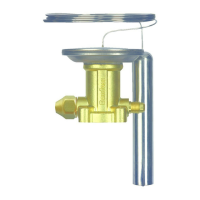
The TE series valves are available in different configurations to suit various system requirements. The document illustrates three main types: TE 5, TE 12/TE 20, and TE 55, each with distinct physical dimensions and connection types.
Installation: The installation process involves several key steps, whether using solder or flange connections.
Pressure Ratings: The valves are designed to withstand significant pressures:
Superheat Adjustment: The valves feature a superheat adjustment mechanism, which allows fine-tuning of the superheat setting to optimize system performance. The document illustrates how to adjust the superheat using an Allen key. Turning the adjustment screw clockwise typically increases superheat, while turning it counter-clockwise decreases it. The static superheat is set at 4 K / 7.2°F, but for range B, it needs to be adjusted. The document provides guidelines for superheat adjustment based on the valve type and range:
MOP (Maximum Operating Pressure) Functionality: Some models may include an MOP function, which limits the evaporator pressure to a maximum value. This protects the compressor from overload, especially during start-up or rapid changes in load. The diagram shows a "12 MOP" indicator, suggesting that certain TE 12 models incorporate this feature.
Rated Capacity: The document includes a comprehensive table of rated capacities for different refrigerants (R407F, R407A, R448A/R449A, R404A/R507, R22, R134a, R407C) and orifice sizes (0.5 to 13). These capacities are provided in both kW and TR (tons of refrigeration) and are based on specific operating conditions:
While the document primarily focuses on installation and usage, several aspects imply ease of maintenance:
In summary, the Danfoss TE series thermostatic expansion valves are designed for precise refrigerant flow control, offering versatility with multiple refrigerants and robust construction. Their installation is guided by clear instructions for both solder and flange connections, with specific torque values for critical components. The ability to adjust superheat and replace orifices contributes to their adaptability and ease of maintenance, making them a reliable choice for various refrigeration applications.
 General
| Supply Voltage | 24 V AC/DC |
|---|---|
| Refrigerant | R134a, R404A, R407C, R410A, R507, R22 |
| Control Signal | PWM |
| Application | Refrigeration |
| Relative Humidity | 95% RH |
| Storage Temperature Range | -40°C to +85°C |

 To Next Page