Need help?
Do you have a question about the Danfoss PVG 16 and is the answer not in the manual?
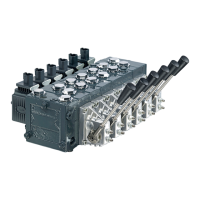
Explains the PVG valve as a load-sensing proportional valve for optimal machine performance.
Details key features like load-independent flow control, energy-saving, and compact design.
Overviews the different modules (PVP, PVB, actuation) that make up the PVG valve assembly.
Illustrates an open circuit load sense system using PVG valves and pump.
Describes how load sensing matches system requirements for pressure and flow, maintaining standby mode.
Explains pressure compensation for maintaining constant system pressure by varying pump output.
Details two-stage control for multiple PC settings, used in low and high pressure applications.
Describes the open center version of the PVP for fixed displacement pumps and flow control.
Explains the closed center version of PVP for variable displacement pumps and flow control.
Shows a manlift control system, emphasizing fault monitoring and safety.
Illustrates a typical wiring diagram for PVE systems, including fault detection.
Presents wiring block diagrams for PVG 32 with different pump types and controls.
Demonstrates fault monitoring for hydraulic system deactivation using PVEs with DI function.
Outlines essential conditions for assembly, emphasizing cleanliness and proper practices.
Describes the basic assembly sequence for PVG 16 and PVG 32 valve groups.
Details the steps for assembling the PVG 16 valve, including actuator mounting.
Details the steps for assembling the PVG 32 valve, including actuator mounting.
Describes the assembly for PVMR actuators with detent option.
Describes the assembly for PVMF actuators with mechanical float option.
Explains the procedure for performing a compressed air leak test on PVG assemblies.
Details how to set relief valves using a gauge after assembly.
Describes how to perform dynamic manual and electrical operation tests on PVG assemblies.
Lists the necessary tools for PVG assembly and testing.
Provides a template for specifying PVG 16 valve configurations and settings.
Provides a template for specifying PVG 32 valve configurations and settings.
The document describes the Danfoss PVG 16 and 32, a series of hydraulic, load-sensing proportional valves designed for optimal machine performance and maximum design flexibility. The modular concept of the PVG valve allows machine designers to tailor a valve solution for various market segments and applications. Its load-independent proportional control, high-performance actuator technology, and low-pressure drop design contribute to improved machine performance, efficiency, increased productivity, and reduced energy consumption.
The PVG 16 and 32 valves are designed to provide load-independent flow control. This means that the oil flow to an individual function remains independent of its own load pressure, and also independent of the load pressure of other functions within the system. This characteristic ensures good regulation and energy-saving operation. The valves can accommodate up to 12 basic modules per valve group and offer various connection thread types, contributing to a compact design and ease of installation.
The PVG system operates with either open-center or closed-center pump configurations. In an open-center system (with fixed displacement pumps), when the pump starts and main spools are in neutral, oil flows from the pump, through connection P, across the pressure adjustment spool to the tank. This flow determines the standby pressure. When a main spool is actuated, the highest load pressure is fed to the spring chamber behind the pressure adjustment spool, partially or completely closing the connection to the tank to maintain pump pressure. A pressure relief valve opens if load pressure exceeds a set value, diverting pump flow back to the tank. In pressure-compensated basic modules, a compensator maintains a constant pressure drop across the main spool, regardless of load changes or other actuated modules. Non-pressure-compensated modules may include a load drop check valve to prevent return oil flow. Shock and suction valves protect individual working functions from overload and cavitation. Adjustable LS pressure limiting valves can be built into A and B ports to limit pressure from individual working functions, saving energy compared to PVLP valves.
In a closed-center system (with variable displacement pumps), an orifice and a plug are fitted instead of the open-center plug. The pressure adjustment spool opens to the tank when pressure in channel P exceeds the pressure relief valve's set value. The pressure relief valve in the PVP should be set approximately 30 bar [435 psi] above the maximum system pressure. In load-sensing systems, load pressure is fed to the pump control via the LS connection. In neutral, the pump load sense control adjusts displacement to compensate for system leakage and maintain standby pressure. When a main spool is actuated, the pump load sense control adjusts displacement to maintain the set differential pressure (margin) between P and LS.
The document emphasizes safety in application, noting that all control valves can fail, and necessary protection against serious consequences must be built into the system. It recommends FMEA (Failure Mode and Effect Analysis) and Hazard and Risk Analysis (ISO 12100-1/14121) to determine required protection levels. It also includes typical wiring block diagrams for man-lift control systems, highlighting fault monitoring and hydraulic deactivation features, and stresses the equipment manufacturer's responsibility for ensuring conformity with relevant machine directives.
 General
| Brand | Danfoss |
|---|---|
| Model | PVG 16 |
| Category | Control Unit |
| Language | English |

 To Next Page