EasyManua.ls Logo

dbx 128 - HOW dbx II TAPE NOISE REDUCTION WORKS; dbx System Overview

dbx 128
42 pages
Print Icon
To Next Page IconTo Next Page
To Previous Page IconTo Previous Page
Loading...
26
HOW
dbx
I!
TAPE
NOISE
REDUCTION
WORKS
A
Short
Explanation
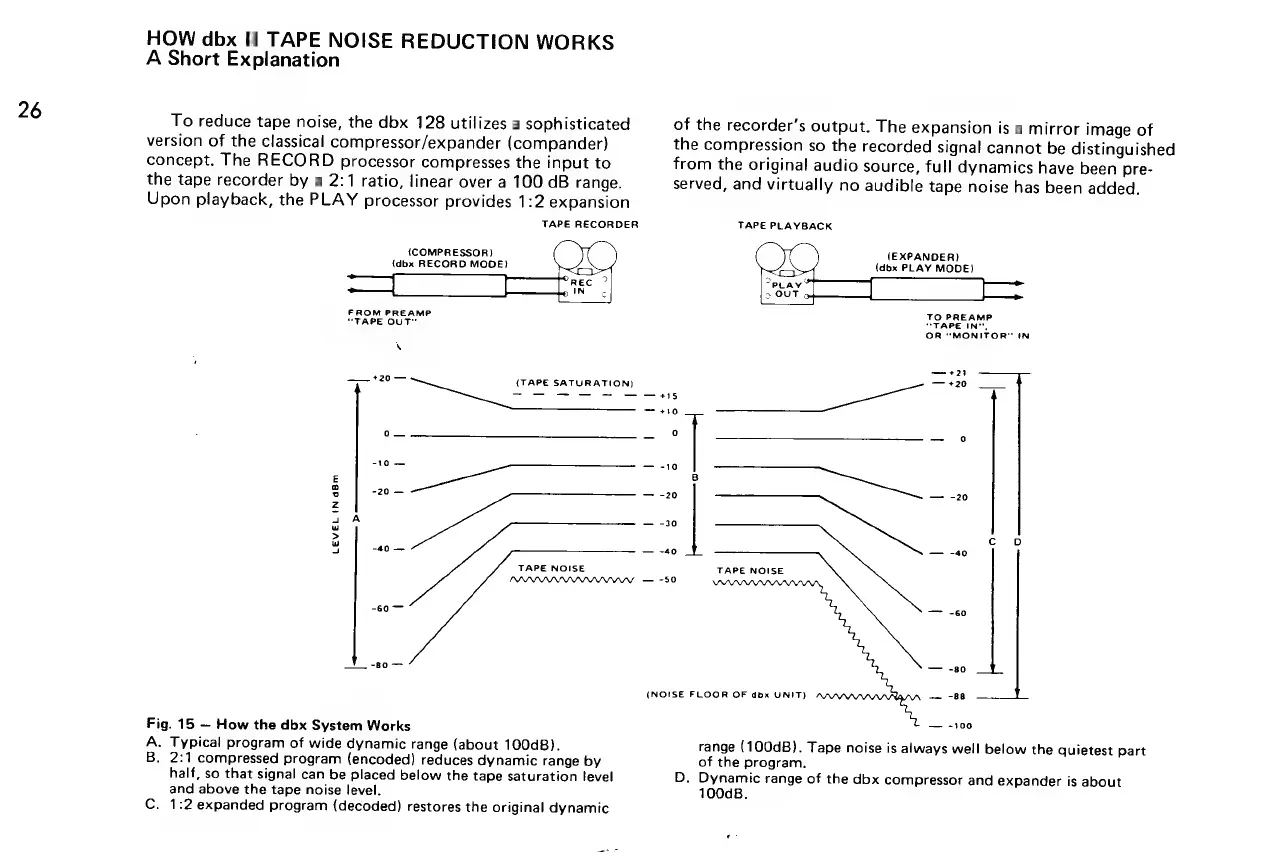
To
reduce
tape
noise,
the
dbx
128
utilizes
a
sophisticated
version
of
the
classical
compressor/expander
(compander)
concept.
The
RECORD
processor
compresses
the
input
to
the
tape
recorder
by
a
2:1
ratio,
linear
over
a
100
dB
range.
Upon
playback,
the
PLAY
processor
provides
1:2
expansion
TAPE
RECORDER
{COMPRESSOR}
{dbx
RECORD
MODE}
FROM
PREAMP
“TAPE
OUT"
\
LEVEL
IN
oBm
>
-40
-60
380°
Fig.
15
How
the
dbx
System
Works
A.
Typical
program
of
wide
dynamic
range
(about
100dB).
B.
2:1
compressed
program
(encoded)
reduces
dynamic
range
by
half,
so
that
signal
can
be
placed
below
the
tape
saturation
tevel
and
above
the
tape
noise
level.
C.
1:2
expanded
program
(decoded)
restores
the
original
dynamic
py)
of
the
recorder’s
output.
The
expansion
is
a
mirror
image
of
the
compression
so
the
recorded
signal
cannot
be
distinguished
from
the
original
audio
source,
full
dynamics
have
been
pre-
served,
and
virtually
no
audible
tape
noise
has
been
added.
TAPE
PLAYBACK
(EXPANDER)
(dbx
PLAY
MODE)
TO
PREAMP
“TAPE
IN",
OR
"MONITOR"
IN
—+27
+20
TAPE
NOISE
(NOISE
FLOOR
OF
dbx
UNIT)
-88
-100
range
(100dB).
Tape
noise
is
always
well
below
the
quietest
part
of
the
program.
D.
Dynamic
range
of
the
dbx
compressor
and
expander
is
about
100dB.

Related product manuals