EasyManua.ls Logo

dbx 128 - dbx II Tape Noise Reduction; Expansion and Compression Explained

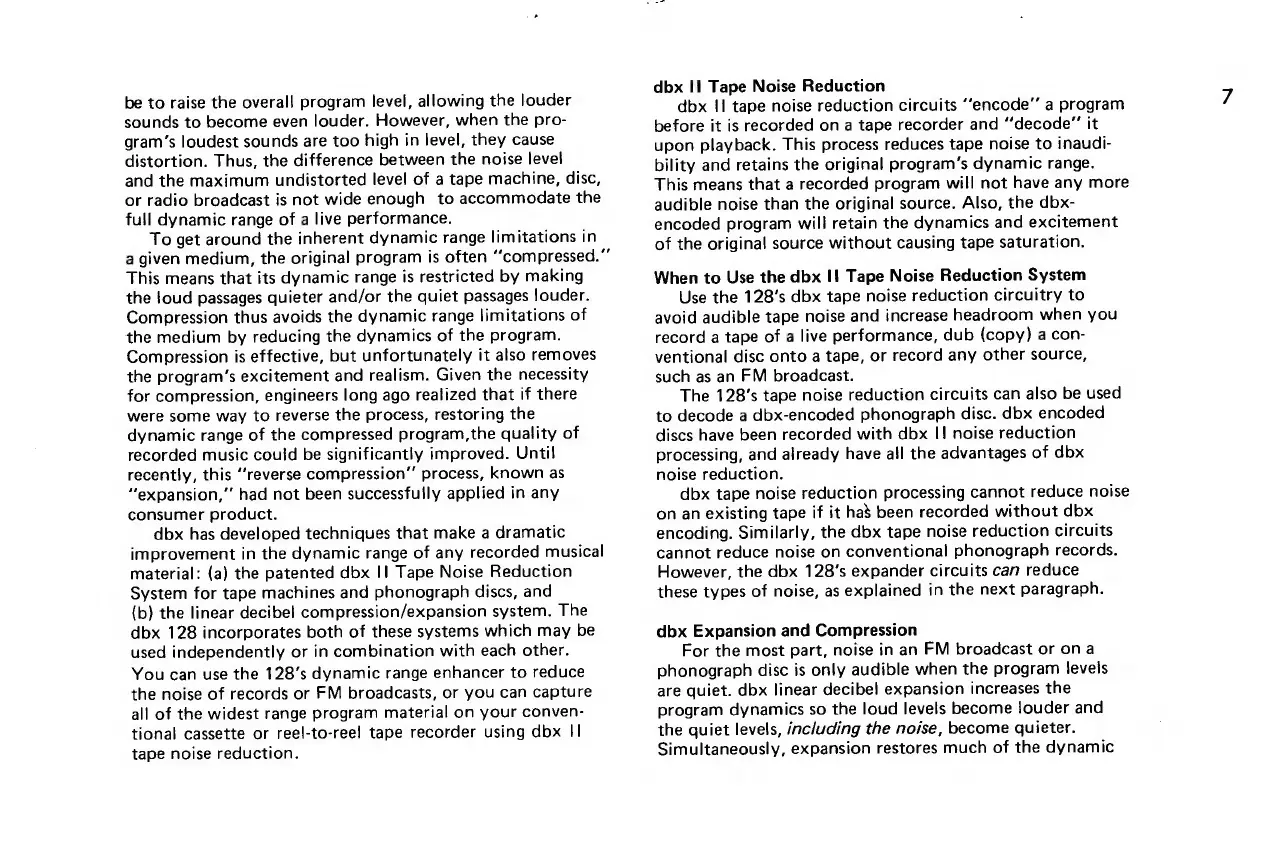
dbx 128
42 pages
Print Icon
To Next Page IconTo Next Page
To Previous Page IconTo Previous Page
Loading...
be
to
raise
the
overall
program
level,
allowing
the
louder
sounds
to
become
even
louder.
However,
when
the
pro-
gram’s
loudest
sounds
are
too
high
in
level,
they
cause
distortion.
Thus,
the
difference
between
the
noise
level
and
the
maximum
undistorted
level
of
a
tape
machine,
disc,
or
radio
broadcast
is
not
wide
enough
to
accommodate
the
full
dynamic
range
of
a
live
performance.
To
get
around
the
inherent
dynamic
range
limitations
in
a
given
medium,
the
original
program
is
often
‘‘compressed.”’
This
means
that
its
dynamic
range
is
restricted
by
making
the
loud
passages
quieter
and/or
the
quiet
passages
louder.
Compression
thus
avoids
the
dynamic
range
limitations
of
the
medium
by
reducing
the
dynamics
of
the
program.
Compression
is
effective,
but
unfortunately
it
also
removes
the
program’s
excitement
and
realism.
Given
the
necessity
for
compression,
engineers
long
ago
realized
that
if
there
were
some
way
to
reverse
the
process,
restoring
the
dynamic
range
of
the
compressed
program,the
quality
of
recorded
music
could
be
significantly
improved.
Until
recently,
this
‘reverse
compression”
process,
known
as
“expansion,”
had
not
been
successfully
applied
in
any
consumer
product.
dbx
has
developed
techniques
that
make
a
dramatic
improvement
in
the
dynamic
range
of
any
recorded
musical
material:
(a)
the
patented
dbx
II
Tape
Noise
Reduction
System
for
tape
machines
and
phonograph
discs,
and
(b)
the
linear
decibel
compression/expansion
system.
The
dbx
128
incorporates
both
of
these
systems
which
may
be
used
independently
or
in
combination
with each
other.
You
can
use
the
128’s
dynamic
range
enhancer
to
reduce
the
noise
of
records
or
FM
broadcasts,
or
you
can
capture
all
of
the
widest
range
program
material
on
your
conven-
tional
cassette
or
reel-to-reel
tape
recorder
using
dbx
II
tape
noise
reduction.
dbx
Il
Tape
Noise
Reduction
dbx
11
tape
noise
reduction
circuits
‘‘encode”’
a
program
before
it
is
recorded
on
a
tape
recorder
and
“‘decode”
it
upon
playback.
This
process
reduces
tape
noise
to
inaudi-
bility
and
retains
the
original
program’s
dynamic
range.
This
means
that
a
recorded
program
will
not
have
any
more
audible
noise
than
the
original
source.
Also,
the
dbx-
encoded
program
will
retain
the
dynamics
and
excitement
of
the
original
source
without
causing
tape
saturation.
When
to
Use
the
dbx
I!
Tape
Noise
Reduction
System
Use
the
128’s
dbx
tape
noise
reduction
circuitry
to
avoid
audible
tape
noise
and
increase
headroom
when
you
record
a
tape
of
a
live
performance,
dub
(copy)
a
con-
ventional
disc
onto
a
tape,
or
record
any
other
source,
such
as
an
FM
broadcast.
The
128’s
tape
noise
reduction
circuits
can
also
be
used
to
decode
a
dbx-encoded
phonograph
disc.
dbx
encoded
discs
have
been
recorded
with
dbx
I!
noise
reduction
processing,
and
already
have
all
the
advantages
of
dbx
noise
reduction.
dbx
tape
noise
reduction
processing
cannot
reduce
noise
on
an
existing
tape
if
it
ha’
been
recorded
without
dbx
encoding.
Similarly,
the
dbx
tape
noise
reduction
circuits
cannot
reduce
noise
on
conventional
phonograph
records.
However,
the
dbx
128’s
expander
circuits
can
reduce
these
types
of
noise,
as
explained
in
the
next
paragraph.
dbx
Expansion
and
Compression
For
the
most
part,
noise
in
an
FM
broadcast
or
ona
phonograph
disc
is
only
audible
when
the
program
levels
are
quiet.
dbx
linear
decibel
expansion
increases
the
program
dynamics
so
the
loud
levels
become
fouder
and
the
quiet
levels,
inciuding
the
noise,
become
quieter.
Simultaneously,
expansion
restores
much
of
the
dynamic

Related product manuals