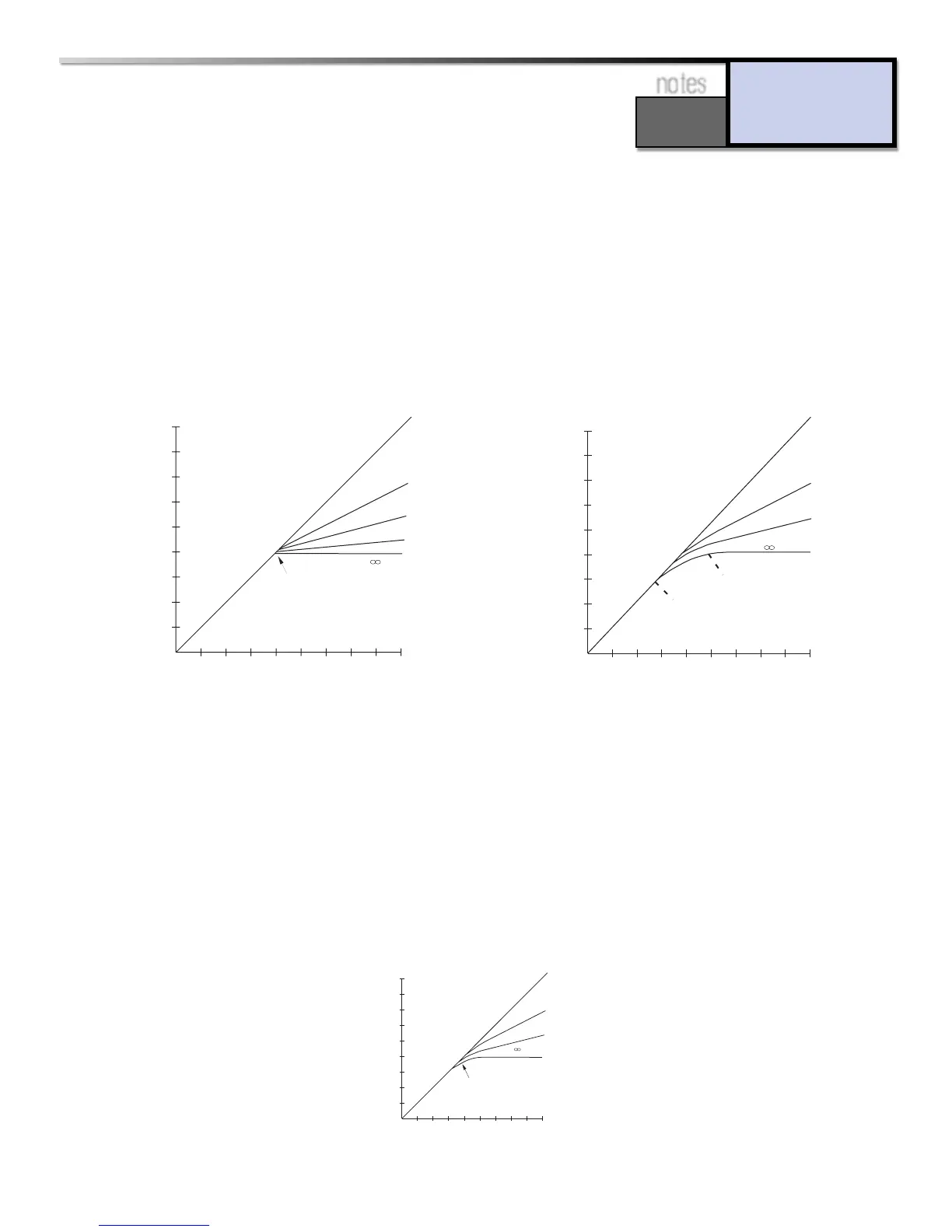
In a typical hard-knee compressor, the threshold control sets a reference level above which input sig-
nals will be attenuated in the manner defined by the setting of the Compression ratio control. Input
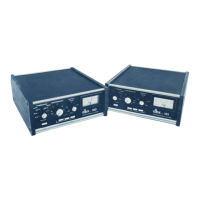
signals which fall below this level will pass through unprocessed. With OverEasy compression, signals
begin to gradually activate the 160S's gain change circuitry as they approach the threshold reference level
and they do not get fully processed in the manner defined by the Compression control until they have
passed somewhat above the threshold reference level. There is no distinct point at which processing
begins, and the threshold setting corresponds to a point on the input/output transfer curve midway
between the onset of processing and that point at which the transfer curve corresponds to the setting of
the Compression control. The following diagrams also show how the 160S's threshold indicator LEDs
correlate with the compression curves.
When an input signal is above the threshold reference level, the setting of this control determines the
number of decibels by which the input signal must change in level to produce a 1dB increase in the sig-
nal level at the output of the 160S. A setting of 2:1 indicates an input:output ratio wherein a 2dB increase
in input signal (above threshold) will produce a 1dB increase in output signal. A setting of ∞:1 indicates
that an infinite increase in input level would be required to raise the output level by 1dB. In other words,
the output level is constant when the input signal is above threshold. The 160S's Compression control
covers the entire range from 1:1 to ∞:1. The control curve of the compression potentiometer has been
designed to provide total operator control, with scale expansion at the subtle lower ratios for easy,
repeatable settings.
Using The Compression Control
OverEasy® And Hard Knee
19



 To Next Page