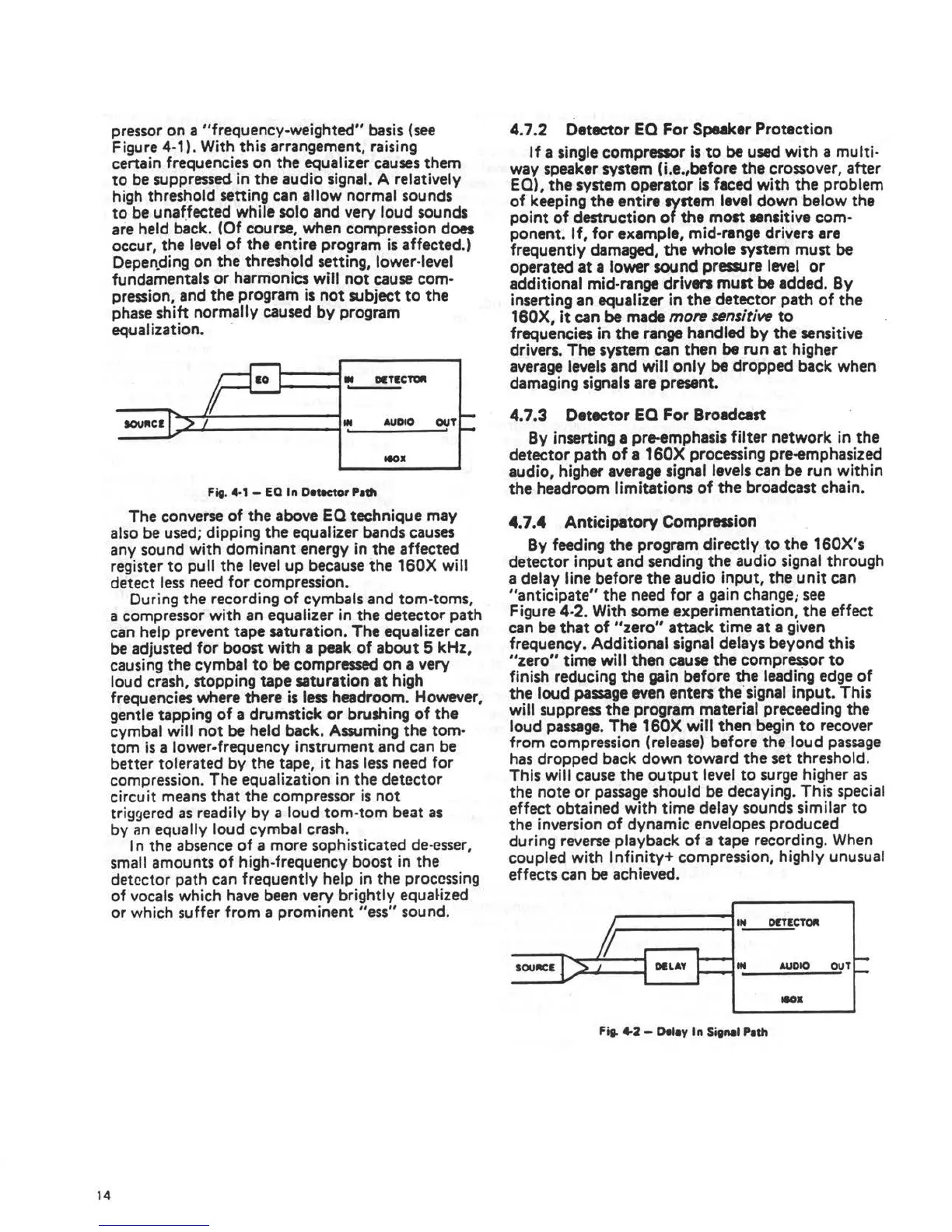
pressor on a "frequency-weighted" basis (see
Figure 4-1). With this arrangement, raising
certain frequencies on the equalizer causes them
to be suppressed in the audio signal. A relatively
high threshold setting can allow normal sounds
t~ be una~fected while solo and very loud sounds
are held back. (Of course, when compression does
occur, the level of the entire program is affected.)
Depen.ding on the threshold setting, lower-level
fundamentals or harmonics will not cause com-
pression, and the program is not subject to the
phase shift normally caused by program
equalization. ·
10
.. NffCTOR
IOUflCI
.,
.. AUDIO
OUT -
-
leOJI
Fig. 4•1 - EQ In DetKtor Padl
The converse of the above EQ technique may
also be used; dipping the equalizer bands causes
any sound with dominant energy in the affected
register to pull the level up because the 160X will
detect less need for compression.
During the recording of cymbals and tom-toms,
a compressor with an equalizer in the detector path
can help prevent tape saturation. The equalizer can
be adjusted for boost with a peak of about 5 kHz.
causing the cymbal to be compressed on a very
loud crash, stopping tape saturation at high
frequencies where there is less headroom. However,
gentle tapping of a drumstick or brushing of the
cymbal will not be held back. Assuming the tom-
tom is a lower-frequency instrument and can be
better tolerated by the tape, it has less need for
compression. The equalization in the detector
circuit means that the compressor is not
triggered as readily by a loud tom-tom beat as
by an equally loud cymbal crash.
14
In the absence of a more sophisticated de-esser,
small amounts of high-frequency boost in the
detector path can frequently help in the processing
of vocals which have been very brightly equaHzed
or which suffer from a prominent "ess" sound.
.
4. 7 .2 Detector EQ For Speaker Protection
If a single compressor is to be used with a multi-
way speaker system (i.e.,before the crossover, after
EQ), the system operator is faced with the problem
of keeping the entire system level down below the
point of destruction of the most sensitive com-
ponent. If. for example, mid-range drivers are
frequently damaged, the whole system must be
operated at a lower sound pressure level or
additional mid-range driven must be added. By
inserting an equalizer in the detector path of the
160X, it can be made more unsitive to
frequencies in the range handled by the sensitive
drivers. The system can then be run at higher
average levels and will only be dropped back when
damaging signals are present.
4.7.3 Detector EQ For Broadcast
By inserting a pre-emphasis filter network in the
detector path of a 160X processing pre-emphasized
audio, higher average signal levels can be run within
the headroom limitations of the broadcast chain.
4. 7 .4 Anticipatory Compression
By feeding the program directly to the 160X's
detector input and sending the audio signal through
a delay line before the audio input, the unit can
"anticipate" the need for a gain change; see
Figure 4-2. With some experimentation, the effect
can be that of "zero" attack time at a given
frequency. Additional signal delays beyond this
''zero" time will then cause the compressor to
finish reducing the gain before the leading edge of
the loud passage even enters the .signal input. This
will suppress the program material preceeding the
loud passage. The 160X will then begin to recover
from compression (release) before the loud passage
has dropped back down toward the set threshold.
This will cause the output level to surge higher as
the note or passage should be decaying. This special
effect obtained with time delay sounds similar to
the inversion of dynamic envelopes produced
during reverse playback of a tape recording. When
coupled with Infinity+ compression, highly unusual
effects can be achieved.
IN
OfTECTOft
j
....
IOUIICE
......_ I
DILAY
IN AUDIO OUT
....
leOJI
Fit- 4-2 - Deley In Sitnal Path


 To Previous Page
 Loading...