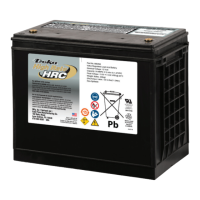
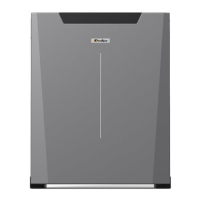
The Deka Ready Power Lithium Motive Power Industrial Battery is designed for powering Class I, II, and III forklift trucks, particularly in high-intensity two and three-shift operations. It utilizes Lithium Iron Phosphate (LiFePO4) technology, which is considered a high-performance and safe Li-Ion chemistry.
Function Description:
The battery provides electrical power to forklift trucks. It features internal contactors that control the flow of electricity, allowing the battery to be "turned on" for operation and charging, or "turned off" for storage, maintenance, and shipping. The battery system includes a Battery Management System (BMS) that monitors user inputs and sensors, ensuring maximum product functionality and safety. In case of a fault, the BMS can initiate an Early Warning Shutdown (EWS) with an audible alarm and countdown, or an Emergency Power Off (EPO) for high-severity faults, which results in an immediate shutdown. Diagnostic Trouble Codes (DTCs) are generated to help identify and resolve issues.
Important Technical Specifications:
The Deka Ready Power Lithium batteries are available in a wide assortment of 24V, 36V, and 48V configurations, all UL listed.
- Voltage (V): 24V, 36V, 48V
- Capacity (AH): Ranges from 525AH to 1050AH, depending on the model.
- Energy (0-100SOC) WH: Ranges from 13,440 WH to 53,760 WH.
- Weight: Varies significantly by model, from 1000 lbs (454 kgs) for a 24V-525AH battery to 5500 lbs (2494 kgs) for a 48V-1050AH battery.
- Max Continuous Discharge (Amps): 340A (Traditional Line) or 350A (High Performance Line).
- Max Continuous Charge (Amps): 340A (Traditional Line) or 350A (High Performance Line).
- Max Discharge Current (Amps): 340 rated (Traditional Line) or 380 limited (High Performance Line).
- Max Charging Current (Amps): 340 rated (Traditional Line) or 380 limited (High Performance Line).
- Max 10 Second Pulse Regen Charge (Amps): 1000A.
- Max 10 Second Pulse Regen Discharge (Amps): 1000A.
- Max 30 Second Pulse - Charge (Amps): 1200A (High Performance Line).
- Max 30 Second Pulse - Discharge (Amps): 1200A (High Performance Line).
- Max 1 Second Pulse - Discharge (Amps): 1500A (High Performance Line).
- Ambient Temperature - Charge: 5° to 45°C (41° to 113°F) for Traditional Line; 0° to 27°C (32° to 81°F) or 5° to 45°C (41° to 113°F) for High Performance Line.
- Ambient Temperature - Discharge: 0° to 50°C (32° to 122°F) for Traditional Line; 0° to 27°C (32° to 81°F) or 0° to 50°C (32° to 122°F) for High Performance Line.
- Storage Temperature: 0° to 45°C (32° to 113°F).
Usage Features:
- User Interface Module (UIM): An accessory with an LCD screen, menu control buttons, and a power button. It displays the State of Charge (SOC), remaining run time, lifetime AH throughput, active fault conditions, and shutdown alarms. Operators can navigate through different pages to view fault codes.
- Battery Discharge Indicator (BDI): A smaller accessory that provides a quick glance at the SOC, has an on-off button, and includes a shutdown alarm. It uses LEDs to indicate SOC levels. BDI 1.0 and BDI 2.0 are available, with BDI 2.0 having a more detailed SOC label.
- CAN Integrated Trucks: For forklifts equipped with lithium integration, the battery communicates with the truck via a CAN communication cable, displaying the SOC on the truck's dash and eliminating the need for a separate UIM or BDI. Fault codes are also displayed on the truck's screen.
- Opportunity Charging: The battery can be connected to a charger anytime the forklift is idle for more than 5 minutes (e.g., during breaks, lunches, nights, and weekends) to maintain readiness for service.
- Battery Balancing: The BMS automatically balances cells at the top of every charge to ensure optimum performance. This process requires no user input.
- Power Save Shutdown: A software feature that prevents over-discharge by initiating a countdown and shutting off the battery when SOC reaches 0%. This protects cells from permanent damage.
- Dual Cable Setups: For dual cable charging, a "Y" harness is installed to join the communication portion of each charge cable before connecting to the battery communication port.
Maintenance Features:
- Regular Inspections: Daily visual inspections of cables, connectors, harnesses, tray, truck connector, and battery compartment for damage and cleanliness.
- Charger Monitoring: Daily verification of charger output amperage and monitoring for fault conditions at the end of charge.
- Charge Verification: Daily verification that the battery has received a full charge.
- Software and Configuration Settings: Quarterly validation of software and configuration settings.
- Balancing Validation: Quarterly validation that the battery is being properly charged and balanced.
- Communication Confirmation: Quarterly confirmation that the BDI or UIM, and "Lithium Ready compatible" truck battery discharge indicator, are communicating properly.
- Warranty Data Download: Quarterly download of warranty data from BMS for fleet management.
- BMS Fault Code Inspection: Quarterly inspection of BMS for fault codes.
- Site Survey and Power Study: Yearly performance of site surveys and power studies to learn customer operating conditions and review throughput.
- Storage Guidelines: For extended storage, the battery must be fully charged and balanced at least once every two months, then powered down. It should be stored in a stable location away from direct weather or extreme temperatures, and its temperature should remain within the specified range. The battery should be monitored monthly during long-term storage to prevent deep discharge.
- Authorized Service: All service work must be completed by an authorized Deka service representative to maintain the product warranty. Tampering with warranty seals or using non-authorized parts voids the warranty.
- Recycling and Disposal: The product should be recycled or disposed of in accordance with local, regional, national, and international regulations.

 Need help?
 General

 To Next Page