www.desatech.com
111986-01F 15
Note: If an offset is needed to avoid
obstructions, you must support the vent
pipe every 3 feet. Use wall straps for this
purpose (see Figure 19, page 14). When-
ever possible, use 45° elbows instead of
90° elbows. The 45° elbow offers less
restriction to the ow of the ue gases
and intake air.
5. Place the ashing over the pipe section(s)
extending through the roof. Secure the
base of the ashing to the roof and fram-
ing with roong nails. Be sure roong
material overlaps the top edge of the
ashing as shown in Figure 19, page 14.
There must be a 1" clearance from the
vent pipe to combustible materials.
6. Continue to add pipe sections until the
height of the vent cap meets the minimum
building code requirements described in
Figure 7 on page7
VENTING INSTALLATION INSTRUCTIONS
Continued
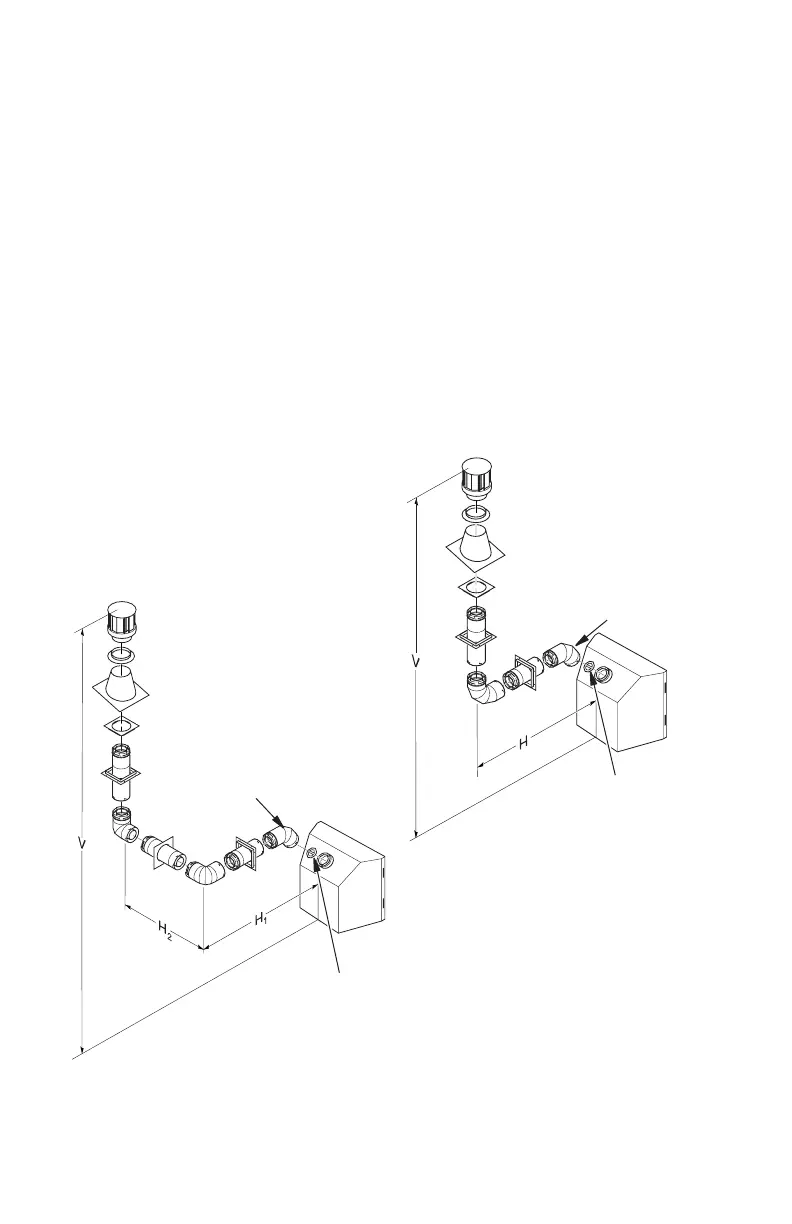
Figures 21 through 24 show four different
congurations for vertical termination.
Horizontal (H
1
Horizontal (H
5' min. 2' max.
6' min. 4' max.
7' min. 6' max.
8' min. 8' max.
20' max. 8' max.
Figure 21 - Vertical Venting
Conguration Using Two 90° Elbows
with Two Horizontal Runs (Vertical
Round High Wind Termination Shown)
Note: Install restrictor
into inner collar of
replace as shown.
45° Elbow
5' min. 2' max.
6' min. 4' max.
7' min. 6' max.
8' min. 8' max.
20' max. 8' max.
Figure 22 - Vertical Venting
Conguration Using One 90° Elbow
(Vertical Round High Wind Termination
Shown)
45° Elbow
Note: Install restrictor into
inner collar of replace as
shown.
Note: You must increase vent height for
steep roof pitches. Nearby trees, adjoining
rooines, steep pitched roofs and other
similar factors may cause poor draft or
down-drafting in high winds. Increasing
the vent height may solve this problem.
7. Twist-lock the vent cap onto the last sec-
tion of vent pipe.
Note: If the vent pipe passes through any oc-
cupied areas above the rst oor, including
storage spaces and closets, you must enclose
pipe. You may frame and sheetrock the en-
closure with standard construction material.
Make sure and meet the minimum allowable
clearances to combustibles. Do not ll any of
the required air spaces with insulation.


 To Next Page