INSTRUCTIONS
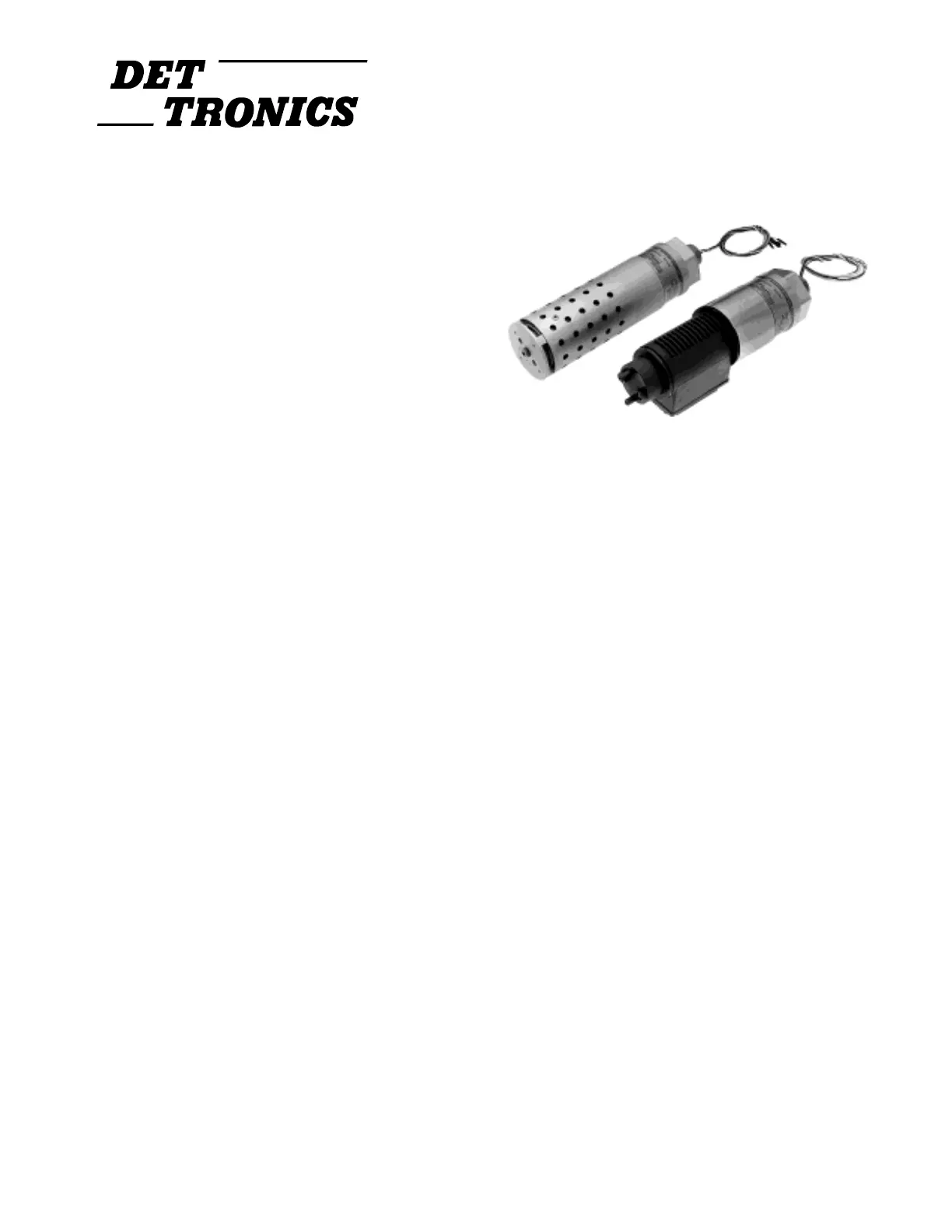
PointWatch™ Infrared
Hydrocarbon Gas Detector
PIR9400
©Detector Electronics Corporation 1996 11/96 95-8440
APPLICATION
The PointWatch Detector is a diffusion-based point-type
infrared gas detector that provides continuous monitor-
ing of combustible hydrocarbon gas concentrations in
the range of 0 to 100% LFL. The detector provides a 4
to 20 milliampere output signal, corresponding to the
detected gas concentrations. The explosion-proof sen-
sor housing meets FM, CSA and CENELEC require-
ments for use in hazardous environments.
PointWatch is ideally suited for use in harsh environ-
ments and where the cost of required maintenance for
conventional catalytic detectors is prohibitive. The
PointWatch IR Detector will perform reliably in the pres-
ence of silicone and other catalytic poisoning agents
and can also operate in oxygen free environments or
where high background gas levels are present. There
are no known poisons that affect this technology.
The PointWatch detector can be used alone or as part
of a larger system such as Det-Tronics’ Infiniti Gas
Transmitter, R8471 Controller, or Eagle 2000 Hazard
Monitoring System.
FEATURES
• Requires no routine calibration to ensure proper oper-
ation.
• Continuous self-test automatically indicates a fault or
fouled optics condition.
• Unique multi-layered filtering system protects optics
from dirt and water ingress.
• Internal heating system minimizes condensation,
allowing reliable operation through temperature
extremes.
• Performs well in the presence of high concentrations
or constant background levels of hydrocarbons and in
oxygen depleted atmospheres.
• There are no known poisons, e.g. silicones or
hydrides, that compromise the integrity of the mea-
surement.
• Standard 4 to 20 milliampere output (current source).
• Standard 0 to 100% LFL detection range.
• Compact, lightweight, explosion-proof housing is
designed for duty in harsh environments.
SPECIFICATIONS
INPUT VOLTAGE—
+24 vdc nominal (range +18 to +32 vdc).
POWER CONSUMPTION (Watts)—
Input Voltage: 18 vdc 24 vdc 32 vdc
Nominal 3.5 4.6 6.2
Maximum 4.0 5.5 7.0
DETECTION RANGE—
0 to 100% LFL.
GASES —
Will respond to most hydrocarbon gases. Outputs lin-
earized for 0 to 100% LFL are provided for methane,
ethane, propane/butane, ethylene, propylene.
All devices are shipped with a 0 to 100% LFL linearized
output for methane. Other linearized outputs are field
selectable by means of a switch.
CURRENT OUTPUT (NON-ISOLATED)—
Linear 4 to 20 ma current source.
• 4 to 20 ma output indicates 0 to 100% LFL
detection range (for linearized gases)
• 23.2 ma indicates over-range condition (120%
LFL)
• 0 to 2.4 ma levels indicate calibration, fault and
fouled optics conditions.
Refer to Table 1 for a detailed description of current out-
puts.
Maximum loop resistance: 600 ohms at +24 vdc. See
Figure 1 for further information.



 To Next Page