LT-1929
9
TROUBLESHOOTING
NOTE–After completing any repairs, ensure hour meter on
the right cover is connected to the DC wire harness and the
control panel ribbon connector is connected to the main PC
board prior to installing the left cover.
PERFORMANCE TEST:
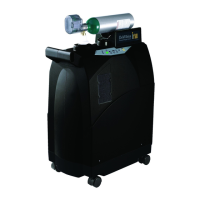
Before returning to service, the iFill Station should be tested to
ensure it is operating properly. This can be done by lling a
cylinder and then testing the oxygen concentration from the
cylinder. Refer to steps 4-8 listed under Initial Inspection. It is
recommend that the cylinder be lled completely before testing
concentration level. This will allow for verication of ll time for
the repaired iFill station.
• Small Magnet: Placed on the intensier center drive
section to visually indicate intensier operation.
NOTE–The intensier’s piston travels up and down to
within ¾” of the top and bottom of the drive section. If the
piston (magnet) stops or takes longer than 9 seconds to
travel one way, the unit will shut off and alarm.
NOTE–Always remove the magnet after troubleshooting
and repair.
• Stopwatch or watch with a second hand
Do First:
• Visually inspect unit for physical damage
• Secure any loose wire and tubing connections
NOTE–The tubing from the three-way valve must be
connected to the top port of the OSD or random shut
down occurs that is difcult to troubleshoot.
• Warm up the unit and duplicate the problem twice.
NOTE–A cold unit, or one that has just been plugged in,
will alarm and react differently which may make
troubleshooting more difcult.
Knowledge:
• Become familiar with the names and locations for all
components
• If the oxygen purity does not come up to specication
(91%) during a continuous 11 minute run in warm up, the
unit will shut off and alarm.
• After the rst 70 seconds from startup, if the ow to the
OSD is below 1.5 lpm, the unit will shut off and alarm.
• If the intensier has a leak or the oxygen concentrator
portion of the unit is not performing correctly, the unit may
constantly transition in and out of the warm up mode
causing extended ll times.
NOTE–Occasionally the unit will go back into warm up
mode for a short period during the early portion of a
cylinder lling cycle. This is most common when lling an
empty cylinder.
o To troubleshoot, use a ow test xture that allows a
maximum ow of 3 lpm. Remove the tubing from the
top metal tting of the three-way valve and install the
tubing from the ow test xture in its place.
o If the unit no longer transitions in/out of warm up,
either the tubing to the intensier is leaking or the
intensier itself is faulty.
NOTE–The three-way valve will make a clicking sound
every 24 seconds indicating the unit is in its normal ll
cycle. This clicking sound will not be heard during the
warm up mode.
o If the unit continues to transition in/out of warm up, the
concentrator portion is not performing correctly. Check
for leaks, faulty sieve beds, faulty rotary valve, etc.
• If the unit is running and not constantly transitioning in and
out of warm up mode, but does not ll a cylinder, the
problem is the intensier. Ensure that there are no system
leaks and that the cylinder and regulator or conserver is
not leaking.


 To Next Page